Cyber Essentials · Guide · Getting certified
How to getCyber Essentialscertification
Most organisations can hold a Cyber Essentials certificate within two to four weeks of deciding to get one. This guide sets out the route step by step, what to gather before you start, where the free help is, and the mistakes that cause a failed assessment.
Plain EnglishUpdated November 2026v3.3 and DanzellTypical: two to four weeks
Decide your scope, check you meet the five controls, fix what you do not, answer the question set, and submit it for marking.
Certificates are issued only by IASME-licensed certification bodies. The work is mostly yours or your IT provider's: knowing what devices, software and cloud services you have, and making sure each one meets the requirements. A readiness check before you start the question set turns a pass-or-fail test into a list of jobs, and that is the single biggest difference between a first-time pass and a resubmission.
- Who can apply
- Any organisation, of any size, in any sector
- Standard
- Requirements for IT Infrastructure v3.3 and the Danzell question set
- Typical time
- Two to four weeks to the certificate
- Signed by
- A board member or equivalent senior person
- Then
- Plus, if you need it, within three months
The route
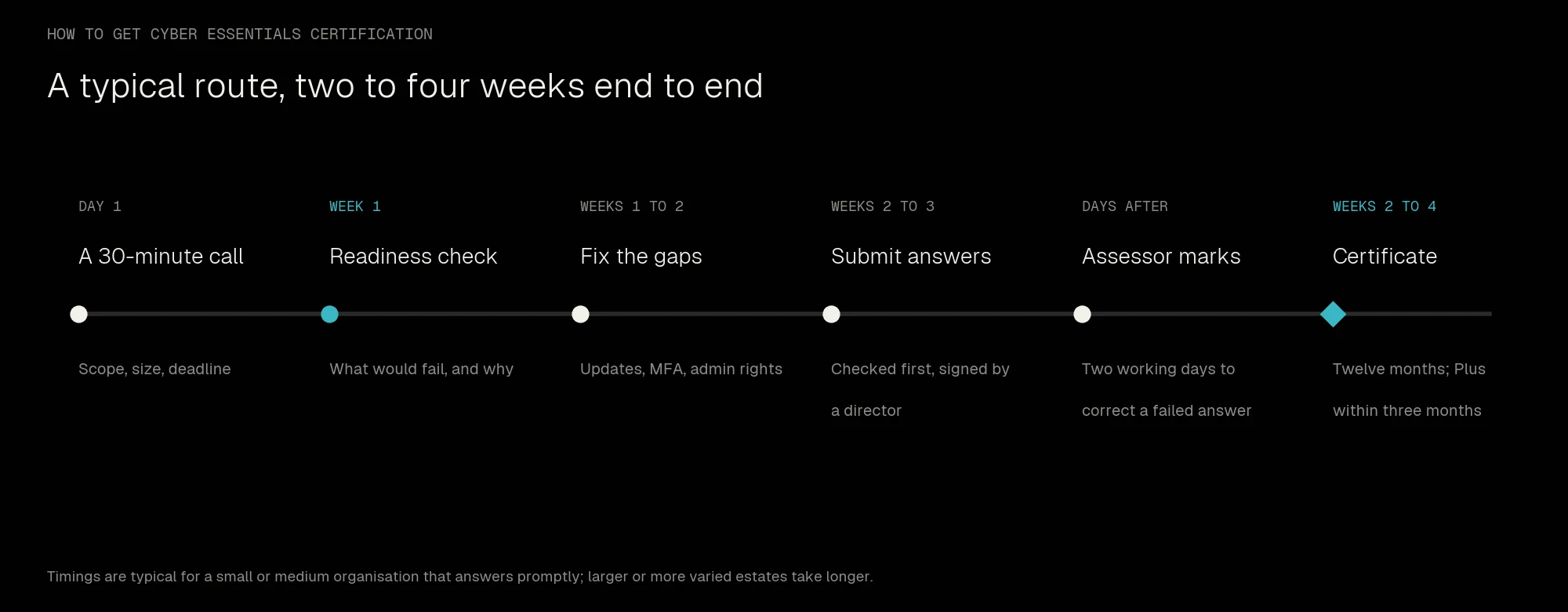
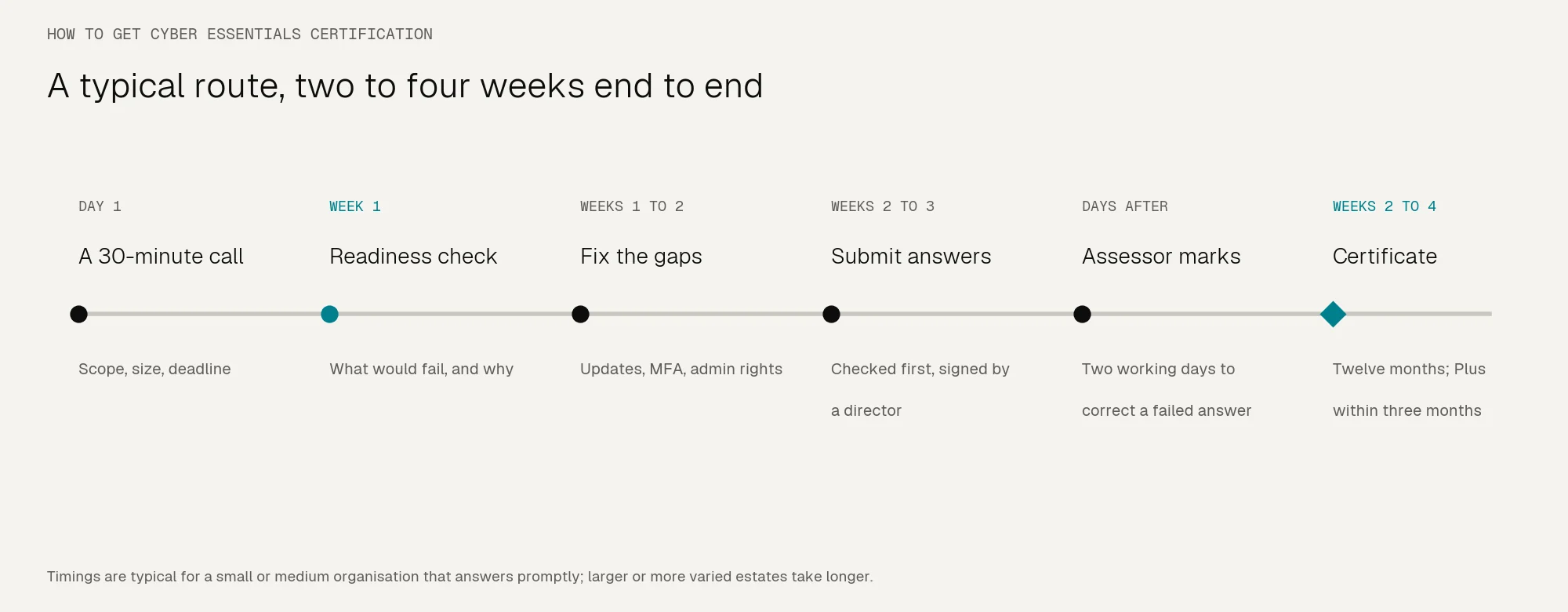
A typical route to the certificate
The timings below are for a small or medium organisation whose IT provider can make changes promptly. Larger estates, or estates with many kinds of device, take longer, mostly at the fixing stage. The assessment itself is short once you know your answers are right.
Step by step
How to get Cyber Essentials certification, in eight steps
Stage 01
Decide the scope
Certifying the whole organisation is simplest and is required for the free insurance. If you exclude part of it, you must describe what is excluded and how it is separated. Cloud services that hold your data cannot be excluded.
Stage 02
Take an inventory
List the laptops, desktops, servers, phones, tablets, network equipment and cloud services in scope, with operating systems and versions. Personal devices that access work email or data are in scope too.
Stage 03
Check your readiness
Compare the inventory with the five controls. The NCSC's free Readiness Tool asks the main questions; our readiness check goes further and gives you a written list of what would fail.
Stage 04
Fix the gaps
Typical fixes are turning on MFA for every cloud service, applying overdue updates, removing unsupported software, separating administrator accounts and changing default passwords.
Stage 05
Choose your provider
Pick an IASME-licensed certification body, or a provider who works with one, and ask what the price includes: help with fixes, a check of your answers, the Plus audit.
Stage 06
Answer the question set
Complete the Danzell questions online, describing your own estate accurately. Vague answers are a common reason for marking queries.
Stage 07
Sign and submit
A director or equivalent signs a declaration that the answers are true and that compliance will be kept up for the year. Then the assessment is submitted for marking.
Stage 08
Marking and certificate
A qualified assessor marks the answers. If something fails you can usually correct it within two working days. On a pass, the certificate lasts twelve months.
Before you start
What to have to hand
| You will need | Why it matters |
|---|---|
| The legal name, address and company number of each organisation in scope | Every in-scope legal entity must now be named on the assessment |
| A list of devices with operating system and version | Unsupported operating systems are an automatic fail |
| A list of cloud services, including any bought on a company card | Each one must have multi-factor authentication turned on where it is offered |
| Your firewall or router make and model | Default passwords and remote administration are checked |
| Who holds administrator rights, and on which accounts | Administrator accounts must be separate from everyday ones |
| How updates are applied, and how quickly | Critical and high-risk updates must be installed within fourteen days |
If you have an IT provider, ask them for this list before anything else. It is the backbone of the assessment, and you will reuse it every year.
Free help
Free help worth using first
The NCSC publishes a free Cyber Essentials Readiness Tool, which asks the key questions and produces a personal action plan. IASME publishes the question set so you can read every question before you register. Small organisations can also book a short free session with an NCSC-assured Cyber Advisor through the Cyber Essentials website. On 3 November 2026 the government announced a further £9.4 million package of support for small and medium-sized businesses; we will add the detail here as schemes open.
None of these replaces knowing your own estate, but together they make a first attempt far more likely to pass. Our requirements guide explains each control in detail.
Common mistakes
Why first attempts fail
Missing MFA on one cloud service. Since 27 April 2026 this is an automatic fail on its own. The usual culprit is a service nobody thinks of as IT: the accounting package, a design tool, the payroll provider.
An unsupported device. One old laptop running an operating system that no longer receives security updates fails the assessment unless it is removed from scope or replaced.
Updates that are late, not missing. The test is fourteen days from release for critical and high-risk updates. A monthly patch cycle can miss it.
Shared or everyday administrator accounts. Administrator rights must sit on separate accounts used only for administration.
Answering for the policy, not the practice. The question set asks what is true on your estate today. If the policy says one thing and the devices do another, the devices win, and at Plus the assessor will find out.
Cyber Essentials guides
Everything on Cyber Essentials
Each page covers one part of the scheme. Start wherever your question is.
Cyber Essentials certification
Our service: a readiness check, the assessment and the Plus audit, from £295 + VAT.
The Cyber Essentials process
Each stage of the self-assessment explained: scope, questions, marking and the certificate.
The Cyber Essentials Plus process
The audit in detail: the sample, the five tests, the 90-day window and what happens if a test fails.
Cyber Essentials requirements
The five technical controls under v3.3, the automatic fails and what scope has to include.
Cyber Essentials vs Cyber Essentials Plus
How the two certificates differ, who asks for which, and how to decide.
Cyber Essentials cost
What the assessment and the Plus audit cost, and the one cost most people do not expect.
Contact
Ask for a readiness check
Tell us roughly how many people and devices you have, which cloud services you use and when you need the certificate. We reply within one working day with a fixed price.
Questions
Questions about getting certified
How long does it take to get Cyber Essentials certification?
Two to four weeks is typical for a small or medium organisation. The question set itself takes a few hours once you have the facts; most of the time goes on fixing what the readiness check finds.
Can I get Cyber Essentials on my own?
Yes. Many small organisations complete it themselves using the NCSC's free tools. Help is worth paying for when you are short of time, have no IT provider, or have failed before. Certificates are always issued by an IASME-licensed certification body.
How much does it cost to get Cyber Essentials?
Our price is from £295 + VAT for Cyber Essentials and from £950 + VAT for the Plus audit, rising with organisation size. The cost guide explains what moves the price.
What happens if we fail?
If an answer does not meet the requirements, you can usually correct it within two working days and have it re-marked. Automatic-fail questions, such as missing MFA on a cloud service, have to be fixed in practice before the answer can change.
Do we need Cyber Essentials Plus as well?
Only if a customer, contract or insurer asks for it, or you want the extra assurance of independent testing. Our comparison helps you decide.
Is there funding for Cyber Essentials?
There have been funded schemes for particular groups of small organisations, and the government announced a £9.4 million support package on 3 November 2026. Check the Cyber Essentials website for what is open, or ask us on a call.
Start a conversation
Most organisations pass first time when they check first.
A thirty-minute call is enough to scope the work and give you a fixed price in writing.