Cyber Essentials Plus · Guide · The audit
Cyber Essentials Pluscertification: howthe audit works
Cyber Essentials Plus takes the controls you declared for Cyber Essentials and tests them. This guide explains the Cyber Essentials Plus process from start to finish: the timing, how the sample of devices is chosen, the five tests, the thresholds that fail an audit and how retests work since April 2026.
Within 90 days of Cyber EssentialsFive testsFrom £950 + VATUpdated November 2026
A hands-on audit of the same five controls, on a representative sample of your devices and every cloud service, within three months of your Cyber Essentials certificate.
You must hold Cyber Essentials for the same scope first, and your answers must be final before testing starts. An assessor then scans your internet-facing addresses, runs authenticated vulnerability scans on sample devices, tests malware protection, checks that every cloud service asks for multi-factor authentication and confirms that administrator rights are separate. Most of the work is remote; some device checks are done in person or over a supervised screen share.
- Prerequisite
- A current Cyber Essentials certificate, same scope
- Window
- Plus complete within three months of it
- Tests
- Five test cases, from the NCSC test specification v3.2
- Fail threshold
- CVSS 7 or above, fix available more than 14 days
- Our price
- From £950 + VAT for a micro business
The audit
The Cyber Essentials Plus process at a glance
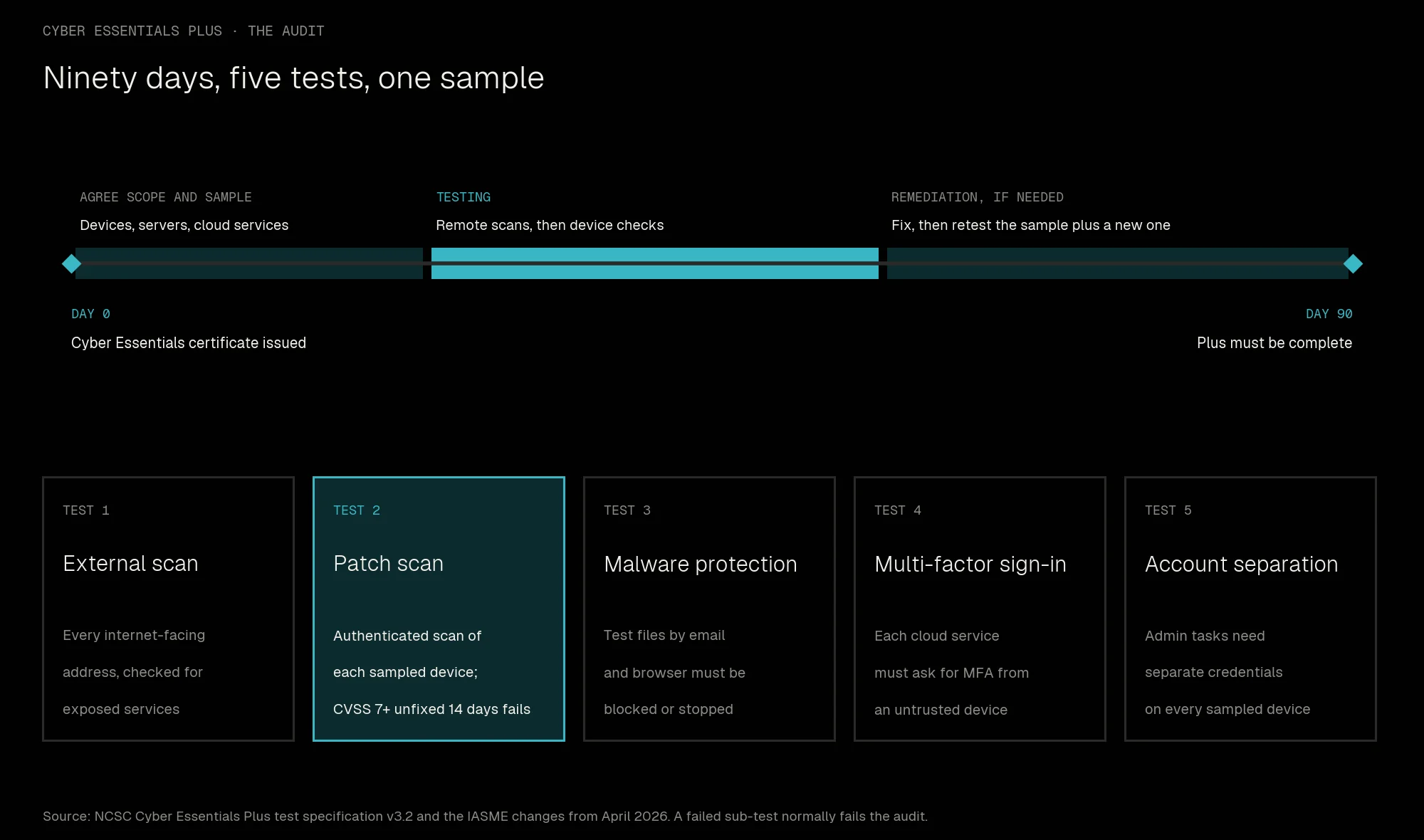
The ninety days start on the day your Cyber Essentials certificate is issued. Scope and sample are agreed first, testing follows, and if anything fails there is time to fix it and be retested inside the same window. Book the audit when you book the assessment, not when the certificate arrives.
The five tests
What the assessor tests
| Test | What happens | What fails |
|---|---|---|
| 1. Remote vulnerability assessment | Every internet-facing IP address in scope, including cloud servers, is scanned for exposed services | A service exposed to the internet that should not be, or is not protected as the specification requires |
| 2. Patching, by authenticated scan | An approved scanner logs in to each sampled device and checks installed software against known vulnerabilities | Any vulnerability rated critical or high risk, or scored CVSS v3 7 or above, with a vendor fix available for more than 14 days |
| 3. Malware protection | Test files are sent by email and downloaded through the browser; logs are checked | Test malware that arrives unblocked, or an executable that runs without a prompt; allow-listing that lets unsigned code run |
| 4. Multi-factor authentication | Users sign in to each cloud service from an untrusted device or private browser window | Any cloud service that does not ask for a second factor, for a normal user or an administrator |
| 5. Account separation | A standard user tries an administrative task on each sampled device | An administrative task that runs without separate administrator credentials |
Any failed sub-test normally fails the audit. The specification allows a narrow exception for marginal deviations in a very small proportion of tests, and only after consultation with IASME.
The sample
How the sample is chosen
The assessor does not test every device. They test a representative sample of laptops, desktops, servers and mobile devices, sized using IASME's method and covering each operating system and build in use. You do not choose which machines are tested. Every cloud service in scope is tested, with at least one normal user and one administrator. Servers with an interactive desktop are included in the malware and account tests, and cloud servers in the patching and malware tests.
Because the sample is drawn from the whole estate, the only safe preparation is to make the whole estate compliant. A laptop that has sat in a drawer for three months, missing a quarter's updates, is exactly the device that tends to be picked.
If a test fails
What happens if something fails
Since April 2026 a failure on the device sample means remediation and a retest, and the retest covers the original sample plus a new random sample. Fixing only the devices that failed is no longer enough: updates must be applied across the whole estate. A second failure leads to the Cyber Essentials certificate itself being revoked.
The answers you gave for Cyber Essentials cannot be adjusted after the Plus results are known. Your self-assessment must be complete, final and unchanged before Plus testing begins, which is another reason to run a readiness check before either stage.
Preparing
How to prepare for a Cyber Essentials Plus audit
Stage 01
Book both stages together
The three-month clock starts when the Cyber Essentials certificate is issued. Booking the audit at the same time avoids a rush at the end.
Stage 02
Patch everything, then check
Bring every device in scope up to date, not just the ones you expect to be sampled. Run your own vulnerability scan if you can, and fix anything rated high or critical.
Stage 03
List every cloud service
Confirm that MFA is on for each one, for every user and administrator. Include the services bought on a company card.
Stage 04
Separate administrator rights
Make sure everyday accounts cannot run administrative tasks without separate credentials, on every device.
Stage 05
Test your malware protection
Check that email filtering and browser protection block test files such as the EICAR string, and that alerts reach someone.
Stage 06
Arrange access
Agree how the assessor will reach sample devices: remote session, on-site visit or a mix, and who will be at each one.
Cyber Essentials guides
Everything on Cyber Essentials
Each page covers one part of the scheme. Start wherever your question is.
Cyber Essentials certification
Our service: a readiness check, the assessment and the Plus audit, from £295 + VAT.
How to get Cyber Essentials certification
The route from first call to certificate, what you need to hand and the free help available.
The Cyber Essentials process
Each stage of the self-assessment explained: scope, questions, marking and the certificate.
Cyber Essentials requirements
The five technical controls under v3.3, the automatic fails and what scope has to include.
Cyber Essentials vs Cyber Essentials Plus
How the two certificates differ, who asks for which, and how to decide.
Cyber Essentials cost
What the assessment and the Plus audit cost, and the one cost most people do not expect.
Contact
Book a Cyber Essentials Plus audit
Tell us how many people and devices you have, which operating systems and cloud services you use, and the date of your Cyber Essentials certificate if you already hold one. We will reply with a fixed price and available dates.
Questions
Questions about Cyber Essentials Plus certification
What is Cyber Essentials Plus certification?
The higher level of the Cyber Essentials scheme. It covers the same five controls as Cyber Essentials, but an assessor tests them on a sample of your devices and on every cloud service, rather than relying on your answers alone.
Do I need Cyber Essentials before Cyber Essentials Plus?
Yes. You must hold Cyber Essentials for the same scope, and the Plus audit must be completed within three months of that certificate being issued.
How long does the Cyber Essentials Plus audit take?
Testing itself usually takes one to three days for a small or medium organisation, depending on the size and variety of the sample. Allow time beforehand for patching and time afterwards in case a retest is needed.
Is the Plus audit done on site?
Partly, if needed. External and many internal scans run remotely. Device checks can be done in person or through a supervised remote session; we agree which in the quote, and any travel is named before you agree to anything.
What is the most common reason for failing Cyber Essentials Plus?
Missing updates: a high or critical vulnerability with a fix available for more than fourteen days, found by the authenticated scan on a sampled device.
How much does Cyber Essentials Plus cost?
From £950 + VAT for a micro business, rising with organisation size and the variety of devices. See our Cyber Essentials Plus cost guide.
Start a conversation
A Plus audit holds no surprises when the readiness check came first.
A thirty-minute call is enough to scope the work and give you a fixed price in writing.