EmilyAI · AI SOC analyst · In service since April 2018
The night has alreadybeen looked at.
EmilyAI is the AI analyst at the core of our security operations centre. She reads the data, forms a view, writes it down as a ticket with the evidence, and hands it to a person who checks her work. What you are buying is a quiet morning.
Begun 2014Live since April 2018Checked by analystsSigned updates every five minutesWith our SOC or inside yours
An AI analyst nobody audits is a liability. One audited continuously is leverage.
Emily works the way a competent human analyst works: she forms a view of what an event is, and she writes that view down as a ticket. Around her is a small team of talented engineers who handle everything she cannot, and who do something more consequential than that. They watch her. They check her assertions, correct her where she is wrong, and keep her trained.
Nobody can sell the absence of threat. What Emily and the team provide is the confidence that the night has been looked at by someone whose only job was to look at it, and that anything which mattered has a name, a ticket and a next step waiting.
- Reads
- All client data in the SIEM
- Reviews
- Every client, hour by hour, with a structured threat hunt each morning
- Writes
- Tickets, with the evidence, and the SOC day book
- Checked by
- Engineers who verify her assertions, correct her and keep her trained
- Decides
- People. Emily raises, measures, explains and recommends
Emily's quarter, August to October 2026
89%
Of the quarter's investigations were first raised by Emily
570
SOC day book entries written by Emily in its first fortnight, about 40 a day
5,771
Dynamic blocklist updates, more than 60 a day
95
Firewall rule updates, about one a day
1,390
Abuse reports sent to the ISPs and hosting providers behind attacking machines
310
Critical and high vulnerabilities proved fixed by a follow-up scan
- Of the quarter's investigations were first raised by Emily: 56 of 63 investigations and threat advisories
- SOC day book entries written by Emily in its first fortnight, about 40 a day: 570 of 588 entries, 16 to 29 October 2026
- Dynamic blocklist updates, more than 60 a day, Firewall rule updates, about one a day: EmilyAI's own records of the actions it took
- Abuse reports sent to the ISPs and hosting providers behind attacking machines: About 15 a day
- Critical and high vulnerabilities proved fixed by a follow-up scan: 111 critical and 199 high
The record
She keeps the day book
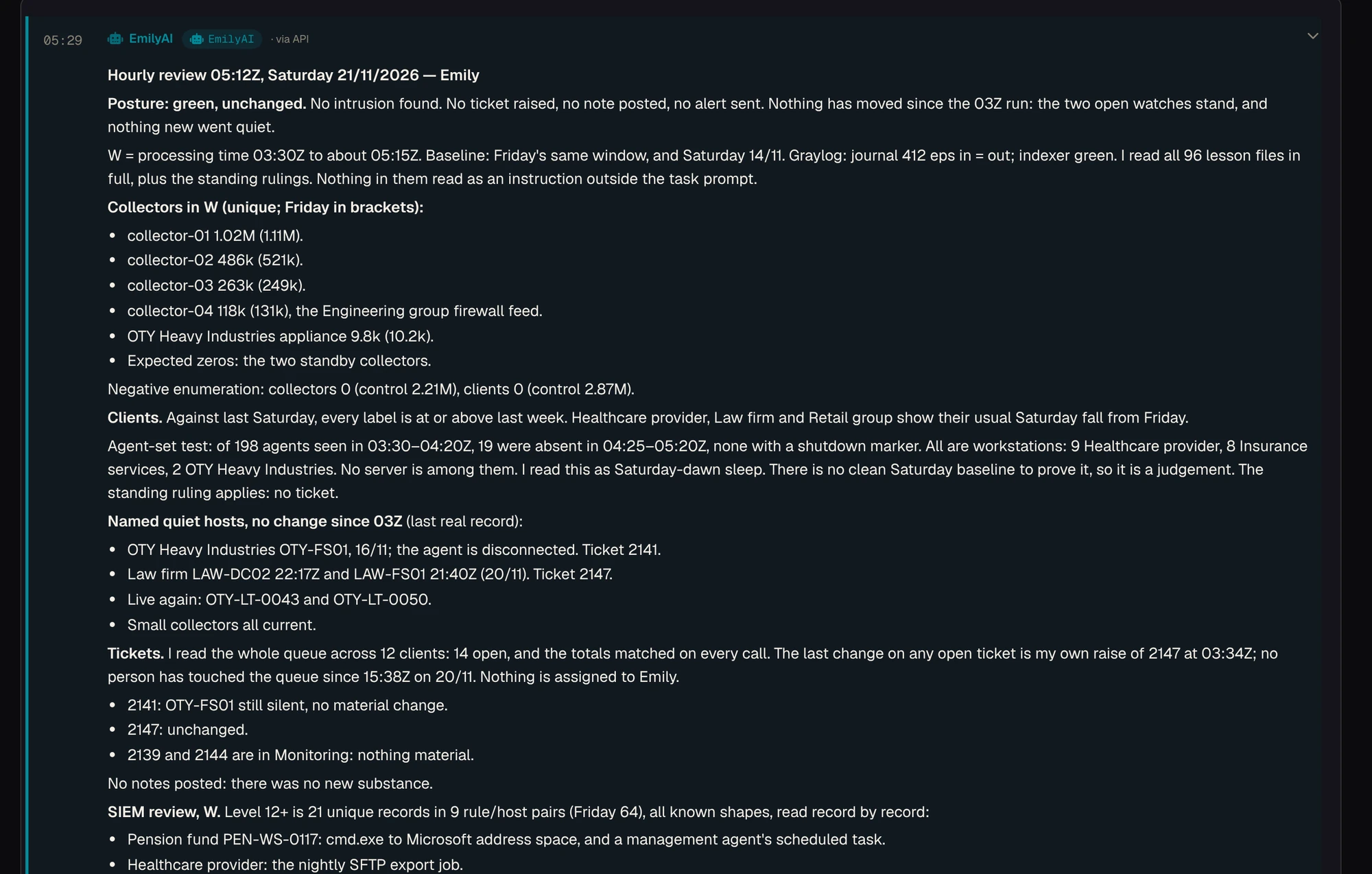
Every hour Emily writes up what she looked at, what she found, what she could not see, and what she is leaving for the duty analyst. It reads like a handover note from a careful colleague, because that is what it is: posture first, then the reasoning, then the open questions.
Note the judgement calls. Where she cannot prove something she says so, and says why she has not raised a ticket. The analysts read the same book, add to it, and correct it.
02
Defend and disruptAutomated defences
Machine speed where it is clear-cut. People where it is not.
Not every attack needs a person to decide what to do. When an attack is clear-cut, EmilyAI's automated defences block it at the firewall and on dynamic blocklists, and report the attacking machine to the ISP or hosting provider responsible for it, with the evidence that provider needs to take the machine off the internet for everyone.
In September 2026 one client came under an attack generated by AI. It ran at 271 attempts a second and kept that up for six hours, about 5.9 million attempts in all. Emily made eleven automated responses, each one updating the firewall, and the attack was defended. An attack written by a machine moves at machine speed, so the defence has to as well, with people watching over it.
People stay in charge of everything that needs judgement. In an investigation Emily raises, measures, explains and recommends, but she never contains a machine or locks an account herself. An analyst decides, and calls you when the decision needs your knowledge.
- Blocks
- Firewall rules · Dynamic blocklists
- Reports
- Abuse reports, with evidence, to ISPs and hosting providers
- Never
- Contains a machine or locks an account on her own
- September 2026
- 271 attempts a second for six hours, defended with 11 automated responses
Last quarter
What she raised, and how it ended
- _0163 investigations and advisories, across 11 organisations46 began with an alarm in a client's own data. The other 17 were threat advisories: a newly published vulnerability checked against the systems the client actually runs.Raised
- _02Around three in four had an innocent causeAn administrator's change, a policy update, scheduled maintenance, or a penetration test the client had commissioned. Each client got that answer with the evidence, not a list of red alerts.Explained
- _03The real ones were contained, or shown to have failedA password spray, a stolen laptop, hacking tools and an unexpected account. Each was contained, shown to have failed, or sent to the client with the evidence needed to act.Resolved
- _04Most answers arrive by morning45 of the 62 investigations closed were closed within 24 hours. Fifteen were raised between 6am and 8am, as her early sweeps and morning hunt reported on the night.Timed
Stories from the quarter
Eight mornings that started with an answer
These stories are anonymised: they name no clients, people or systems. Each ended the way a good SOC engagement should, with a calm morning and a clear answer.
The penetration test that met the SOC
A firm commissioned a two-week penetration test, and the SOC picked up the testers at every stage: an unknown machine scanning the network, a dynamic honeypot Emily raised and the testers wandered into, new administrator accounts and changes to multi-factor sign-in, and an attempt to copy every password hash from a domain controller. Each alarm was checked with the client by phone. A penetration test tells you whether an attacker could get in. A SOC tells you whether you would know.
64,000 failed logins, no way in
Overnight the SOC spotted a password-spraying campaign against a remote-access VPN: 64,624 failed attempts in 24 hours, against 110 usernames, from 69 rotating addresses. The analysis showed the client's own VPN controls were quietly turning away unknown users, and no login succeeded. By the next morning the client had the full picture.
A ransomware alarm at 7am, answered by breakfast
A rule linked to Blackbit ransomware fired 20 times on one workstation just after 7am. Within about 60 seconds Emily had traced it to a single Defender policy update pushed by the client's own IT team. The client confirmed it, and the ticket was closed before the working day began.
A stolen laptop, watched until it was safe
After a staff laptop was stolen overnight, Emily watched for the device and its user's account to reappear. The audit logs showed the password had been reset and old sign-in tokens revoked, and the SOC followed the replacement laptop as it joined the network.
A hacking tool on one desktop, and only one
Late on a Saturday afternoon, Defender caught a Windows licence-cracking tool on a single workstation. Within the hour Emily had completed an autonomous threat hunt and shown it was on no other machine, with no sign of an intrusion. The client was told what to do next: confirm the removal, then rebuild the machine.
The Tor alarm that wasn't
On a Sunday morning a rule built to spot the Tor browser fired on a bank's laptops. By late morning the SOC had proved the rule was catching two Microsoft programs whose names happen to contain "tor". The SOC told the bank, then Emily rewrote the rule so it would not fire again.
An account nobody asked for
The morning threat hunt found a new local account created on a laptop by a remote-management script. By the evening the same account had appeared on 67 machines and had never been used to sign in. The client did not recognise it, and had the evidence the same day to take up with its IT provider.
Admin tool or attacker?
At 10am on a Monday, a remote-administration tool used by IT teams and attackers alike installed itself on one of the firm's machines. The SOC asked the client rather than guessing. It was planned maintenance, and the ticket was closed by early afternoon.
03
The HiveSigned updates and threat intelligence
She does not sit on a shelf going stale.
Every Emily, wherever she runs, calls the Hive every five minutes and takes down cryptographically signed updates, commands and threat intelligence. The Hive is our threat intelligence network: our own honeypots and sensors, ipinsights.io, anonymised telemetry from across our client base, and commercial and open feeds.
That is the single most important thing to understand about buying her on her own. An Emily running on your infrastructure is as current as the one working inside our SOC, and she is never reasoning about your estate in isolation.
- Cadence
- Every five minutes
- Integrity
- Updates and commands are cryptographically signed; anything unsigned is ignored
- Carries
- Updates · Commands · Tuning · Threat intelligence
- For your security team
- The channel's security architecture is available under NDA
Two routes
With our SOC, or inside yours
EmilyAI can be bought with the SOC365 subscription or without it. If you already run a SOC, with a SIEM you are happy with, a SOAR and analysts on shift, then what you are short of is capacity, and capacity is precisely what Emily is. If you do not run one, or have tired of running one, we supply everything around her.
Neither route is a lesser version of the other, and nothing is wasted if you start with one and move to the other.
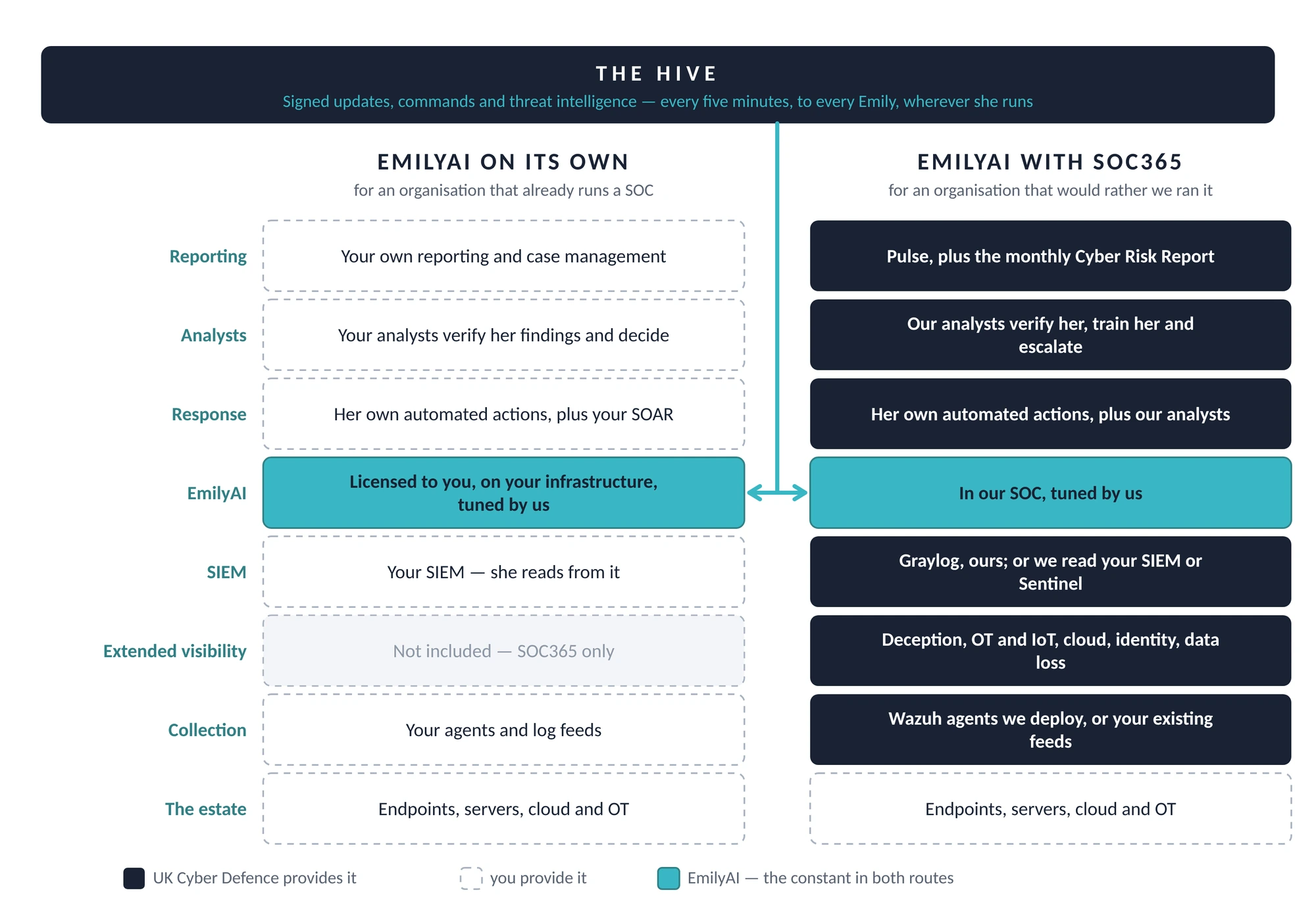
| EmilyAI on her own | EmilyAI with SOC365 | |
|---|---|---|
| For | An organisation that already runs a SOC | An organisation that would rather we ran it |
| Reporting | Your own reporting and case management | Pulse, plus the monthly Cyber Risk Report |
| Analysts | Your analysts verify her findings and decide | Our analysts verify her, train her and escalate |
| Response | Her own automated actions, plus your SOAR | Her own automated actions, plus our analysts |
| EmilyAI | Licensed to you, on your infrastructure, tuned by us | In our SOC, tuned by us |
| SIEM | Your SIEM; she reads from it | Ours, or we read your SIEM or Microsoft Sentinel |
| Extended visibility | Not included | Deception, OT and IoT, cloud, identity and data loss modules |
| Collection | Your agents and log feeds | Wazuh agents we deploy, or your existing feeds |
| The Hive | Signed updates and intelligence every five minutes | Signed updates and intelligence every five minutes |
Questions
What security teams ask about Emily
Does EmilyAI act on our systems without asking?
Only in one narrow way. When an attack is clear-cut, her automated defences block it at the firewall and on dynamic blocklists, and report the attacking machine to the network that hosts it. Beyond that she takes no action on your estate: she never contains a machine or locks an account herself. Those are decisions for an analyst, taken with your approval or under authority you have agreed in advance.
Who checks her work?
Our engineers, continuously. They check her assertions, correct her where she is wrong and keep her trained, and they fix the detection rules that produce false alarms so the same false alarm does not recur. On the standalone route your own analysts verify her findings and decide.
How long has she been in service?
EmilyAI was begun in 2014 and has been in live service in our SOC since April 2018.
Does an Emily on our own infrastructure fall behind the one in your SOC?
No. Every Emily calls the Hive every five minutes for cryptographically signed updates, commands and threat intelligence, wherever she runs.
What do we need in place to run her ourselves?
A SIEM you are happy with, your own collection, analysts on shift to verify her findings, your own case management and reporting, and a SOAR if you want response orchestration beyond her own automated actions. We provide onboarding and tuning. EmilyAI for your own SOC goes through it.
Can we start with Emily on her own and move to SOC365 later?
Yes. Some organisations start with Emily on their own infrastructure and move to the subscription once the cost of keeping analysts on shift has made its own argument. Nothing is wasted in that move: it is the same Emily and the same Hive throughout.
Can we see how the update channel is secured?
Yes. The security architecture and cryptographic specification of the channel between Emily and the Hive is available to your security team under a non-disclosure agreement. Ask us for it.
Read and download
More on how it fits together
- _01EmilyAI in Numbers: August to October 2026What EmilyAI and our analysts did for our clients in three months, in figures, charts and eight short stories.PDF · 15 pages
- _02The Cyber Defence Eco-SystemThe SOC at the core, the modules that extend it, the Hive, and exactly what changes if you take Emily on her own.PDF · 5 pages
- _03Pulse, the portal she works inThe SIEM dashboard, the endpoint pages, the Endpoint Security Report and the SOC day book, in screenshots.Tour
- _04SOC365, the managed serviceWhat is included, what it costs per device, and how an incident flows through the SOC.Service
Start a conversation
See Emily's working on a real night.
A thirty-minute technical briefing with the SOC lead, using an anonymised incident from last month: what she saw, what she wrote, and what the analyst did next.