Cyber Essentials · Guide · The process
The Cyber Essentialsprocess, step by step
What happens at each stage of a Cyber Essentials assessment, who does what, how marking works and what changed in April 2026. Written for the person who has been asked to get the certificate and wants to know what they are signing up to.
Six stagesv3.3 and DanzellAutomatic fails explainedUpdated November 2026
Scope, readiness, fixes, the question set, marking and the certificate: six stages, of which the first three decide whether you pass.
Cyber Essentials is a verified self-assessment. You describe your own estate in an online question set, a senior person signs it, and a qualified assessor from an IASME-licensed certification body marks it against the published requirements. Nobody tests your devices at this level; that is what Cyber Essentials Plus adds. The process rewards preparation, because the answers are only as good as your knowledge of what you actually run.
- Delivered by
- The NCSC, with IASME as delivery partner
- Questions
- The Danzell question set, from 27 April 2026
- Marking
- A qualified assessor
- Failed answers
- Usually two working days to correct
- Certificate
- Twelve months
Overview
The six stages of the Cyber Essentials process
Each stage is explained below. If you only read one part, read the readiness check: it is where an assessment is won or lost, and it is the part most organisations skip.
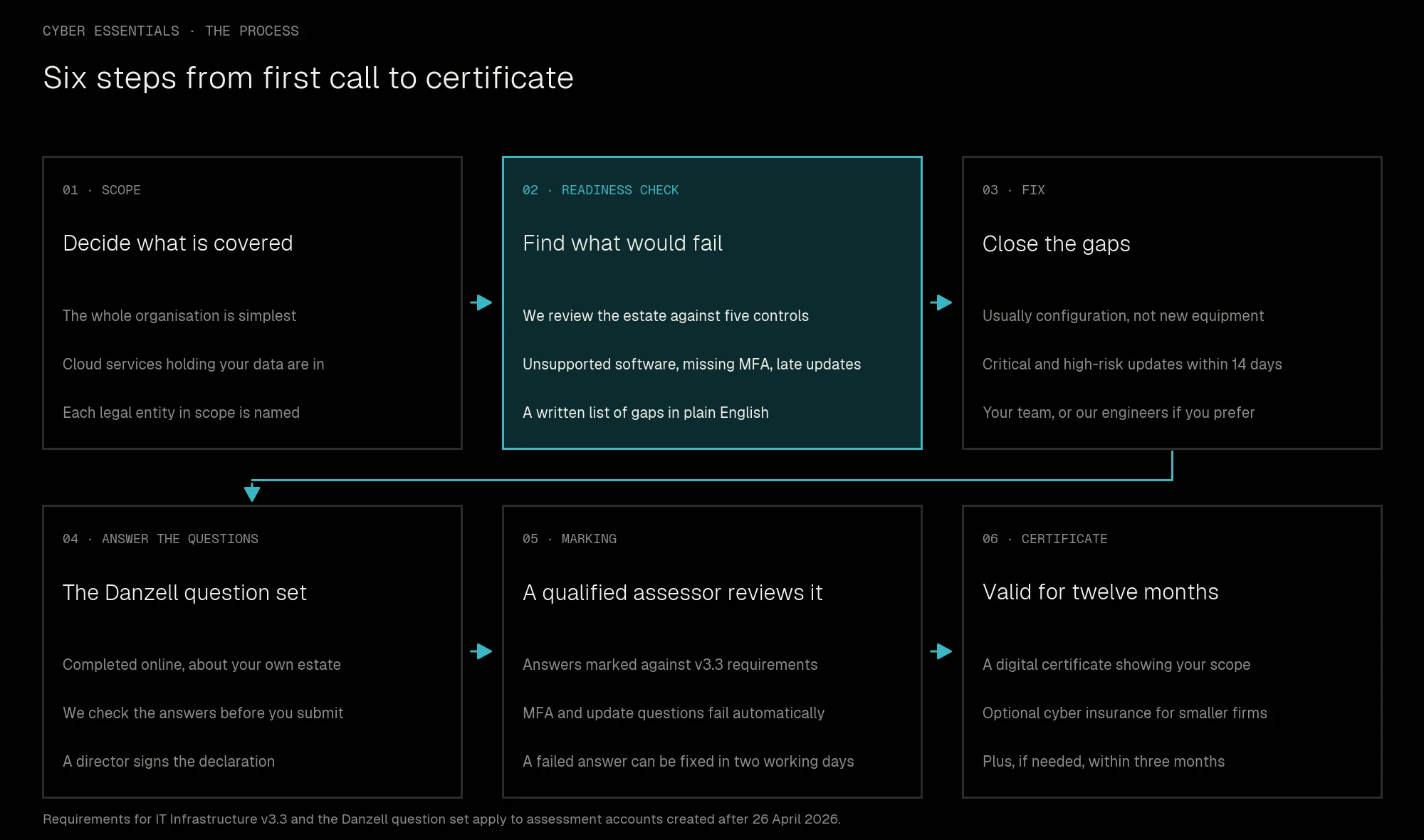
Stage by stage
What happens at each stage
1. Scope
Scope is what the certificate covers. Certifying the whole organisation is simplest and is required for the free cyber insurance. A narrower scope is allowed if the excluded part is properly separated, but since April 2026 you must describe what is excluded and why, and every legal entity in scope must be named with its address and company number. Cloud services that hold your data or run your services cannot be excluded. Your scope description now appears on the digital certificate.
2. Readiness check
A review of your estate against the five controls before you answer anything. We look hardest at the questions that fail an assessment on their own: multi-factor authentication on cloud services, and critical and high-risk updates applied within fourteen days. The output is a written list of gaps in order of importance. The NCSC's free Readiness Tool is a good first pass if you are doing this yourself.
3. Fixing the gaps
Usually configuration rather than new equipment: MFA turned on, an update policy tightened, administrator accounts separated, an unsupported laptop replaced or retired. Your own team or IT provider can do this from our guidance, or our engineers can, at the consulting day rate.
4. The question set
Since 27 April 2026, new assessment accounts use the Danzell question set, written against Requirements for IT Infrastructure v3.3. You answer online, describing your firewalls, devices, accounts, malware protection and update practice. We check the answers before submission. A board member or equivalent then signs a declaration that the answers are true and that the organisation will keep the controls in place for the year.
5. Marking
A qualified assessor marks each answer. Two questions on update management (A6.4 for operating systems and firmware, A6.5 for applications) and the requirement for MFA on cloud services are automatic fails: one wrong answer fails the assessment whatever else is right. If other answers fall short, you can usually correct them within two working days and have them re-marked.
6. The certificate
On a pass, the certificate is issued and lasts twelve months. "Point in time" means the issue date, so everything in scope must be supported on that day. If you need Cyber Essentials Plus, the audit must follow within three months; our guide to the Cyber Essentials Plus process explains it.
What changed
What changed in April 2026
| Change | What it means in practice |
|---|---|
| Questions A6.4 and A6.5 became automatic fails | A late critical or high-risk update, on devices, firmware or applications, fails the whole assessment |
| MFA mandatory on every cloud service that offers it | Free, included or paid-for, if MFA exists it must be on |
| Scope descriptions expanded | Exclusions must be explained and justified; legal entities must be named |
| Cloud services cannot be excluded | If a service holds your data or runs your services, it is in scope |
| Declaration strengthened | The signatory accepts responsibility for compliance throughout the year |
| Requirements v3.3 | Adds a cloud services definition and highlights passwordless sign-in such as passkeys |
Organisations whose assessment account was created before 27 April 2026 had six months to certify under the previous version, Willow. Every new assessment now uses v3.3 and Danzell. The detail of each control is in our requirements guide.
Cyber Essentials guides
Everything on Cyber Essentials
Each page covers one part of the scheme. Start wherever your question is.
Cyber Essentials certification
Our service: a readiness check, the assessment and the Plus audit, from £295 + VAT.
How to get Cyber Essentials certification
The route from first call to certificate, what you need to hand and the free help available.
The Cyber Essentials Plus process
The audit in detail: the sample, the five tests, the 90-day window and what happens if a test fails.
Cyber Essentials requirements
The five technical controls under v3.3, the automatic fails and what scope has to include.
Cyber Essentials vs Cyber Essentials Plus
How the two certificates differ, who asks for which, and how to decide.
Cyber Essentials cost
What the assessment and the Plus audit cost, and the one cost most people do not expect.
Contact
Talk to us about the process
Tell us roughly how many people and devices you have, which cloud services you use and when you need the certificate. We reply within one working day with a fixed price.
Questions
Questions about the Cyber Essentials process
What is the Cyber Essentials process?
Six stages: agree the scope, check readiness against the five controls, fix the gaps, answer the Danzell question set online, have it marked by a qualified assessor, and receive a certificate valid for twelve months.
Who marks a Cyber Essentials assessment?
A qualified assessor working for an IASME-licensed certification body. Only those bodies can issue Cyber Essentials certificates.
What are the automatic-fail questions?
Since 27 April 2026, the update-management questions A6.4 and A6.5 and the requirement for MFA on cloud services. Getting any of them wrong fails the assessment regardless of the other answers.
Can we change our answers after submitting?
If an answer fails, you can usually correct it within two working days. Once a certificate is issued, the answers stand, and if you go on to Cyber Essentials Plus they cannot be adjusted to match the audit results.
Does anyone visit or test our devices?
Not for Cyber Essentials. It is a verified self-assessment. Testing of devices and cloud accounts is what Cyber Essentials Plus adds.
How long does the process take?
Two to four weeks is typical, most of it in the readiness and fixing stages. Our guide to how to get Cyber Essentials certification has a typical timeline.
Start a conversation
Most organisations pass first time when they check first.
A thirty-minute call is enough to scope the work and give you a fixed price in writing.