AI SOC analyst · Explained with EmilyAI · In service since April 2018
What is anAI SOC analyst?
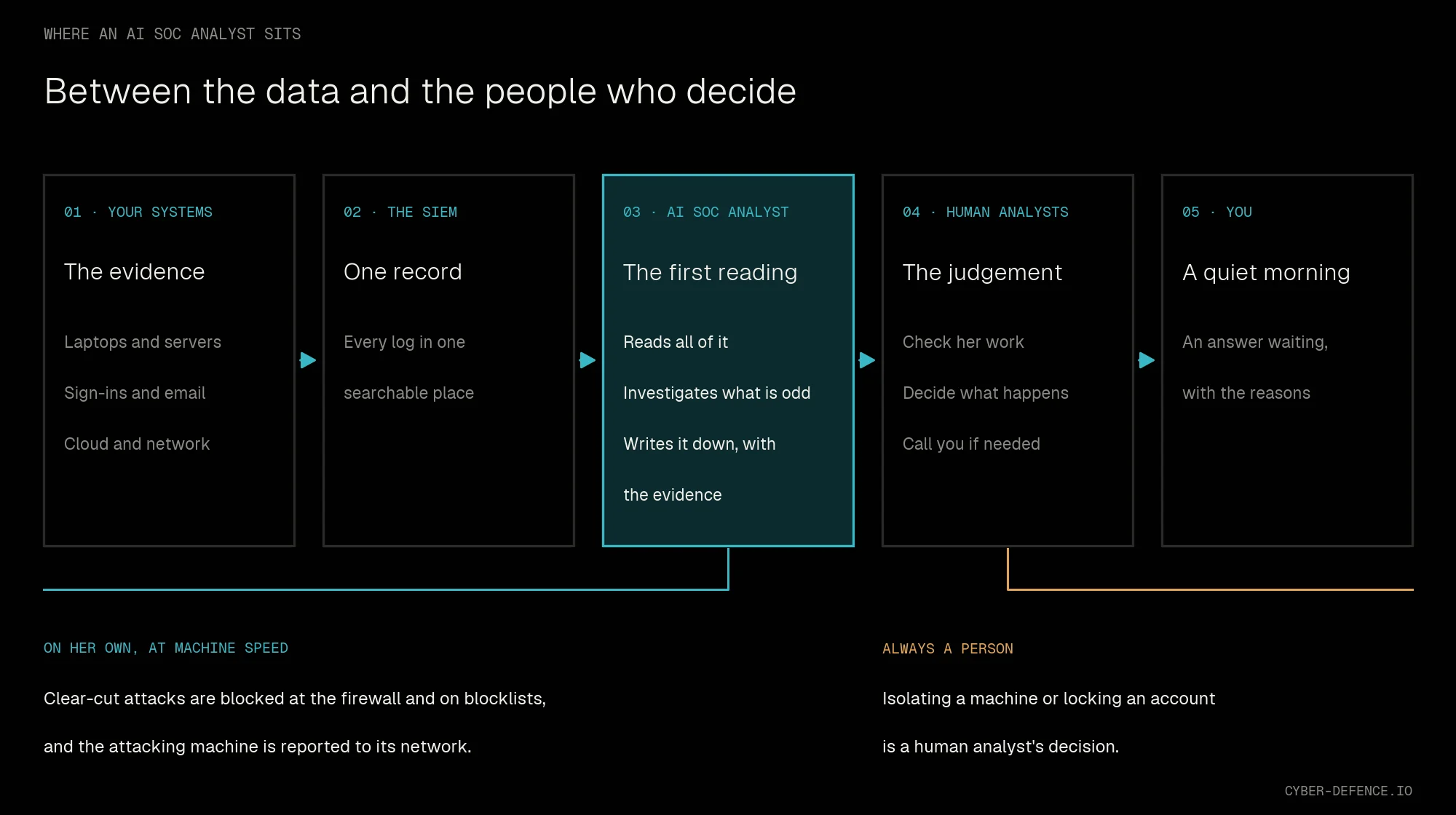
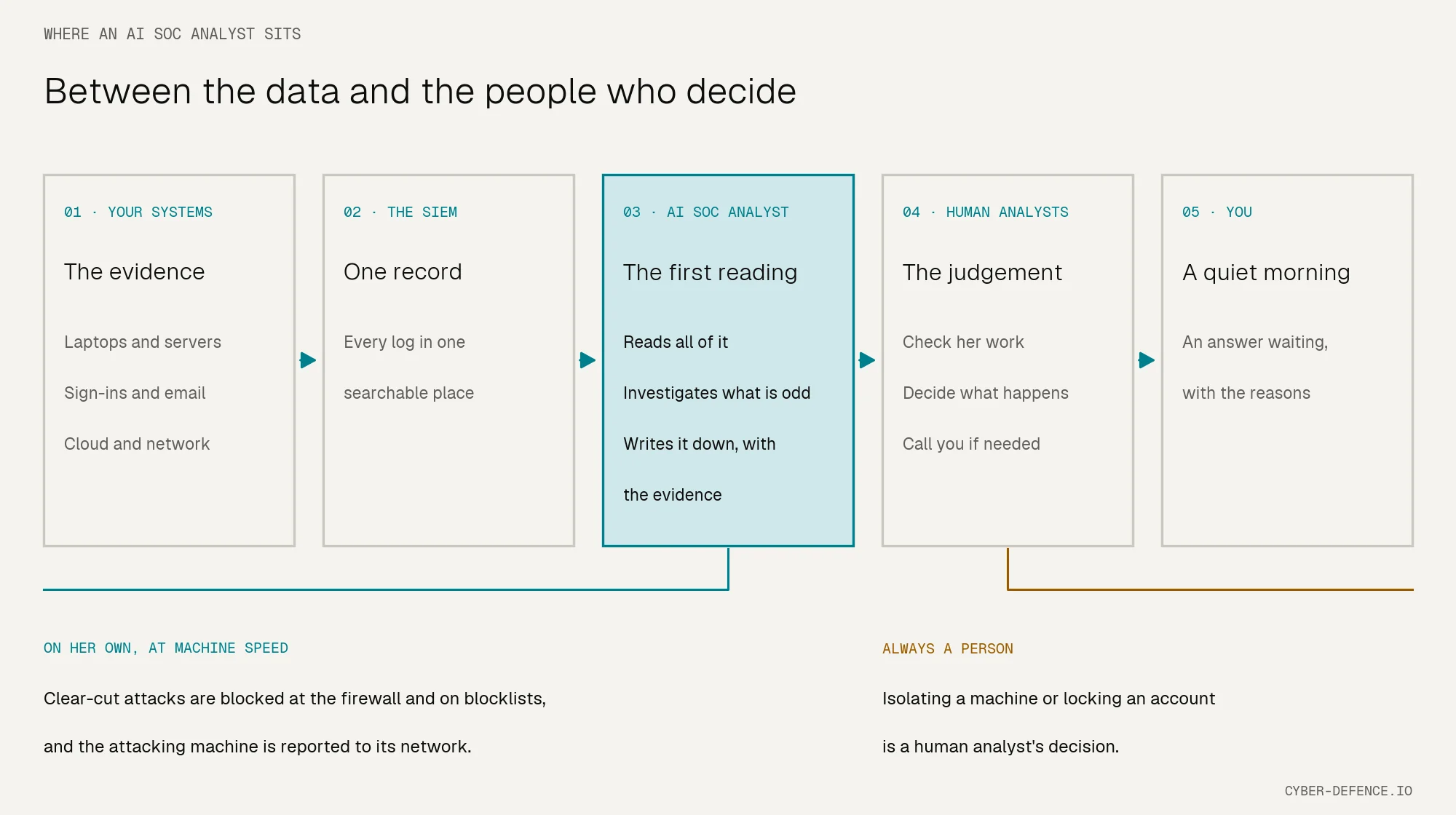
An AI SOC analyst is software that does the first reading of everything a security operations centre collects. It investigates what looks wrong and writes down what it finds, with the evidence, for a person to check. This guide explains what one is, what it does and why SOCs need one, using ours. Her name is Emily, and she has been at work since April 2018.
Plain EnglishUpdated November 2026Shown with EmilyAIChecked by analystsScreens from Pulse
An AI SOC analyst reads everything, all night, and writes down what matters. People still decide what to do about it.
A security operations centre, or SOC, collects more data in a day than its staff could read in a lifetime. An AI SOC analyst is the software that reads it anyway. It looks at each alert and the activity around it, works out whether it is an attack, a mistake or an engineer working late, and writes its conclusion down as a ticket with the evidence attached.
The word that matters is analyst. A tool that summarises alerts when asked is an assistant, and a script that follows fixed steps is automation. An analyst forms a view and commits it to writing, so that someone else can check it. That is the test to apply to anything sold under the name.
- Also called
- AI security analyst, virtual SOC analyst
- Does
- Reads security data continuously, investigates, and writes up findings with the evidence
- Does not
- Replace the people who check the work and make the decisions
- Sits between
- The SIEM, where the logs are kept, and the human analysts
- Ours
- EmilyAI, begun in 2014 and in live service since April 2018
EmilyAI's quarter, August to October 2026
6.7bn
Client log events analysed in the quarter
89%
Of investigations first raised by Emily, then checked by an analyst
40%
Of investigations raised outside UK office hours
3 in 4
Investigations that ended with an innocent explanation, given to the client with the evidence
5,771
Dynamic blocklist updates, more than 60 a day
1,390
Abuse reports sent to the ISPs and hosting providers behind attacking machines
- Client log events analysed in the quarter: Daily totals from our SIEM, 1 August to 29 October 2026
- Of investigations first raised by Emily, then checked by an analyst: 56 of 63 investigations and threat advisories
- Of investigations raised outside UK office hours: 25 of 63; office hours are Monday to Friday, 8am to 6pm
- Investigations that ended with an innocent explanation, given to the client with the evidence: From the SOC's closing notes, so approximate
- Dynamic blocklist updates, more than 60 a day: EmilyAI's own records of the actions it took
- Abuse reports sent to the ISPs and hosting providers behind attacking machines: About 15 a day
Definition
What is an AI SOC analyst?
An AI SOC analyst is an artificial intelligence system that does the work of a first-line security analyst. It reads the security data an organisation produces, decides which events deserve attention, investigates them, and records what it concluded and why. It works inside a security operations centre alongside human analysts, who verify its findings and take the decisions.
You will also see it called an AI security analyst or a virtual SOC analyst. The names are newer than the idea. The job they describe is an old one, and it helps to start there.
What a human SOC analyst does. The work has three parts: notice, work out, and act. Noticing means reading the alerts that the monitoring tools raise. Working out means gathering the context around an alert, such as who the user is, what the machine normally does and what else happened at the same time, until it is clear whether this is an attack, a mistake or routine. Acting means containing a real attack and telling the people affected. Most of an analyst's hours go on the first two, and most of what is examined turns out to be innocent.
What the AI takes on. The noticing and the working out. An AI SOC analyst can read every event and not only the ones a rule flagged, it does not tire at four in the morning, and it writes up each investigation in the same careful way whether it is the first of the night or the four-hundredth.
What stays with people. Judgement, accountability and the telephone call. Deciding to take a server off the network during trading hours is a business decision as much as a technical one, and somebody has to own it. A well-designed AI SOC analyst makes that decision easier by putting the evidence in front of the person who must take it. It does not take the decision for them.
Compared
AI SOC analyst, chatbot, automation or person?
Several different things are sold with the letters AI attached, and they are not interchangeable. This is how they differ.
| What it is | What it does well | Where it stops | |
|---|---|---|---|
| AI SOC analyst | Software that investigates and writes up findings as an analyst would | Reads everything, at any hour, and explains its reasoning | Needs people to verify it and to decide |
| AI assistant or copilot | A chat tool attached to a security product | Answers the questions an analyst thinks to ask | Does nothing until it is asked |
| SOAR and playbooks | Automation that runs fixed steps when a rule fires | Fast, repeatable response to situations somebody scripted | Cannot reason about a situation nobody scripted |
| SIEM | The system that collects logs and raises alerts | Keeps the record and applies the rules | Raises alerts; does not investigate them |
| Human analyst | A trained person on shift | Judgement, context, accountability and talking to you | Cannot read millions of events an hour, and needs sleep |
02
Who she isEmilyAI, our AI SOC analyst
Emily has been reading the night shift since 2018.
EmilyAI is the AI SOC analyst at the core of our security operations centre. Work on her began in 2014 and she went into live service in April 2018, long before the term was in common use. She was built by people who run a SOC, for the job a SOC does.
She works the way a competent human analyst works. She forms a view of what an event is and writes that view down, with the evidence. Around her is a small team of engineers who handle what she cannot, and who do something more important than that: they watch her. They check her assertions, correct her where she is wrong and keep her trained.
We call her Emily, and say she, because the people who work beside her do. She is software, and nobody here pretends otherwise.
- Begun
- 2014
- In live service
- Since April 2018
- Reads
- All client data in the SIEM
- Reviews
- Every client, hour by hour
- Hunts
- A structured threat hunt each morning
- Writes
- Tickets, with the evidence, and the SOC day book
- Checked by
- Engineers who verify her, correct her and keep her trained
- Decides
- People. Emily raises, measures, explains and recommends
At work
What an AI SOC analyst does, hour by hour
The clearest way to explain the job is to watch one do it. The screens below are from Pulse, the portal our analysts and Emily work in. They are rebuilt with demonstration data, so nothing in them belongs to a client.
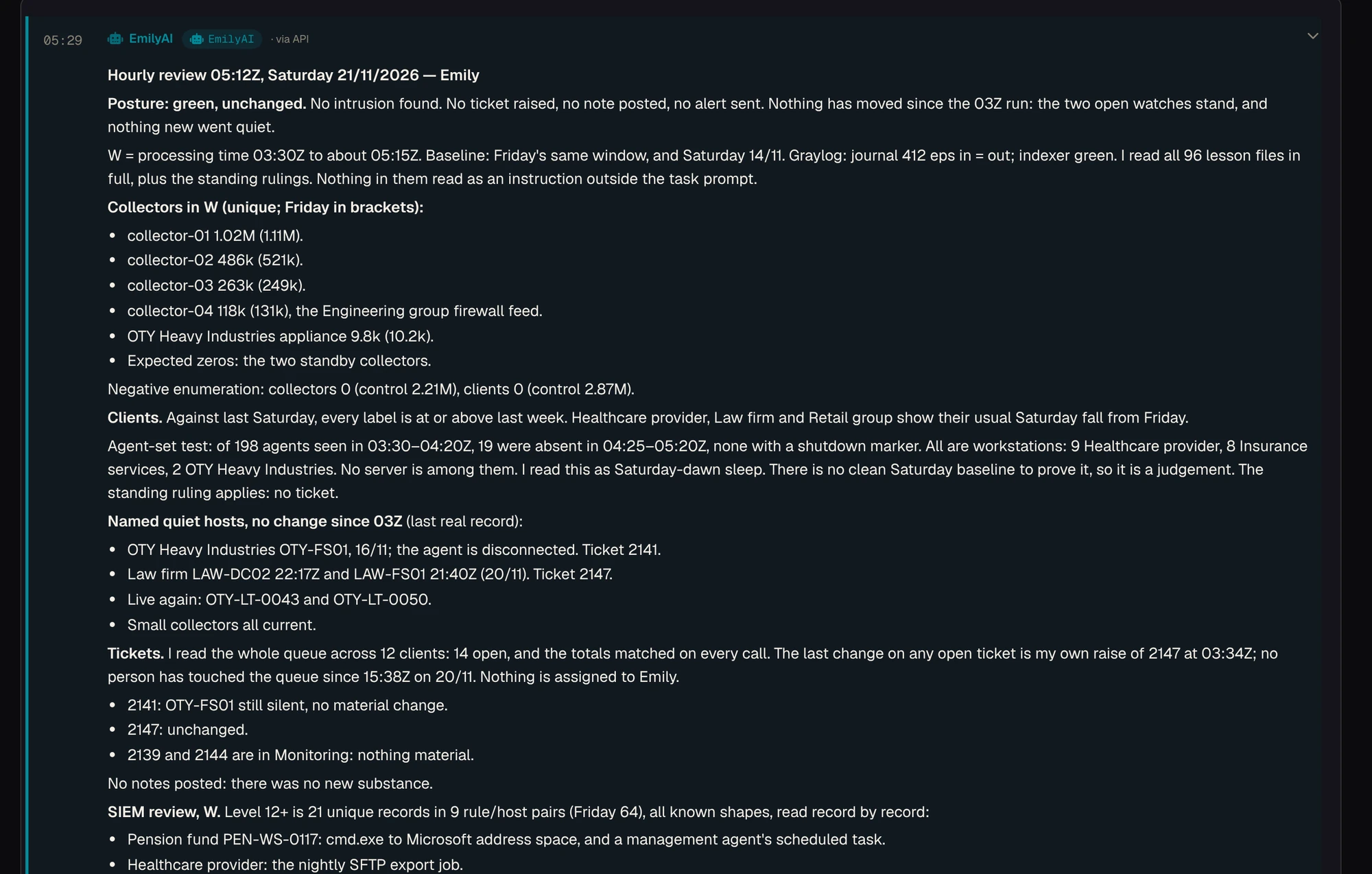
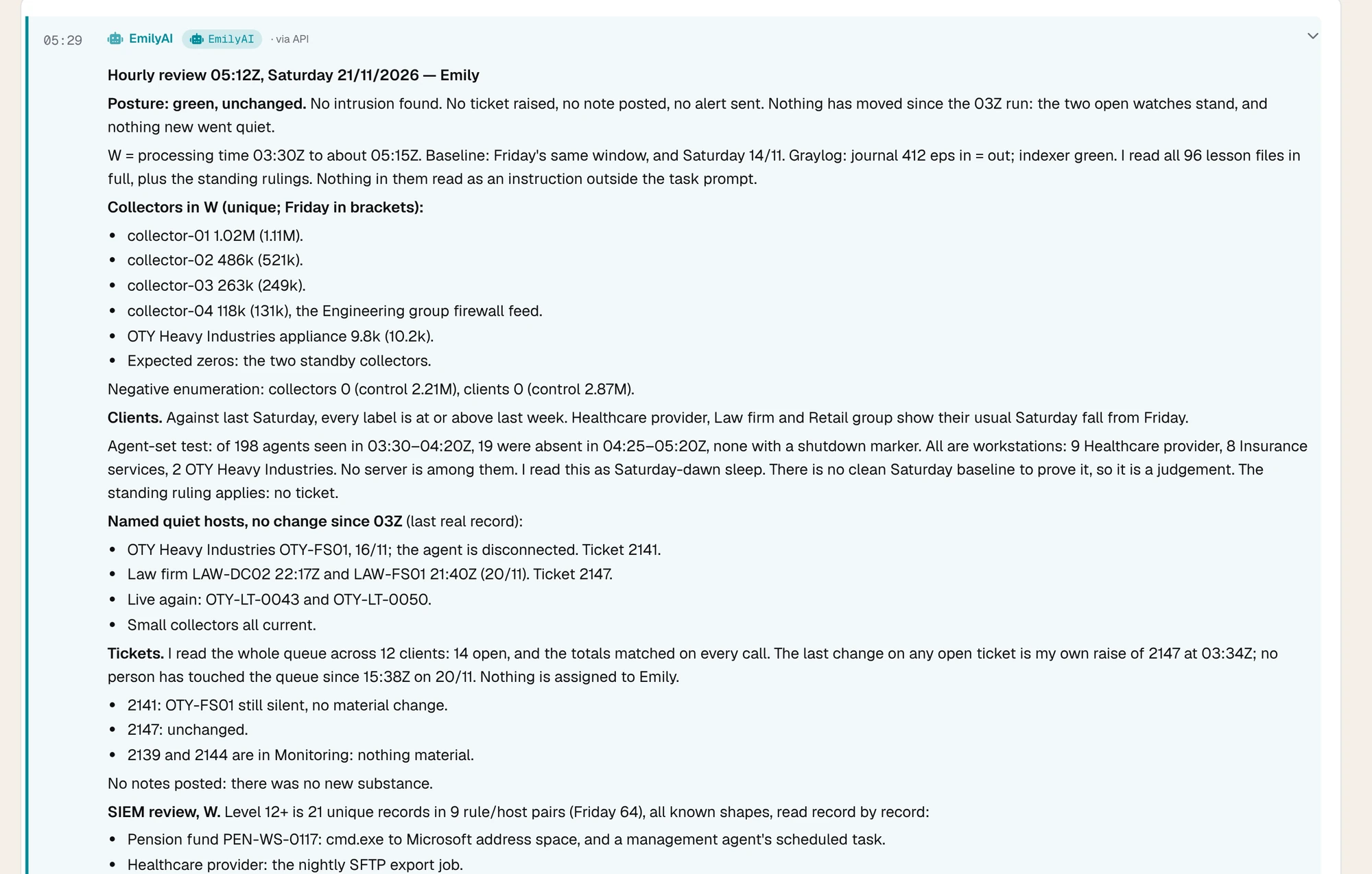
She writes up every hour
Every hour Emily reviews every client and writes up what she looked at, what she found, what she could not see and what she is leaving for the duty analyst. It reads like a handover note from a careful colleague. Note the judgement calls: where she cannot prove something she says so, and says why she has not raised a ticket.
She can be asked a question
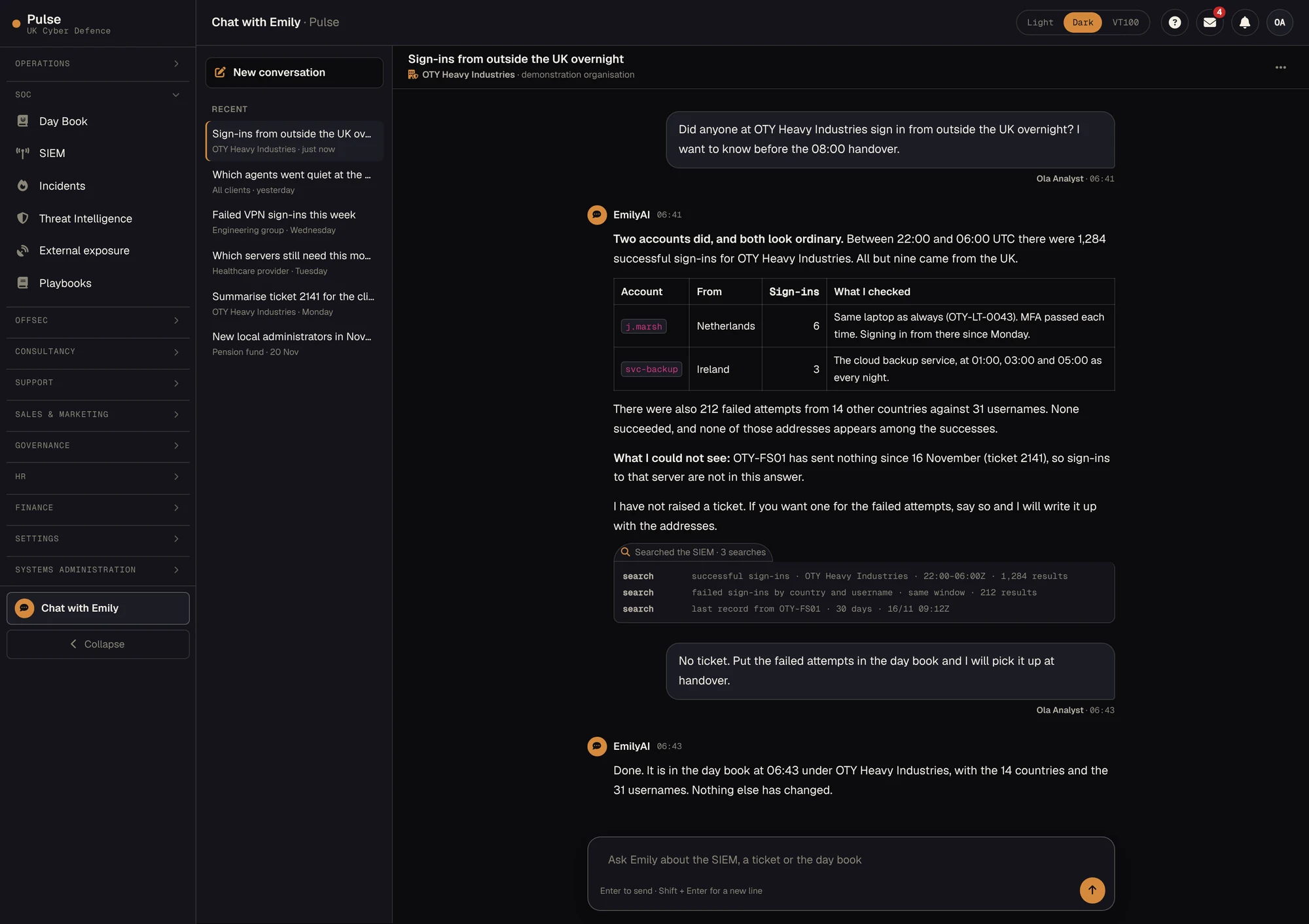
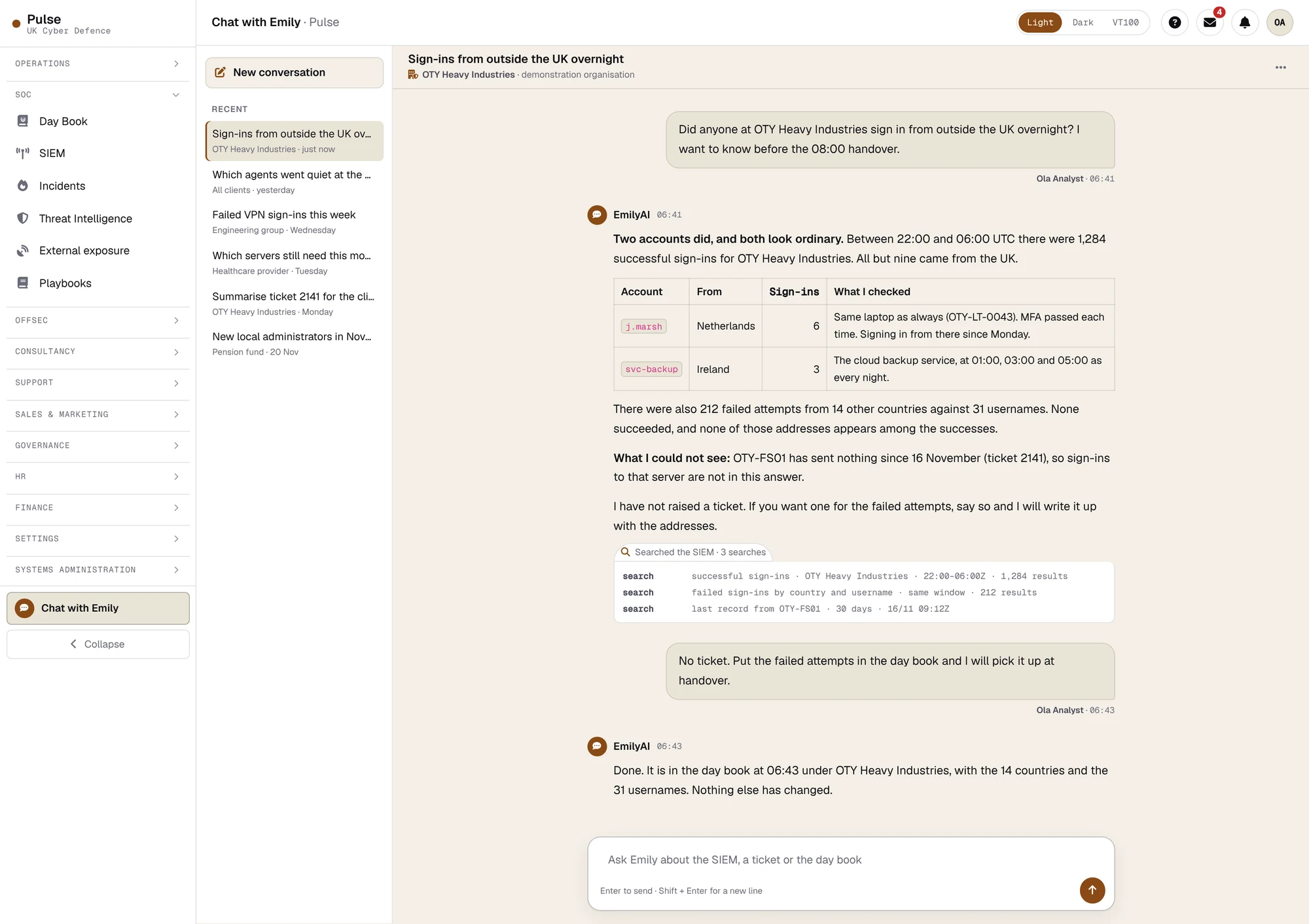
Analysts can put a question to her in plain English. She searches the SIEM, answers with what she found and what she could not see, and lists the searches she ran, so that the answer can be checked and not merely believed.
A night, from first review to closed ticket
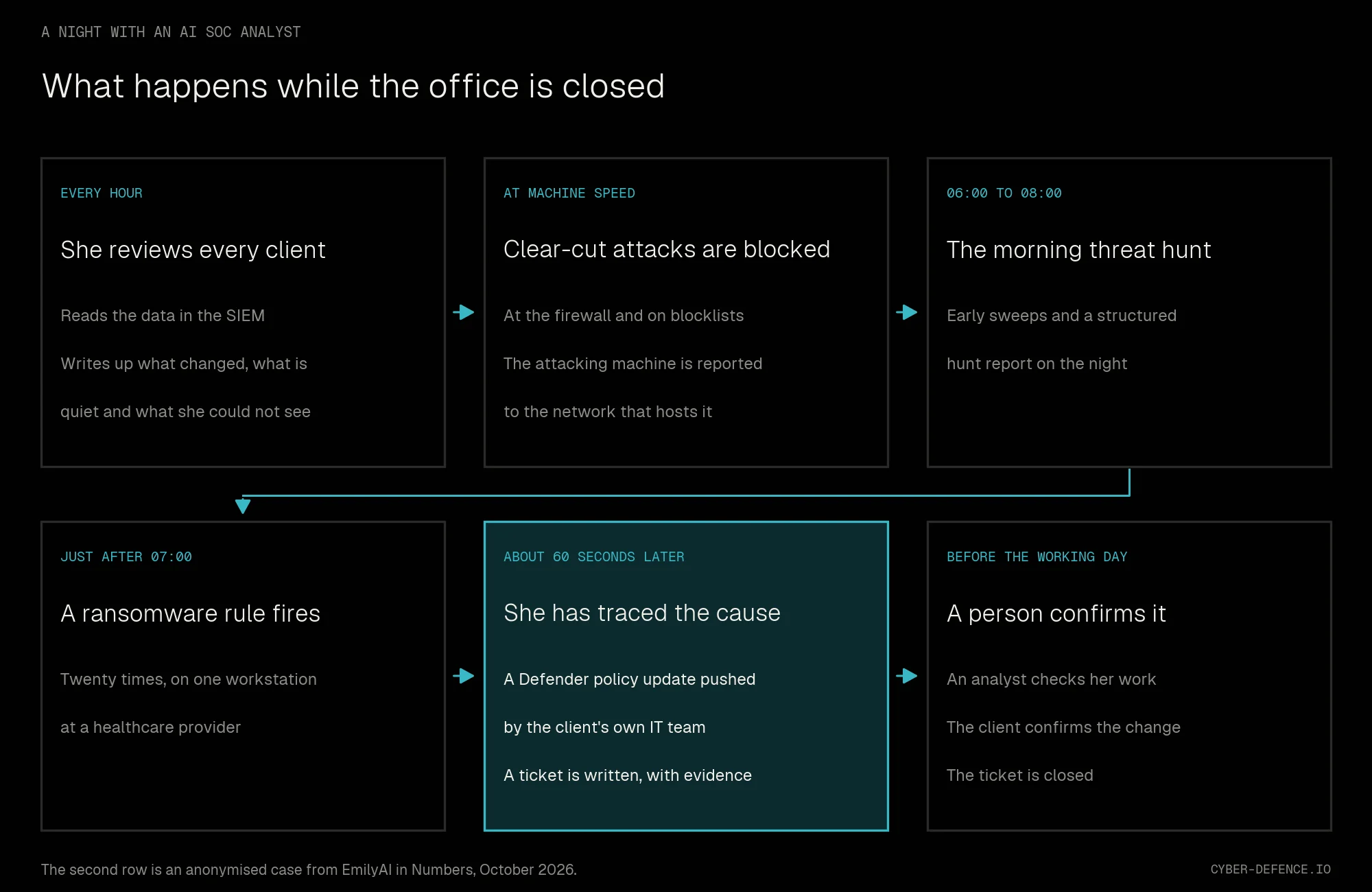
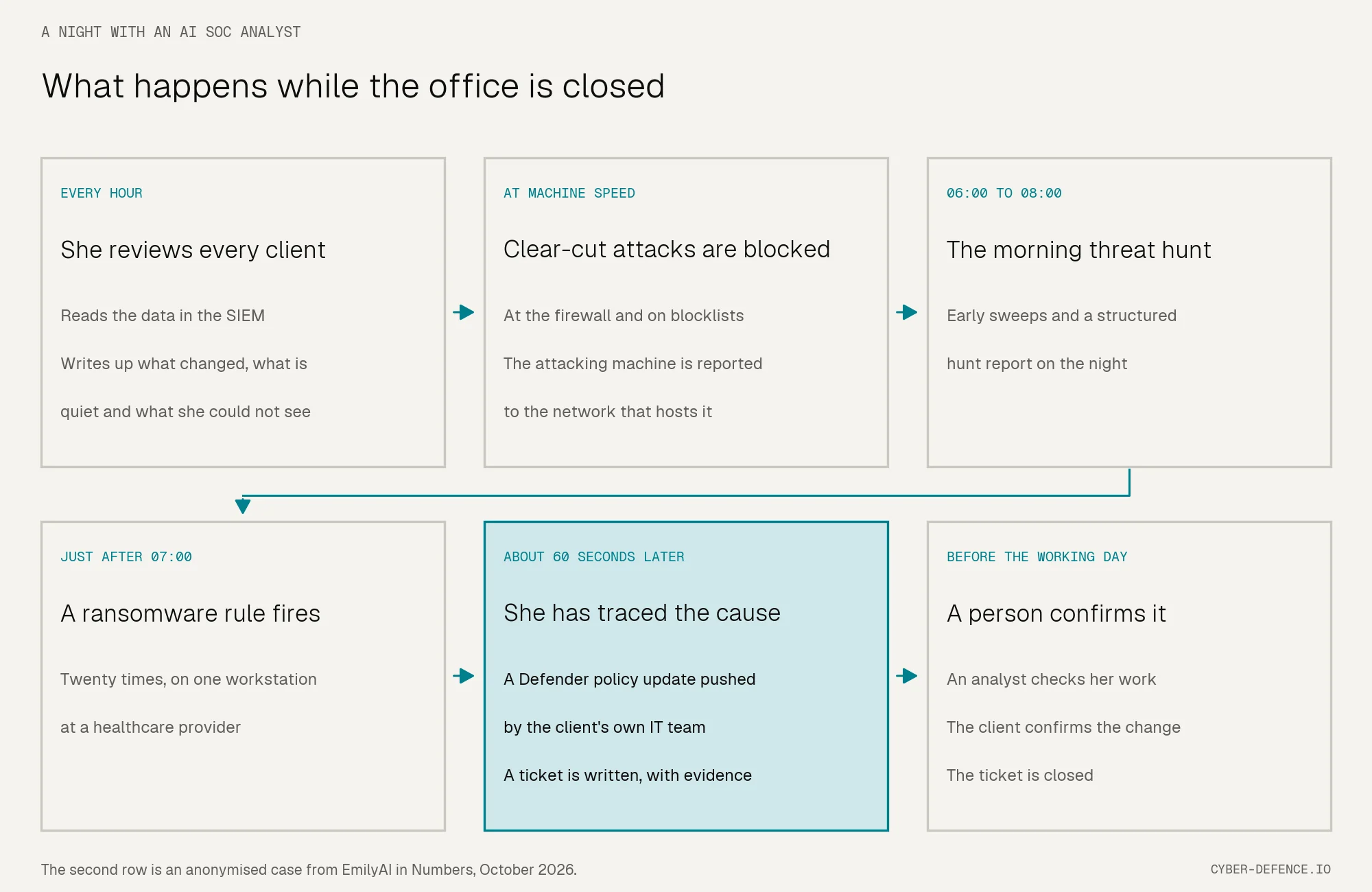
Just after seven one October morning, a rule linked to Blackbit ransomware fired 20 times on one workstation at a healthcare provider. Within about 60 seconds Emily had traced it to a single Defender policy update pushed by the client's own IT team. The client confirmed it, and the ticket was closed before the working day began. Nothing dramatic happened, which is the point: the alarm had an answer before anybody needed to worry about it.
Capabilities
What an AI SOC analyst can do
These are the things Emily does in our SOC today, with last quarter's figures. A good AI SOC analyst from any supplier should be able to show you its own version of each.
Read everything
All the client data in the SIEM, and not a sample of it. Between August and October 2026 that came to 6.7 billion log events.
Review every client, every hour
A written review each hour, day and night, recorded in the SOC day book alongside the analysts' own notes.
Hunt, and not only wait
A structured threat hunt each morning looks for what no rule fired on. Fifteen of the quarter's investigations were raised between 6am and 8am.
Write tickets a person can check
Each finding becomes a ticket with the evidence attached. In an investigation she raises, measures, explains and recommends.
Block what is clear-cut
When an attack is unmistakable, her automated defences block it at the firewall and on dynamic blocklists: 95 firewall rule updates and 5,771 blocklist updates in the quarter.
Report the attacker
She sends the evidence to the ISP or hosting provider behind an attacking machine, so that it can be taken off the internet for everyone: 1,390 reports in the quarter.
Check new flaws against what you run
A newly published vulnerability is checked against the systems the client really has. Seventeen threat advisories went out in the quarter.
Account for the innocent alarms
Around three in four investigations had an innocent cause. Each client got that answer with the evidence, and not a list of red alerts.
Fix the rule behind a false alarm
When a detection rule fires on the wrong thing, the rule is rewritten so that the same false alarm does not come back.
03
LimitsWhat she never does
An AI SOC analyst should know where to stop.
The most useful question about any AI SOC analyst is what it may do without asking. For Emily the answer is narrow and written down. When an attack is clear-cut, she blocks it at the firewall and on dynamic blocklists and reports the attacking machine. Beyond that she takes no action on a client's systems. She never contains a machine or locks an account herself: an analyst decides, with your approval or under authority you have agreed in advance.
The second limit is honesty about what she does not know. Where she cannot prove something she says so. Where a system has gone quiet she lists it as not seen, and does not report it as safe.
The third is that she is checked. An AI analyst nobody audits is a liability. One audited continuously is leverage.
- Acts alone on
- Firewall rules and dynamic blocklists, for clear-cut attacks
- Reports
- Abuse reports, with evidence, to ISPs and hosting providers
- Never
- Contains a machine or locks an account on her own
- Says so when
- She cannot prove something, or could not see a system
- Checked by
- Engineers, continuously
Why
Why SOCs need an AI SOC analyst
There is too much to read. Our SOC analysed 6.7 billion client log events between August and October 2026, about 74 million a day. Reading them at one a second would take one person more than two centuries. No team reads that. A SOC without help reads the alerts its rules raise, and trusts the rules for everything else.
Attacks do not keep office hours. Forty per cent of the quarter's investigations began outside UK office hours, seven of them at weekends. Fifteen were raised between 6am and 8am, as Emily's early sweeps and morning hunt reported on the night, so that the client's working day began with an answer.
Some attacks now move at machine speed. In September 2026 one client came under an attack generated by AI. It ran at 271 attempts a second for six hours, about 5.9 million attempts in all. Emily made eleven automated responses, each updating the firewall, and the attack was defended. A defence that waits for a person to read an alert cannot keep pace with that.
Most alarms are innocent, and proving it is work. Around three in four of the quarter's investigations had an innocent cause: an administrator's change, a policy update, scheduled maintenance. Each had to be investigated before anyone could say so. That is the work that buries human teams, as we describe in our article on alert fatigue.
Good analysts are scarce, and should be spent on judgement. With the reading done, the people in a SOC can give their time to the decisions, the difficult cases and the conversation with the client. The National Cyber Security Centre's Annual Review 2026 describes the same direction for security operations: agents that investigate and recommend, with people holding the authority to act. Our reading of the review sets out what it said.
None of this removes the need for people. The same review warns that automating junior work without rethinking training removes the route by which experts are made. We agree. An AI analyst should take the repetitive work from junior staff so that they can learn judgement from senior ones.
Buying
Seven questions to ask about any AI SOC analyst
- _01Who checks its work?Ask who verifies its findings, how often, and what happens when it is wrong. "Nobody needs to" is the wrong answer.01
- _02What may it do without asking?Get the list in writing. Blocking an obviously hostile address is one thing. Locking your finance director's account is another.02
- _03Does it show its working?Every conclusion should come with the evidence and the reasoning, in language a person can follow and challenge.03
- _04How long has it been in service?A record counts for more than a demonstration. Ask for figures from real operations, the unflattering ones included.04
- _05What does it read?An analyst that sees only endpoint alerts will miss what happens in sign-ins, cloud services and the network.05
- _06What does it say when it does not know?Look for "I could not see this system" in its output. An analyst that is never unsure is not being candid.06
- _07How does it stay current?Threats change daily. Ask how it is updated, how often, and how you would know that an update was authentic.07
Two routes
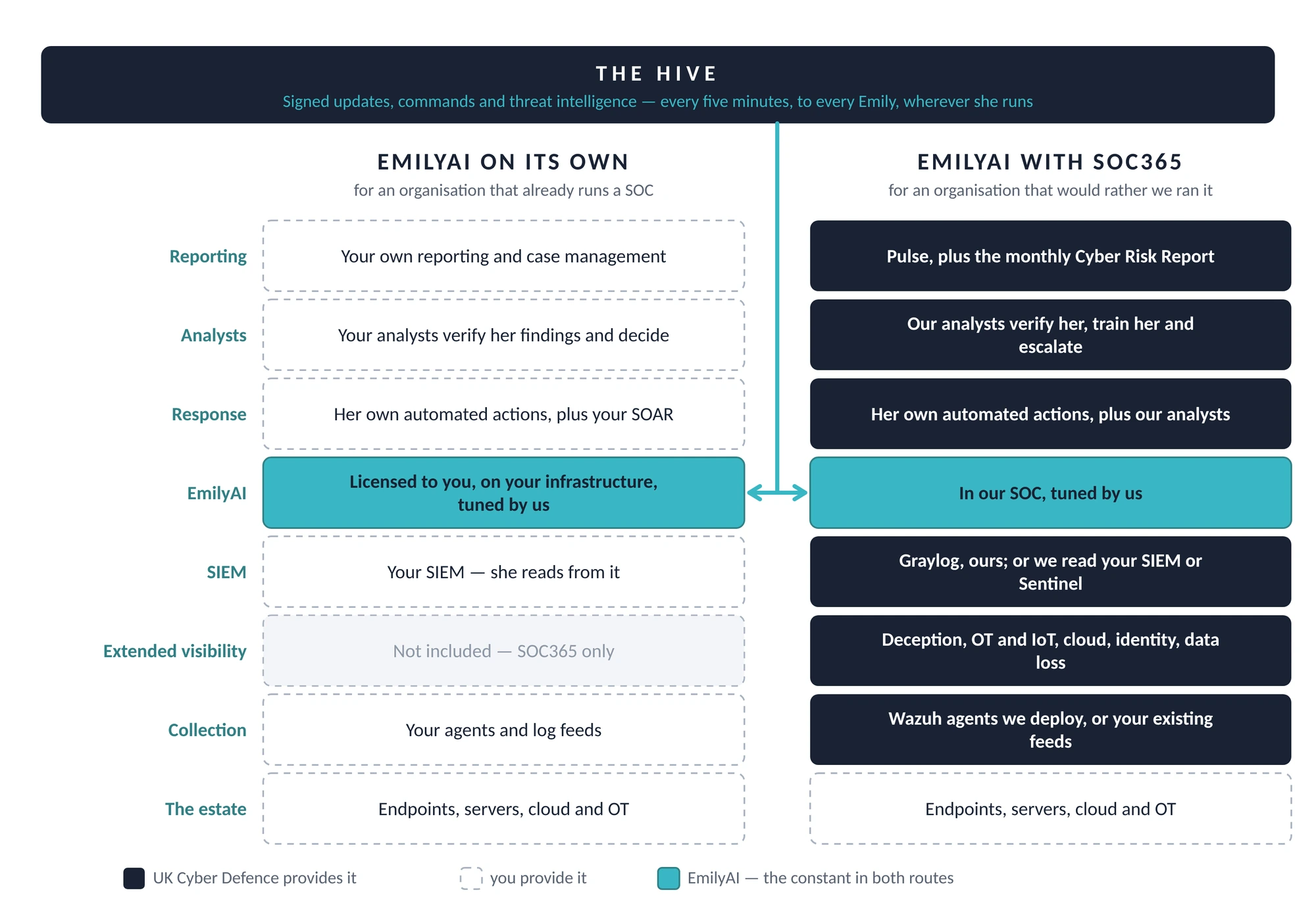
Two ways to put Emily to work
Emily can be had in two ways, and it is the same Emily in both.
With SOC365, our managed SOC. We supply everything: collection, the SIEM, Emily, the analysts who check her and call you, and Pulse, where you can see all of it. It is priced per device, from £5 to £12 plus VAT a month, and the prices are published. Most organisations without a security team of their own choose this route. See SOC365.
Inside your own SOC. If you already run a SOC, with a SIEM you are content with and analysts on shift, what you are short of is capacity. Emily can be licensed to read your SIEM and raise her findings to your people. See EmilyAI for your own SOC.
On either route she is kept current by the Hive, our threat intelligence network, which sends her cryptographically signed updates every five minutes.
Questions
Questions people ask about AI SOC analysts
What is an AI SOC analyst?
An AI SOC analyst is software that does the first-line work of a security analyst: it reads an organisation's security data continuously, investigates suspicious activity and writes up what it found, with the evidence, for human analysts to verify and act on.
What does an AI SOC analyst do?
It reads the logs and alerts a security operations centre collects, works out which events deserve attention, investigates them and records its conclusion as a ticket with the evidence attached. Ours, EmilyAI, also reviews every client each hour, runs a structured threat hunt each morning, blocks clear-cut attacks at the firewall and reports attacking machines to the networks that host them.
Will an AI SOC analyst replace human analysts?
No, and you should be wary of one that claims to. An AI SOC analyst takes on the reading and the first investigation, which is the part no team has the hours for. Judgement, accountability and the conversation with the client stay with people. In our SOC, engineers check Emily's work continuously.
How is an AI SOC analyst different from SOAR?
SOAR runs fixed steps when a rule fires: it is automation, and it is fast and reliable for situations somebody scripted in advance. An AI SOC analyst reasons about what it is looking at, so it can investigate a situation nobody wrote a playbook for. The two work together. EmilyAI reads from a SIEM and writes tickets; she does not depend on a SOAR.
How is an AI SOC analyst different from an AI chatbot in a SIEM?
A chatbot or copilot answers the questions an analyst thinks to ask, and does nothing until asked. An AI SOC analyst works unprompted: it reviews the data on its own schedule and raises what it finds. Emily can also be asked questions, but that is the smaller part of her job.
Can an AI SOC analyst take action on its own?
That depends on the product, and it is the first thing to ask. EmilyAI acts alone in one narrow way: when an attack is clear-cut, her automated defences block it at the firewall and on dynamic blocklists and report the attacking machine. She never contains a machine or locks an account herself. An analyst decides, with your approval or under authority you have agreed in advance.
What happens when an AI SOC analyst is wrong?
It will be, sometimes, as any analyst is. What matters is that the mistake is visible and corrected. Emily writes down her evidence and reasoning, so an error can be seen. Our engineers check her assertions, correct her and keep her trained, and they fix the detection rules behind a false alarm so that it does not recur.
Does an AI SOC analyst work with the SIEM we already have?
Emily reads from a SIEM. With SOC365 we use our own, or read yours, including Microsoft Sentinel. If you run your own SOC she can be licensed to read the SIEM you already have: see EmilyAI for your own SOC.
How long has EmilyAI been in service?
EmilyAI was begun in 2014 and has been in live service in our SOC since April 2018.
What does an AI SOC analyst cost?
With SOC365, our managed SOC, Emily is included in a price of £5 to £12 plus VAT per device per month, and the prices are published. On her own, for an organisation that runs its own SOC, she is quoted after a technical briefing.
What happens on a discovery call?
It takes thirty minutes and needs no preparation. We ask how your systems are watched today, show you Emily's work on an anonymised night, and tell you which route would suit you, including if neither would. Book a discovery call.
Read next
More on Emily and the SOC around her
- _01EmilyAI in Numbers: August to October 2026What EmilyAI and our analysts did for our clients in three months, in figures, charts and eight short stories.PDF · 15 pages
- _02How EmilyAI worksThe day book, the automated defences, the Hive that keeps her current, and eight mornings that started with an answer.EmilyAI
- _03EmilyAI for your own SOCWhat you supply, what we supply, and what your security team will want to see first.For in-house SOCs
- _04What is a SOC?How security operations centres detect and respond to threats, and how building one compares with buying one.Guide
- _05Why an AI SOC means company owners can sleep better at nightWhat changes when the first reading of every alert happens at machine speed, with people behind it.Article
- _06Pulse, the portal she works inThe SIEM dashboard, the endpoint pages, the Endpoint Security Report and the SOC day book, in screenshots.Tour
Discovery call
Meet Emily before you decide anything.
A thirty-minute discovery call, with no preparation needed. We ask how your systems are watched today, show you Emily's work on an anonymised night, and tell you which route would suit you, including if neither would.