What Is a SOC? How Security Operations Centres Detect and Respond to Threats
A security operations centre is the team that watches your systems day and night and acts on what it finds. This guide explains what a SOC does, what it watches, how it responds, and how building one compares with buying one.
A security operations centre, or SOC, is the team that watches an organisation's computer systems around the clock, works out which of the millions of things happening on them matter, and acts on the few that do. If you have been asked whether your organisation "has a SOC", or you are comparing providers and the vocabulary has started to blur, this guide sets out what a SOC is, what it does all day and all night, and how the two ways of getting one, building it or buying it, compare.
What is a SOC?
A SOC (security operations centre, or security operations center in American spelling) is the combination of people, processes and technology that monitors an organisation's IT estate continuously, detects signs of attack and responds to contain them. It is a function and not a room: some SOCs sit in a purpose-built facility with a wall of screens, and many very good ones are a distributed team working from one shared platform.
The UK's National Cyber Security Centre makes the same point in its guidance on building a security operations centre: SOCs differ widely in scope, most exist to detect and respond to cyber attacks, and there is no single design that suits everybody. What matters is that the monitoring is proportionate to the threats an organisation faces and the resources it has.
Three things have to be present for a SOC to be worth the name. There must be visibility, meaning the logs and signals from the systems that matter arrive somewhere they can be searched. There must be judgement, meaning a competent person decides what each alert means. And there must be authority, meaning somebody is able and allowed to act when the answer is "this is real". A tool can supply the first. Only a team supplies the other two.
What a SOC does, day and night
The work of a SOC is a loop of six jobs. None of them is exotic. What makes a SOC valuable is that all six happen, in order, every hour of the year.
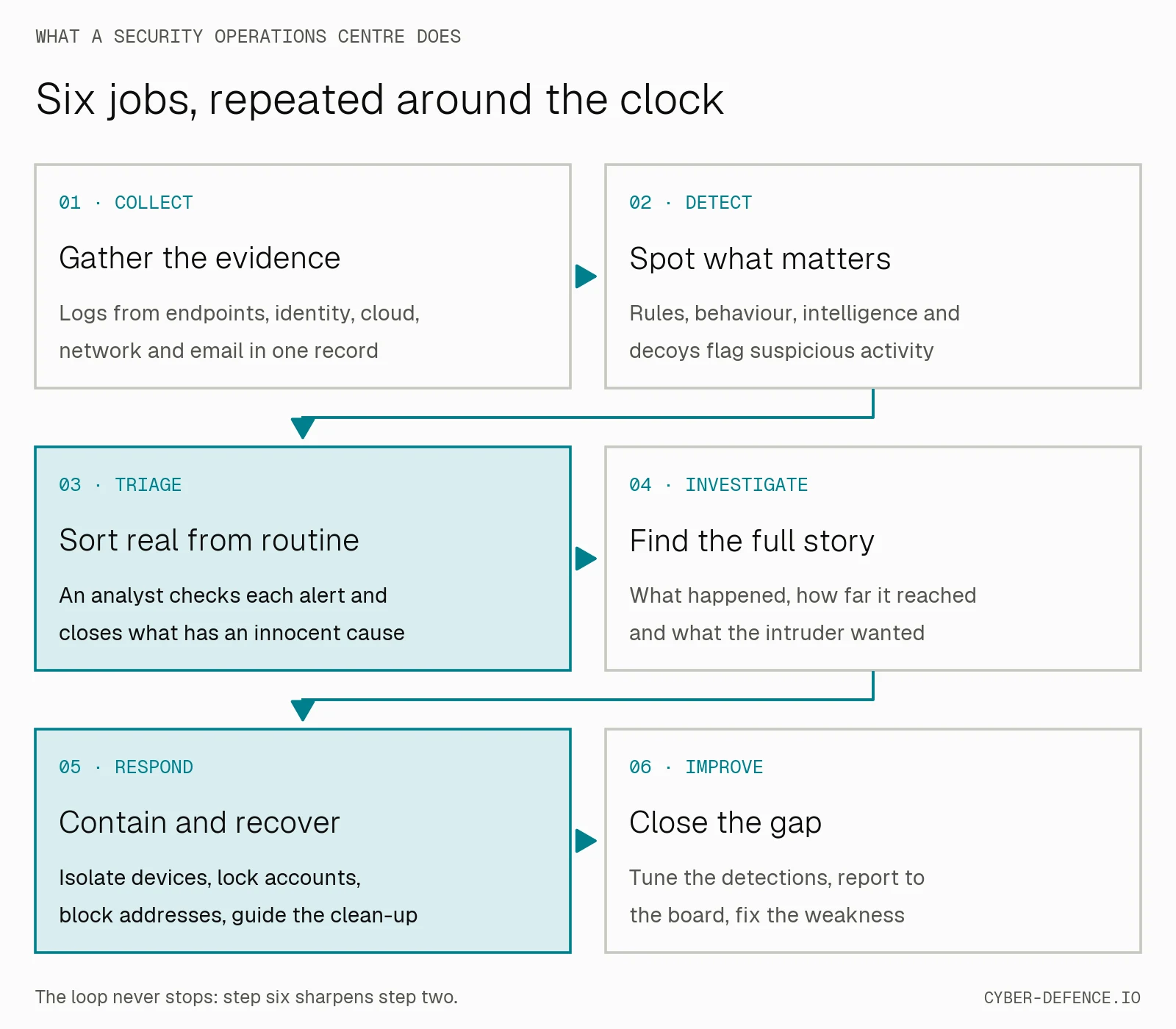
Collect. Logs and security signals are gathered from across the estate into one searchable record.
Detect. Rules, behavioural analytics, threat intelligence and decoys pick out the events that deserve attention.
Triage. An analyst looks at each alert, adds context and decides whether it is an attack, a mistake or an engineer working late. Many alerts turn out to have an innocent cause, and saying so with evidence is part of the service. This is also where SOCs most often fail: a team buried in unfiltered alerts stops reading them, a problem we cover in our article on alert fatigue.
Investigate. For anything real, the SOC establishes what happened, how the intruder got in, how far they reached and what they were after.
Respond. The threat is contained: a device isolated, an account locked, an address blocked. The SOC then guides the clean-up and confirms the intruder's access has gone.
Improve. Detections are tuned, the weakness that let the attacker in is reported, and the board gets a plain account of what happened.
What a SOC watches: endpoints, identity, cloud and network
A SOC can only detect what it can see, so the first design question is always coverage. Modern estates have five main sources of evidence, and an attack usually leaves traces in more than one of them.
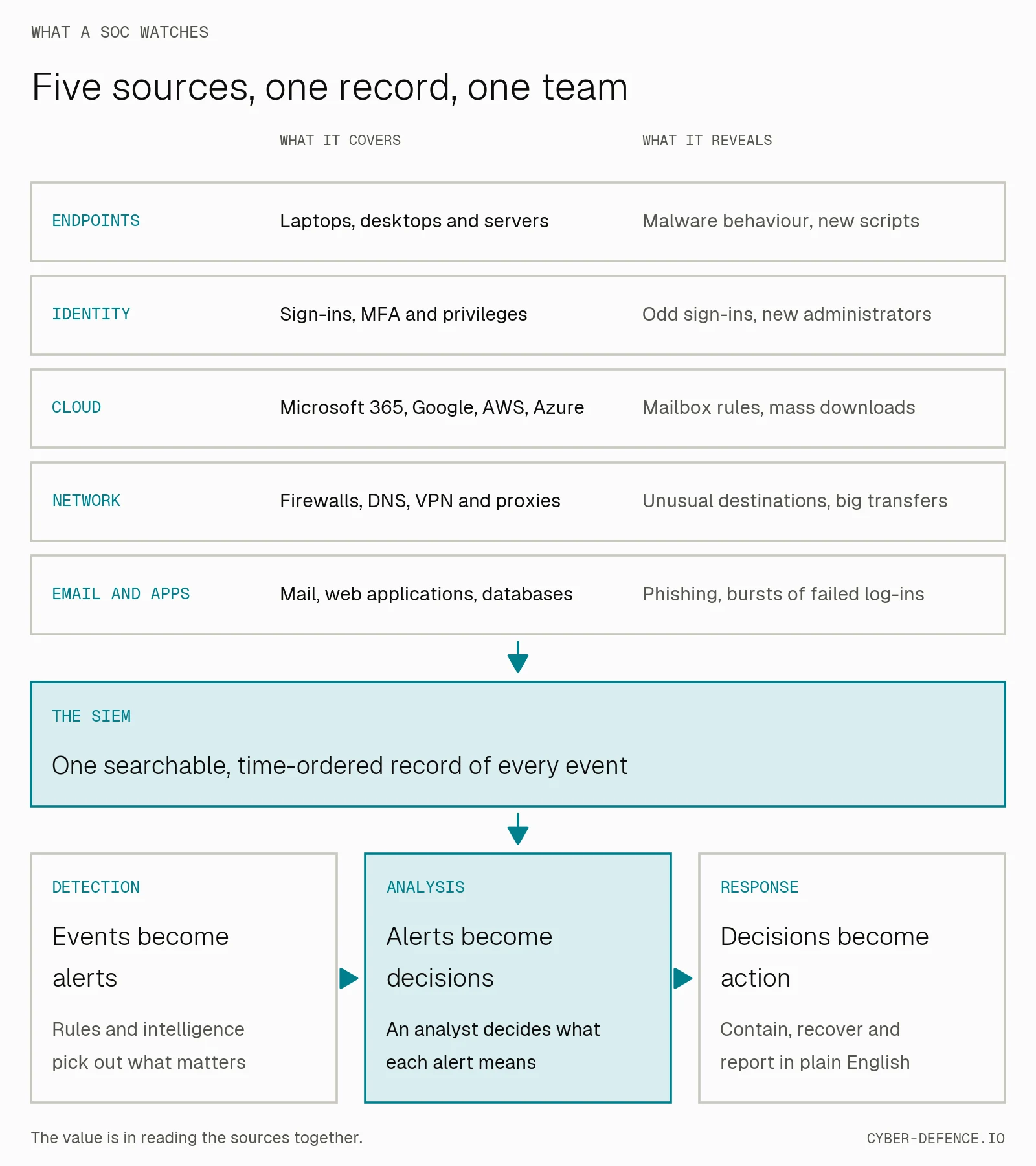
| Source | What it covers | What it reveals |
|---|---|---|
| Endpoints | Laptops, desktops and servers | Malware behaviour, new scripts and services, changed files |
| Identity | Sign-ins, multi-factor authentication and privileges | Sign-ins from unfamiliar places, password resets, new administrators |
| Cloud | Microsoft 365, Google Workspace, AWS and Azure | Mailbox forwarding rules, mass downloads, new API keys |
| Network | Firewalls, DNS, VPN and proxies | Connections to known-bad addresses, large outbound transfers, internal scanning |
| Email and applications | Mail gateways, web applications and databases | Phishing, unusual queries, bursts of failed log-ins |
These feeds arrive in a SIEM (security information and event management system), which stores them in time order and lets analysts search across all of them at once. That last point is the one that matters. A sign-in from an unfamiliar country is a curiosity. The same sign-in followed by a new mailbox rule and a large download is an incident, and only somebody reading the sources together will see it. Our guide to integrating EDR, XDR and SIEM goes further into how the tools fit.
How a SOC detects threats
Detection is the craft of turning a flood of events into a short list of alerts worth a person's time. A good SOC layers several methods, because each catches what the others miss.
- Known indicators. Addresses, domains and file hashes already linked to attackers. Quick to check and easy for an attacker to change, as our guide to indicators of compromise explains.
- Behaviour. What attackers do, whatever tools they use: an office document launching a script, an account reading thousands of files it has never touched. Most SOCs map these detections to MITRE ATT&CK, the public catalogue of attacker techniques drawn from real intrusions, so that gaps in coverage are visible.
- Threat intelligence. Knowledge of who is attacking organisations like yours and how, fed into the detections continuously.
- Deception. Decoy systems and accounts that no legitimate user has any reason to touch, so any contact with them is close to certain evidence of an intruder.
- Threat hunting. Analysts searching proactively for intrusions that no rule has caught, starting from a hypothesis and not from an alert.
The balance matters as much as the list. Too few detections and attacks pass unseen; too many and the real one drowns. Writing, testing and retiring detections is a discipline of its own, called detection engineering, and it never finishes.
How a SOC responds: from alert to contained
Speed is the reason a SOC works around the clock, and two recent studies show why. In the incidents Sophos investigated for its 2026 Active Adversary Report, 88 per cent of ransomware was launched outside business hours, and intruders took a median of 3.4 hours to reach Active Directory, the system that controls every account in a typical Windows network. Mandiant's M-Trends 2026 found that, across its 2025 investigations, attackers were inside a network for a median of 14 days before anyone noticed. The encouraging figure in the same report is that organisations spotted the intrusion themselves in 52 per cent of cases, up from 43 per cent a year earlier. Monitoring works, and more organisations are doing it.
Here is what a response looks like when it goes well.
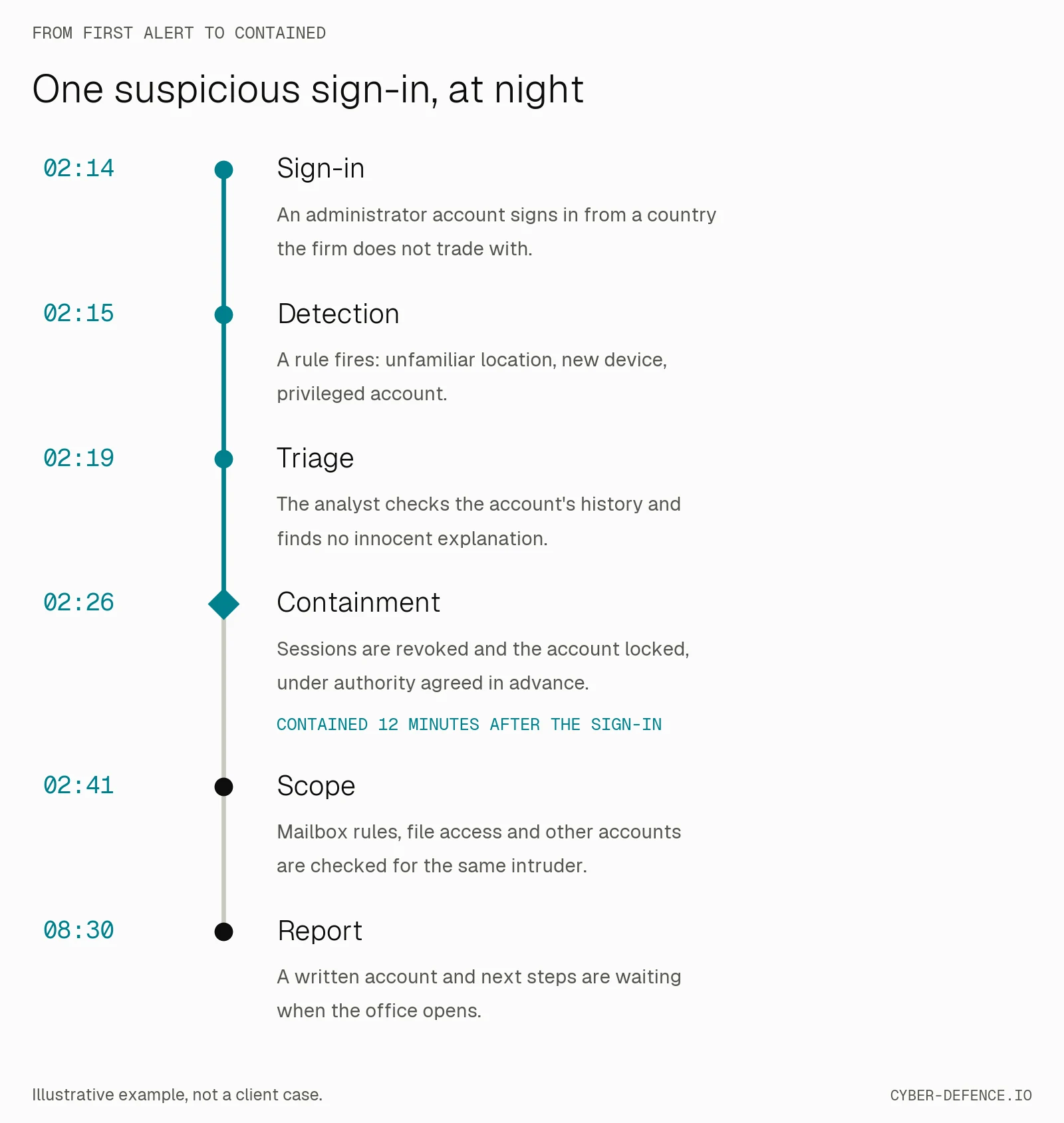
Two details in that timeline decide the outcome. The first is that a person looked at 02:19 and not at 09:00. The second is the phrase "authority agreed in advance". A SOC that can only telephone you in the middle of the night is a smoke alarm. A SOC that has agreed with you in advance which actions it may take, such as locking an account or isolating a laptop, can stop the incident while it is still one account on one machine.
Containment is not the end. A full response follows a recognised structure, such as the US standards body NIST's incident response guidance, SP 800-61, which runs from preparation through detection, response and recovery to lessons learned. For larger events the SOC hands over to, or becomes, an incident response team.
Who works in a SOC
The traditional SOC is organised in tiers. Tier 1 analysts triage alerts as they arrive. Tier 2 analysts investigate the ones that prove real and lead containment. Tier 3 analysts and threat hunters handle the hardest cases and look for what the rules missed. Around them sit detection engineers, who write and tune the rules, platform engineers, who keep the data flowing, and a SOC manager, who owns quality and reporting.
That model is changing. The first pass over an alert, gathering the context and forming a view of what it is, is work that an AI analyst now does well and without tiring, which leaves the people to check, decide and act. We have written separately about what an AI SOC is and is not. The short version is that the judgement and the accountability stay with a named person.
SOC, SIEM, MDR and NOC: the terms people mix up
| Term | What it is | How it relates to a SOC |
|---|---|---|
| SIEM | Software that collects logs, stores them and raises alerts | The SOC's main tool. A SIEM with nobody reading it is an archive |
| EDR and XDR | Software on endpoints, and beyond, that records behaviour and can isolate a machine | A source of signals and a means of response |
| MDR | Managed detection and response: a provider's analysts detect and respond on your behalf | In effect a SOC delivered as a service; check what it can see beyond your laptops |
| MSSP | Managed security service provider | A broader label that may or may not include a SOC |
| NOC | Network operations centre | A neighbour, not a synonym. The NOC asks "is it running?"; the SOC asks "is it safe?" |
| SOC 2 | An audit report on a supplier's controls | Unrelated, despite the name |
A SIEM and an EDR are tools; a SOC is a team. Our guide to MDR and the managed SOC takes each term in turn, and the glossary covers the rest.
In-house SOC or managed SOC?
There are two ways to have a SOC: build one or buy one. The technology is the smaller part of the decision. The larger part is hours.
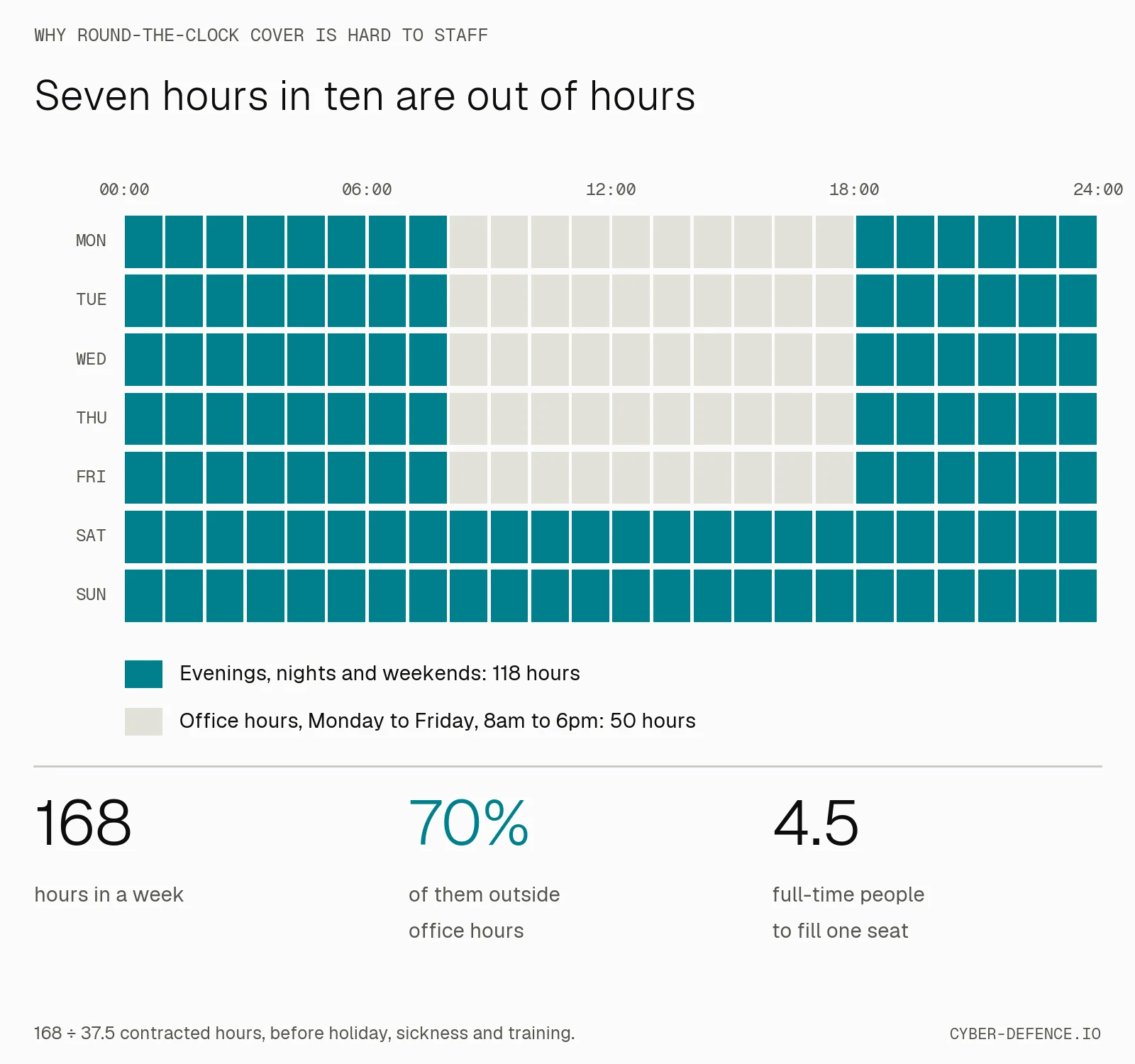
A week has 168 hours and a full-time contract covers about 37.5 of them, so keeping one analyst's chair occupied day and night takes 4.5 people before anyone takes a holiday, falls ill or goes on a course. In practice it takes five or six, and a SOC needs more than one chair.
| In-house SOC | Managed SOC | |
|---|---|---|
| People | Five or six analysts per seat, plus engineers and a manager, all to recruit and keep | A shared team you do not have to hire, with a named contact |
| Time to full cover | Many months of hiring, tooling and tuning | Weeks |
| Typical annual cost | £250,000 to £400,000 for an organisation of 50 to 100 staff, which buys a small team without full night cover; £700,000 to £1 million for 250 to 1,000 | Usually priced per device or per user; ours is £12,000 a year for 100 devices and £28,800 for 300, plus VAT |
| Knowledge of your business | Deep, and builds over time | Has to be built at onboarding and kept current |
| Breadth of experience | One estate | Patterns seen across many clients at once |
| Control | Complete | Shared: you agree in advance what the provider may do |
| Suits | Large or heavily regulated organisations able to recruit and retain specialists | Most organisations below about a thousand staff |
The in-house figures come from our guide to managed SOC costs in the UK, which sets out the working. There is also a middle route, the co-managed or hybrid SOC, in which your own security staff work office hours on the same platform as a provider who covers nights, weekends and overflow. It suits organisations that already have a small security team and want to keep its knowledge.
Whichever model you choose, a board should expect the same things of it: evidence of what was seen and done, response times that are measured, and a clear answer to what happens if you leave. Our article on what a board should expect from a SOC provider lists them, and regulated firms will want to read how a SOC supports FCA, DORA and NIS2 obligations.
A managed SOC in practice: SOC365
SOC365 is our own managed SOC, and it shows how the outsourced model works day to day. It is a CREST-accredited service run under ISO 27001 and ISO 9001 certified processes.
Collection. We deploy our own agents, take the feeds your existing tools already produce, or read from the SIEM or Microsoft Sentinel you already run. Replacing what you own is rarely necessary.
Detection. The Wazuh manager is the signal and alert engine, Graylog takes the place of the Wazuh indexer as the store of client data, and the front end is our own portal, Pulse, which your team signs in to as well. If you run Wazuh yourselves, the same engineers offer Wazuh consulting.
Analysis. EmilyAI, the AI SOC analyst we have run in live service since April 2018, reviews every client's data hour by hour, runs a structured threat hunt each morning and raises tickets with the evidence attached. Our engineers check her assertions and correct her where she is wrong.
Response. Clear-cut attacks are blocked automatically at the firewall and on blocklists. Isolating a machine or locking an account is decided by an analyst, with your approval or under authority you have agreed in advance.
The figures for August to October 2026 give a sense of scale. The SOC analysed 6.7 billion log events and opened 63 investigations. Forty per cent of those began outside UK office hours, all four of the top-priority ones were picked up within four minutes, and about three in four ended with a confirmed, legitimate explanation sent to the client with the evidence. That last number is the service working as intended: the question "is that anything?" was answered by somebody qualified, at the time.
SOC365 is priced per device per month on a published scale: £12 for up to 50 devices, £10 up to 150, £8 up to 500, £6 up to 1,500 and £5 beyond that, plus VAT. A firm with 120 devices pays £1,200 a month. The estimator on the SOC365 page does the sum for your own numbers.
Does your organisation need a SOC?
Not every organisation does, and size is a poor guide. The government's Cyber Security Breaches Survey 2025/2026 found that 43 per cent of UK businesses identified a breach or attack in the previous twelve months, rising to 65 per cent of medium-sized businesses and 69 per cent of large ones. Phishing was the most common kind by a wide margin, and most attempts end at the inbox. The question is who would notice the one that did not.
A SOC is worth having when nobody would see a problem outside office hours, when a customer, insurer or regulator is asking how you are monitored, when a day without systems would be expensive, or when you hold money or data belonging to other people. We have turned those into seven questions that settle whether a business your size needs a SOC. If the answer is no, the money is better spent on Cyber Essentials, multi-factor authentication and backups that have been tested. Our reading of the NCSC Annual Review 2026 reaches the same conclusion: the defences that stop most attacks are already known. A regular penetration test is also a sound way to find out whether the monitoring you have would notice a real intruder.
Frequently asked questions
What does SOC stand for? Security operations centre. In cyber security it means the team and systems that monitor for attacks and respond to them. It is unrelated to SOC 2, which is an audit report, and to "system on a chip" in electronics.
What does a SOC do? A SOC collects security data from across an organisation, detects suspicious activity, investigates it and contains anything that proves to be an attack. It does this continuously, including nights, weekends and holidays.
What is the difference between a SOC and a SIEM? A SIEM is software that gathers logs and raises alerts. A SOC is the team that reads those alerts, decides what they mean and acts. A SIEM without a SOC records an attack; it does not stop one.
Is a managed SOC the same as MDR? Very nearly. Both mean a provider's analysts detecting and responding on your behalf. The useful differences lie underneath the labels: what the service can see, whether a person reviews every alert, and what the provider is allowed to do.
How much does a SOC cost in the UK? Building an in-house SOC typically costs from £250,000 a year for a small organisation to between £700,000 and £1 million for one of 250 to 1,000 staff. A managed SOC is usually priced per device or per user: SOC365 costs between £5 and £12 plus VAT per device per month.
Does a small or medium-sized business need a SOC? It depends less on size than on exposure: whether anyone would notice a problem out of hours, whether customers or insurers ask about monitoring, and whose data you hold. Many firms of fifty staff need one; some larger ones do not.
Can AI replace SOC analysts? No. AI is good at the first pass over an alert: gathering context and forming a view at any hour. Deciding what to do, and being accountable for it, remains a person's job.
Next steps
If you are weighing up a managed SOC, three things will move the decision along. Put your device count into the estimator on the SOC365 page to see the monthly figure. Download our free checklist of twenty questions to ask a SOC provider, which shows what a good answer looks like, and score every provider against it, ours included. And if you would like to talk it through with someone who runs one, book a thirty-minute call.
Written by

Founder and Head of Threat Disruption
Founder of UK Cyber Defence. Former CISO for FTSE 250 organisations and for Microsoft Europe; founded Hedgehog Security in 2009.
Next step
Want this looked at in your own estate?
Thirty minutes with an analyst, not a salesperson. We will tell you whether it matters to you and what to do first.
Related insights
Iranian state spyware ‘CHOSEN BRICK’: what it does and what to do
The NCSC, FBI and AIVD have exposed Iranian spyware (CHOSEN BRICK) used to surveil dissidents, activists and journalists. What the campaign does, who is really at risk, and the practical steps that protect the people targeted and the organisations around them.
How Alert Fatigue Destroys Security Teams, and How Managed SOC Solves It
Why security teams drown in alerts, what it costs in missed attacks and lost analysts, and how a managed SOC reduces the noise through tuning, correlation and triage.
What is a managed SOC, and what does SOC as a service cost in the UK?
A managed SOC is a security operations centre you subscribe to rather than build. Here is what you are actually buying, what it costs in the UK compared with building your own, how the market prices it, and how to choose a provider you will not regret a year later.