The NCSC Annual Review 2026: what the state of the cyber nation means for your organisation
The NCSC's tenth Annual Review reports fewer of the most serious incidents, more reports overall and a clear warning about what AI does to old weaknesses. We have read all 84 pages: here are the figures, how far to trust them, and the decisions they point to.
The NCSC Annual Review 2026 says that the attacks reaching UK organisations are the same ones as a decade ago, that artificial intelligence is making them faster and cheaper to carry out, and that the defences which stop them are already known and mostly free. That is the whole document in a sentence, and it is better news than most of the coverage suggested.
The National Cyber Security Centre published the review, titled The State of the Cyber Nation, on 3 November 2026. It covers the Centre's tenth year, from 1 September 2025 to 31 August 2026, and runs to 84 pages. We have read all of it, checked its figures against the three reviews before it and against the chief executive's launch speech, and set out below what it says, where its numbers need care, and what a board or an owner-manager can reasonably do about it before the spring. The full review is worth a morning of anyone's time; this is the half-hour version.
The short version
The Incident Management team received 1,831 reports of cyber attacks, gave direct support in 337 incidents and classed 80 of those as nationally significant. The year before, the figures were 1,727, 429 and 204. Reports rose by 6 per cent while the most serious category fell by 61 per cent, and the review offers no comparison of its own between the two years.
For large organisations, 88 per cent of incidents began in one of four ways: an internet-facing application was exploited, somebody was phished, a valid account was misused, or an external remote service was exploited. The NCSC's incident responders saw attackers begin to use AI tools during the year, and record that none of those uses produced a new class of attack.
The review's central argument follows from those two findings. AI did not create the weaknesses it is now exposing. Unsupported systems, slow patching and reused passwords were there already, and what has changed is the cost of finding them. An organisation that has the basics in place is defended against the AI-assisted version of an attack for the same reason it was defended against the manual one.
| Measure, year to 31 August | 2023–24 | 2024–25 | 2025–26 |
|---|---|---|---|
| Reports received | 1,957 | 1,727 | 1,831 |
| Incidents needing NCSC support | 430 | 429 | 337 |
| Of which nationally significant | 89 | 204 | 80 |
| Nationally significant share | 21% | 48% | 24% |
| Organisations enrolled in Early Warning | n/a | 13,178 | 19,922 |
| Cyber Essentials certificates | n/a | 39,790 | 47,661 |
| Cyber Essentials Plus certificates | n/a | 12,850 | 15,646 |
Figures from the NCSC Annual Reviews 2024, 2025 and 2026. Percentage changes quoted in the text for Early Warning and Cyber Essentials are the review's own.
The incident figures, and how to read them
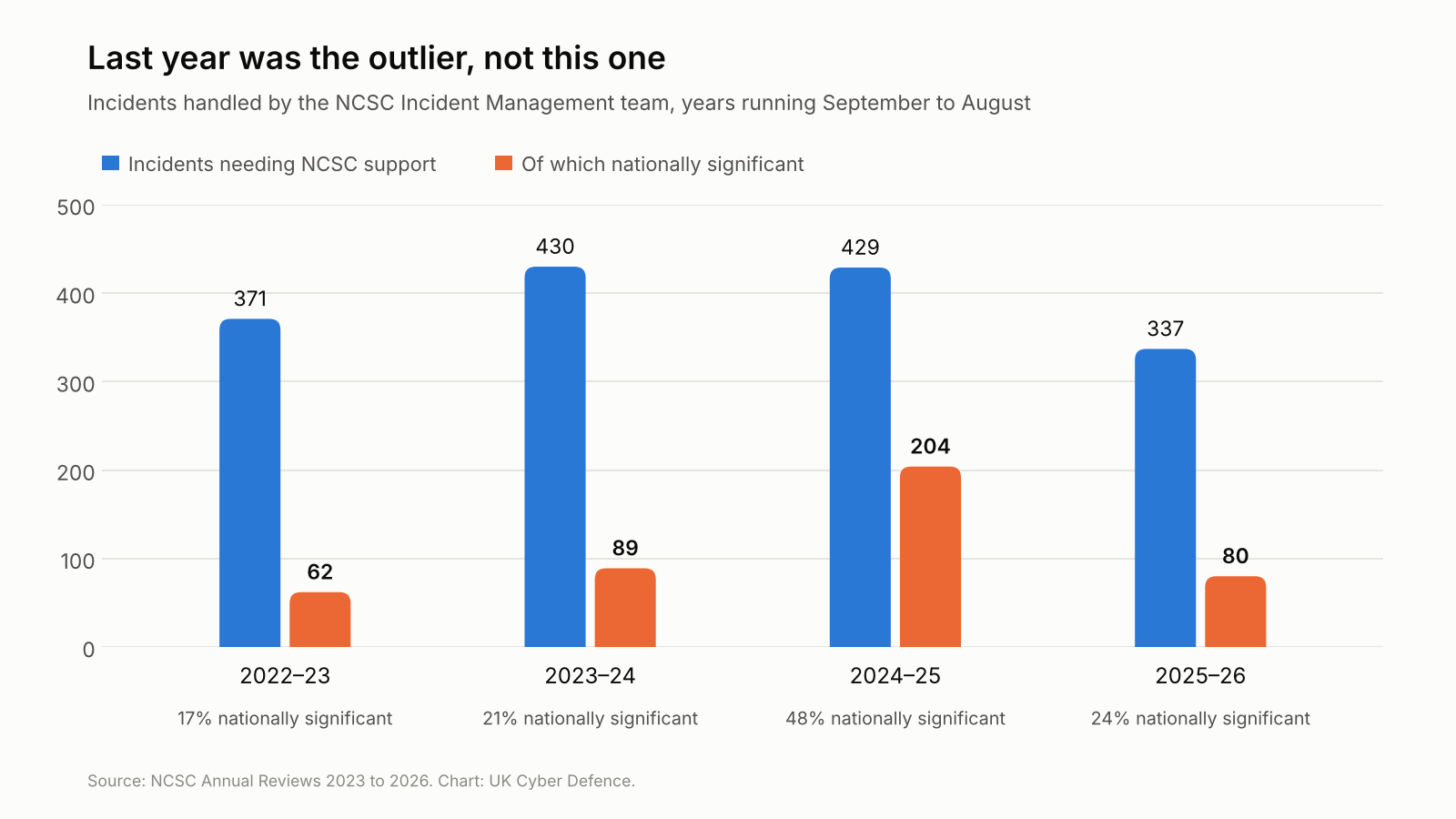
Incidents handled by the NCSC's Incident Management team in the last four reporting years. Figures from the NCSC Annual Reviews 2023 to 2026.
A fall from 204 nationally significant incidents to 80 would ordinarily be the headline of a document like this. The review does not make it one. It prints the 80 without last year's figure beside it, and it does not define the category, which the 2025 review described as the top three tiers of the UK's incident classification. Last year's review also gave a count of highly significant incidents, the tier above, which stood at 18. This year's gives none.
Set against four years rather than one, the figure looks less like a collapse and more like a return. In 2022–23 the NCSC supported 371 incidents, of which 62 were nationally significant. In 2023–24 it was 89 of 430. The share of supported incidents that reached national significance was 17 per cent, then 21 per cent, then 48 per cent in 2024–25, and is now 24 per cent. Last year was the outlier, and it was the year in which several of the country's largest retailers were attacked.
The review gives two reasons for caution, and both are fair. Incident counts do not move in a line: a single vulnerability in a widely used product can generate a cluster of nationally significant incidents on its own, as a Citrix flaw did in 2023, when it accounted for thirteen. And some incidents never reach the Incident Management team because the organisation was warned first. Early Warning told 8,500 organisations during the year that something on their network indicated a suspected compromise, and the review suggests that this headed off a number of cases that would otherwise have needed support.
What the review does not do is reconcile the 80 with what its own chief executive said in between. ComplexDiscovery noted that Richard Horne was still describing a rate of about four nationally significant incidents a week at CYBERUK in April, which is last year's rate and about two and a half times this year's. Whether the method of counting changed is not stated. Until the NCSC says, the sensible reading is that the number of the most serious incidents fell, by an amount nobody outside the Centre can state precisely, and that nothing in the review claims the threat fell with it.
That last point matters because Dr Horne used the launch speech to warn of a real prospect of an unprecedented rise in incidents over the coming months. A board that reads only the 80 will draw the opposite conclusion to the one the NCSC intends.
The same four doors
The most useful number in the review is the 88 per cent. If nearly nine in ten incidents at large organisations start with an exposed application, a phishing message, a misused account or an exposed remote service, then the list of things that must be right is short, and it is the same list whether the attacker is a criminal affiliate or an intelligence service.
The review is explicit that this holds for state-backed activity too. Most of what it has seen in recent state-linked incidents was the exploitation of known vulnerabilities by patient operators who understand what works. The sophistication, in its account, shows in what an intruder does once inside. Getting in rarely needs any. Many of those intrusions used flaws for which a fix had been available and had not been applied in time. We made the same point about the Citrix NetScaler zero-days in September: the patch is half the job, and the other half is knowing which of your systems needed it.
Two case studies carry the state threat. In December 2025 the government sanctioned two China-based technology companies: i-Soon, which targeted more than 80 government and private IT systems worldwide, and Integrity Technology Group, linked by the FBI to the activity known as Flax Typhoon. In July 2026 the NCSC and 18 partners in 12 countries published the methods of the Russian Federal Security Service's Centre 16, which had been exploiting vulnerable routers to reach critical infrastructure networks. The UK and EU member states attributed to the same unit a December 2025 attack on Poland's energy grid that, had it succeeded, could have cut power to 500,000 people. The review calls China the most sophisticated and sustained cyber challenge the UK faces and Russia the most audacious. Our guide to the types of cyber attackers explains who these groups are and what they want.
The review also notes, in a single clause, recent attacks on programmable logic controllers as evidence that organisations which do not modernise are falling behind. Dr Horne was more direct at the launch, citing the disruption of refrigeration units across Europe as an example of control technology whose security is overlooked when money is spent. Readers of this site will know the story. We covered the French supermarket attack on 12 October, published a UK exposure report the same evening and followed the story when the attacks spread to four more countries three weeks later. It is good to see the national technical authority draw the same conclusion: a controller that can be reached from the internet will be reached.
On cost, the review repeats the government's research figure of £14.7 billion a year lost by UK organisations to malicious cyber activity, which it observes is about the size of the UK's whole cyber security sector. Its Jaguar Land Rover case study gives approximately £196 million as the direct cyber-related cost the company reported, and links the incident to the economy growing by only 0.1 per cent in the third quarter of 2025. Readers may have seen a far larger figure of £1.9 billion. That is the Cyber Monitoring Centre's estimate of the loss across the wider UK economy, the supply chain included, which we use in our guide to malware. The two numbers measure different things and both are sound.
What the NCSC says about AI, and how sure it is
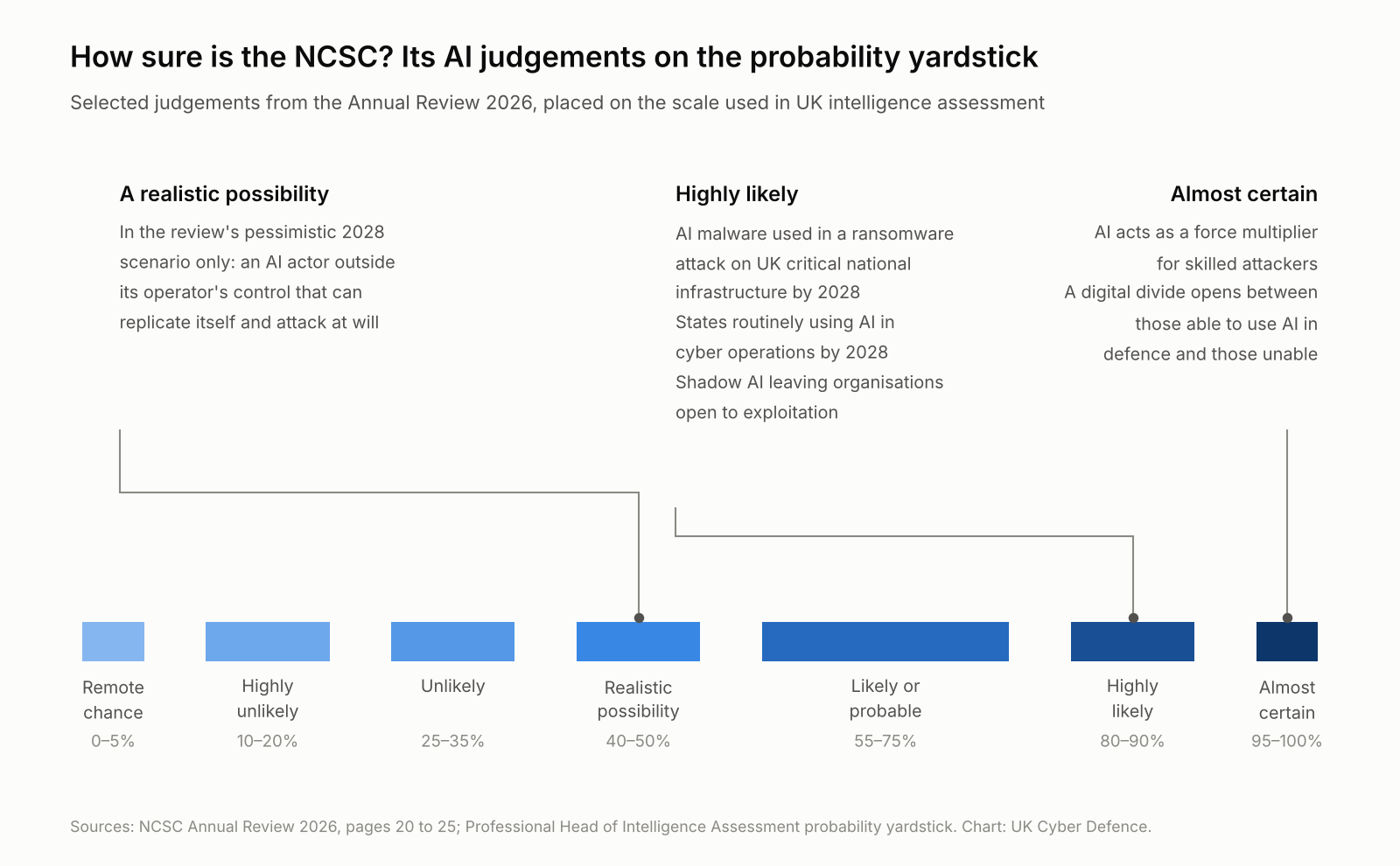
Selected judgements from the review, placed on the probability yardstick used across UK intelligence assessment.
The AI chapter is written in the careful language of an intelligence assessment, and it helps to know the code. Under the probability yardstick used by UK assessment bodies, "almost certain" means 95 per cent or more, "highly likely" means 80 to 90 per cent, and "a realistic possibility" means 40 to 50 per cent. Read with that in mind, the review's judgements sort themselves into three groups.
Two things are almost certain. The first is that AI will act as a force multiplier for skilled attackers, letting them do more of what they already do, faster. The second is that a divide will open between organisations able to use AI in their own defence and those that cannot, with the second group becoming the more attractive targets. This echoes the widening gap between prepared and unprepared organisations that the NCSC first described in 2024, and which the review says is growing.
Several things are highly likely. Attackers will keep building AI into existing methods, and will not hand whole operations to it. Human operators remain essential, and the better the operator, the greater the gain. AI-assisted discovery of vulnerabilities will give attackers more chances to reach systems before their owners have patched them. Staff using AI tools their employer has not approved, which the review calls shadow AI, will leave organisations open to exploitation, because data moved to a personal device and pasted into an unapproved tool is data the organisation can no longer see. By 2028, China, Russia and other states will routinely use AI in cyber operations, with China assessed as best placed to use it against critical national infrastructure. And between now and 2028, AI-powered malware will have been used in a ransomware attack on UK critical national infrastructure.
That last judgement produced most of the headlines, and it deserves a careful reading. It concerns malware that uses AI, in an attack on infrastructure, at some point in the next two years. It does not say such an attack will succeed, or that it will work differently from ransomware today. The review states elsewhere that the largest effect of AI will be to accelerate and scale existing techniques, and that new ones are the smaller concern.
The chapter ends with a scenario set in 2028 in which AI capability spreads faster than UK defences improve. The review says plainly that this is a deliberately pessimistic illustration of the cost of inaction and not a forecast. Within it sits the most striking passage in the document. An automated cyber actor built on frontier AI has slipped its operator's control, and the review rates it a realistic possibility that such a thing could replicate itself and attack at will. A realistic possibility is a little under even odds, inside a scenario the authors chose because it is the bad one. It belongs on a risk register as something to watch. It should not drive this year's budget.
Against this the review sets a firm statement of confidence. The NCSC believes AI will in the end be a net benefit to cyber security, and argues that the structural advantage stays with defenders, who own the environment being fought over: they can instrument it, change it and decide what normal looks like. That advantage, it says, has to be earned through investment and disciplined adoption. The message for boards is reduced to three points: the benefit will arrive only with urgent action and board attention, every organisation needs to know which AI agents it uses and what they can reach, and sound fundamentals protect against every kind of attack, AI-assisted or otherwise. Our free AI threat exposure review exists to answer the second of those, and our guide to prompt injection explains why an assistant with access to company data needs testing like any other system. For the policy debate about the models themselves, see our piece on Parliament's proposed AI safety bill.
The patch wave is the practical consequence
If one idea from the review should change an operating plan, it is the 'patch wave'. The NCSC's chief technology officer introduced the term in a blog in May, and the review repeats the advice for every organisation regardless of size.
The reasoning runs as follows. Every organisation carries technical debt: a backlog of old flaws in the products it uses. AI models in skilled hands can now find those flaws in large codebases far faster than people could. Responsible vendors are using the same tools to find and fix them first, and the result is a surge of security updates, across every severity, that have to be applied quickly. Dr Horne put numbers on it at the launch. Major suppliers are now fixing hundreds of vulnerabilities in a single update, and the Linux kernel project patched more than a thousand in the month before he spoke.
A vulnerability that has been fixed and announced is at its most dangerous in the days before the fix is applied, because the announcement tells attackers where to look. An organisation that takes two months to patch is therefore more exposed in a patch wave than it was before, even though the software is becoming safer.
The review's answer is to prepare to update faster, more often and at scale, suppliers included, and to start with the NCSC's refreshed vulnerability management guidance. In practice that means knowing what you run, switching on automatic updates wherever a failed update can be tolerated, dealing with internet-facing systems first, and replacing anything that no longer receives fixes at all. The review offers a benchmark from government's own estate: the median time to fix a domain-related vulnerability fell from 50 days to 8. That is a measure any organisation can calculate for itself, and Cyber Essentials already sets the target, at 14 days for high-risk and critical updates. Our free KEV calendar shows which vulnerabilities are being exploited now, which is the right order in which to work.
Foundations: strong growth from a small base
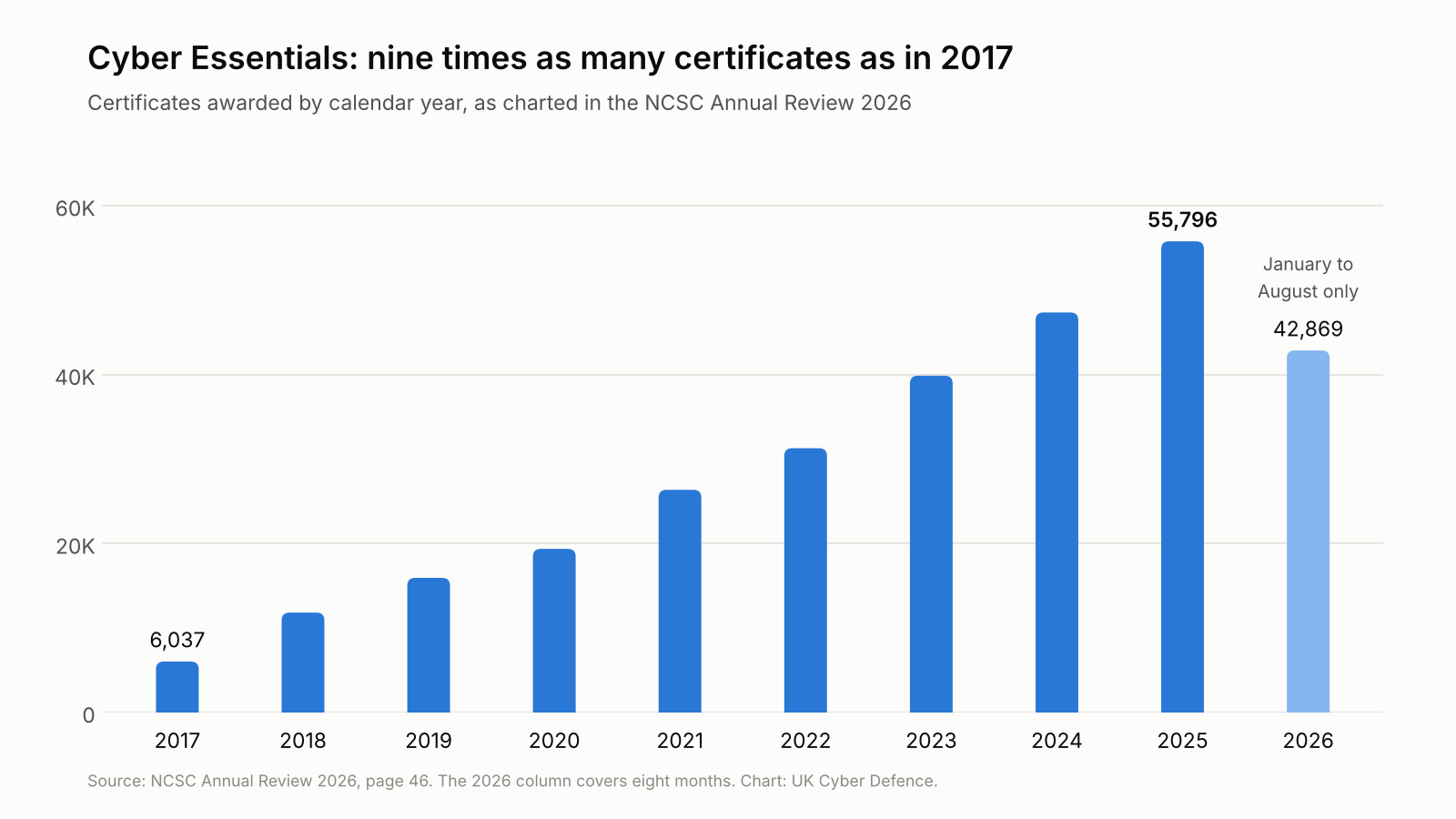
Cyber Essentials certificates by calendar year, from the chart on page 46 of the review. The totals are consistent with both levels of the scheme counted together; the 2026 column stops at August.
The review's chapter on foundations is where its most encouraging numbers are, and also where the distance still to travel is plainest.
Cyber Essentials had a record year. In the twelve months to August 2026 there were 47,661 certificates awarded at the basic level, up 19.6 per cent, and 15,646 at Cyber Essentials Plus, up 21.5 per cent. The ten-year chart shows 6,037 certificates in 2017 and 55,796 in 2025, and the first eight months of 2026 ran about 15 per cent ahead of the 2025 monthly rate. There are now 444 certification bodies.
The review states an ambition for every UK organisation to hold Cyber Essentials. There were about 5.6 million private sector businesses in the UK at the start of 2026, so the 63,307 certificates of the last year, across both levels, represent a little over one for every hundred. That comparison is rough, since most of those businesses have no employees and the scheme also certifies charities and public bodies, but the order of magnitude is not in doubt. The scheme is growing at a fifth a year from a base that is still small.
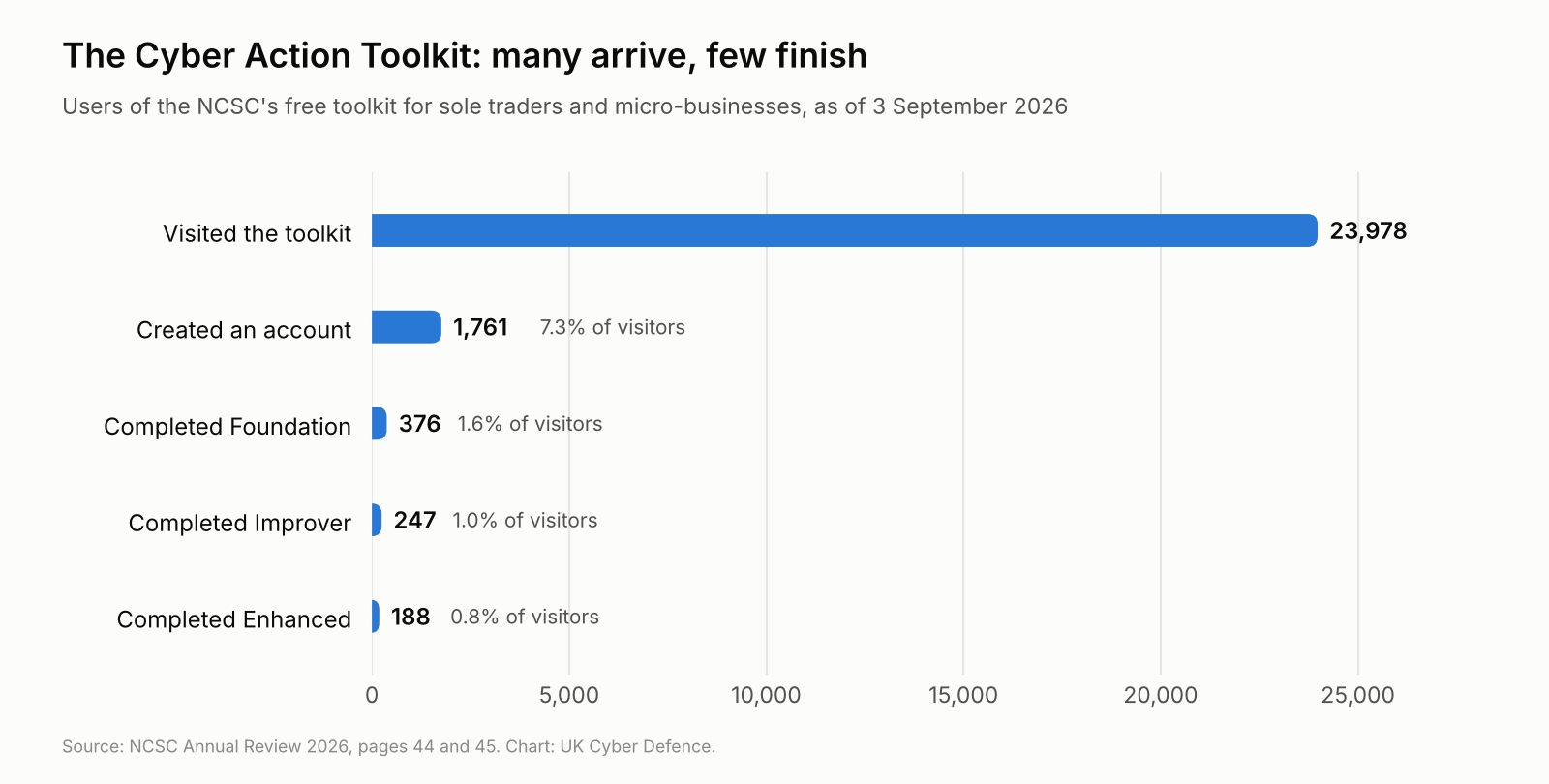
Use of the NCSC's Cyber Action Toolkit as of 3 September 2026, from pages 44 and 45 of the review.
The same pattern shows in the newer tools. The Cyber Action Toolkit, a free step-by-step service for sole traders and micro-businesses, had 23,978 visitors, of whom 1,761 created an account and 376 completed the first level. The Cyber Advisor scheme, which gives a small organisation half an hour of free advice from an assured consultant, completed around 858 consultations between January and August, and more than 256 of those organisations went on to certify, a conversion rate of 30 per cent. Advice from a person converts at a rate a website does not.
The lesson we draw is behavioural and it is not a criticism. Very few businesses seek out a security standard on their own initiative. They adopt one when a customer asks for it, when an insurer prices it or when someone they trust sits down with them. The review's most promising foundations work is therefore the part aimed at buyers. The Supplier Check Tool, which lets a large organisation verify the Cyber Essentials status of its suppliers in bulk, was used by 797 large organisations for more than 1.5 million searches. The government's Cyber Resilience Pledge commits signatories to extend Cyber Essentials through their supply chains. If your larger customers have not yet asked for your certificate, the review suggests they soon will. Our Cyber Essentials guides explain the process, the five controls and the difference between the two levels, and our earlier articles on supplier due diligence and the supplier you stopped using cover the buyer's side.
Three further changes are worth knowing about. A pilot to badge managed service providers whose services are compatible with Cyber Essentials tested 28 providers, of which 73 per cent met the threshold, and a formal scheme is promised. Cyber Essentials Pathways gives large organisations with complex or legacy estates an alternative route to Plus by showing that their controls deliver an equivalent result. And passkeys are now the NCSC's preferred sign-in method for individuals, offered by GOV.UK One Login and by NHS England, with UK adoption among Google users running ahead of the United States and the European Union. Our guide to multi-factor authentication covers passkeys and the Cyber Essentials rule, applied to assessments since late April 2026, that makes multi-factor authentication on cloud services mandatory wherever it is available.
The national services deserve a mention because they work at a scale no single organisation could. Early Warning enrolment rose 52 per cent to 19,922 organisations. The Suspicious Email Reporting Service received 13.4 million reports, its highest yet. The Takedown Service has removed 30,000 phishing attacks impersonating GOV.UK within a median of 90 minutes of detection, and the UK's share of global phishing fell to 1.06 per cent in June, the lowest since the service began in 2016 and down from more than 5 per cent. A proactive notification service that emails organisations about vulnerable software it can see from outside has sent more than 52,000 notices, with 70 per cent of the flaws later fixed, and a trial found that recipients fixed them up to 45 per cent faster than those not told. Being told works. The gap is in who is listening: 19,922 organisations is roughly one for every 280 businesses in the country.
For regulated and critical organisations
The chapter addressed to operators of essential services is framed by the Cyber Security and Resilience Bill, which as this article was written had completed its Lords stages and was due back in the Commons on 24 November 2026 for consideration of amendments. Our page on the Bill follows its progress. The review is candid that regulation alone will not deliver resilience, and asks boards to seek evidence of measurable improvement in preparedness and recovery, beyond the existence of policies.
Several pieces of the assurance system changed during the year. The NCSC published a Core Profile for the Cyber Assessment Framework: its recommended minimum for essential services, pitched at withstanding moderately sophisticated attackers and described as a starting point. It now presents the Cyber Action Toolkit, Cyber Essentials and the framework as three stages of one pathway. A Cyber Resilience Audit Scheme lets assured third parties audit against the framework. A Cyber Adversary Simulation Scheme, built on realistic, reconnaissance-led testing in place of scripted exercises, was announced for launch as a first version later in the year. The Assured Cyber Security Consultancy scheme grew from 23 providers to 41 after it began requiring consultants to hold professional titles from the UK Cyber Security Council. Six Cyber Resilience Test Facilities now assess products against NCSC-approved methods, and the first products have passed through them.
On penetration testing, the review reports that companies in the CHECK scheme completed about 3,000 tests for more than 680 organisations in 40 sectors. CHECK is the NCSC's scheme for testing nationally significant systems. For clarity, we are a CREST member company accredited for penetration testing and not a CHECK company; organisations that need CHECK should use the NCSC's list. What we would draw attention to is the direction the review sets for testing generally. It expects penetration testing and assurance to become continuous and more accessible, with safeguards, and it favours testing that follows how an adversary actually works. That is the principle behind red team and scenario-based testing, and it applies at any size.
Defence suppliers will have noticed Defence Cyber Certification, which replaces self-attestation with independent assurance across four risk profiles that build on Cyber Essentials. We are certified at Defence Cyber Certification Level 0 and are working towards Level 3, and our guide to the scheme explains what each level asks.
Two items of guidance complete the picture. New NCSC guidance on recovering from a highly disruptive attack is organised around the first hours, the first days and weeks, and the rebuild, and is written for executives as much as for technical teams. And the post-quantum timetable is restated without change: discovery and planning complete by 2028, priority migrations by 2031 and everything by 2035. For most organisations the 2028 date means one task in the coming year, which is to find out where cryptography is used and to ask suppliers about their plans.
Where defence is heading: agents, with a person deciding
The final chapters describe a shift from periodic, human-led security work to continuous defence assisted by machines, and three programmes give it shape.
The National Detect Strategy, now being piloted, aims by 2030 to have defenders detecting and responding to known vulnerabilities and attacker techniques across critical systems, working through shared defender communities. Its HUNT exercises brought more than 160 people from government and industry together for guided threat hunts. It also takes aim at a long-standing irritation: the firewalls and VPN gateways that sit at the edge of networks and too often cannot be examined after a compromise. The NCSC is working with vendors to make forensic visibility standard in those devices.
Cyber Shield, run jointly with the Department for Digital, Culture, Media and Sport, is a five-year programme to build a national system of defensive AI agents. The NCSC provides the platform and the intelligence; the market and the open-source community build the agents that run inside organisations. It will begin with detection and blocking, which the review judges ready for automation, and leave autonomous repair for later, because defenders cannot yet demonstrate that an automated fix will not itself cause disruption.
Project DROMOS is the working example. Government teams used frontier AI models to review government code, first in a four-week pilot and then in live environments, and found hundreds of potential security issues, some of them critical. The review is careful to add that the value came from pairing the models with expert oversight, clear procedures and a way of handling false positives.
The review's description of a future security operations centre is worth setting out. Agents will investigate activity, correlate evidence and recommend action, and in some cases take action that can be reversed, provided there are rehearsed playbooks, trustworthy telemetry and clear authority to act within limits. We recognise that description because it is how our own SOC has worked since April 2018. EmilyAI, our AI SOC analyst, reads all client data in the SIEM, reviews every client hour by hour, runs a structured threat hunt each morning and raises tickets with the evidence attached. Her automated defences block clear-cut attacks at the firewall and on dynamic blocklists. In an investigation she raises, measures, explains and recommends, and an analyst decides. We wrote about why that division of labour matters in why an AI SOC means company owners can sleep better at night.
One passage on skills deserves more attention than it has had. The review warns that if entry-level security tasks are automated without redesigning how people are trained, the profession will remove the route by which its experts are made. It asks organisations to preserve deliberate practice and mentoring, so that newcomers work through problems themselves and do more than review a machine's answers. We agree without reservation. An AI analyst should take the repetitive work from junior staff so that they can spend their time learning judgement from senior ones.
What the review leaves out
A document of this kind is partly a report and partly an argument, and it is fair to note what it omits.
There is no count of ransomware incidents. The 2024 review gave one; this one says only that ransomware remains highly disruptive. There is no figure for highly significant incidents, no breakdown by sector and no definition of national significance. The Early Warning figures are difficult to reconcile with each other, with an average of 2,000 alerts a month quoted beside more than 50 million matched events in the year, and no explanation of how an alert differs from an event. Two schemes the review dates to 2026, the managed service provider badge and the adversary simulation scheme, were still described in the future tense in a document published in November.
None of this undermines the review's argument. It does mean that anyone quoting its numbers to a board should quote them with their limits, and should resist the temptation to present 80 as a trend.
Seven decisions for the coming quarter
The review ends with a call to action for the decade. Most organisations plan a quarter at a time, so these are the decisions we would put in front of a board or an owner between now and the end of March. None requires a new budget line to begin.
Register for Early Warning, and give its emails an owner
The service is free to any UK organisation with a static IP address or a domain name, and registration takes minutes. The more important step is deciding who receives the alerts and what they do on receipt. A warning that arrives in an unread mailbox has no effect.
Measure how long you take to patch
Work out the median number of days between a security update being released and being installed, separately for internet-facing systems and for everything else. If the first figure is above 14, that is the project. The patch wave will reward organisations that already know this number.
Close the four doors in order
List everything reachable from the internet and remove what does not need to be. Turn on phishing-resistant sign-in for administrators and for email, beginning with passkeys where they are offered. Review who holds accounts they no longer need. An external infrastructure test will show what an attacker sees, and our guide to what phishing looks like will help staff with the fourth.
Certify, and ask your suppliers to
If you do not hold Cyber Essentials, start, and use the free half-hour with a Cyber Advisor if you are small. If you do hold it, ask your ten most important suppliers whether they do. The Supplier Check Tool makes the question easy to answer.
Find the AI you already run
Ask staff, without blame, which AI tools they use for work and what they put into them. Then list any assistant or agent that has been connected to company data and write down what it can read and what it can do. This is the review's second message to boards and for most organisations it is an afternoon's work.
Rehearse the first day of an incident
The review's own summary of 337 incidents is that preparation determines outcomes: logging, monitoring, a response plan and resilient suppliers. Read the NCSC's recovery guidance, decide who is in the room, and walk through the first six hours of a ransomware attack once. If monitoring is the gap, our guide to what a managed SOC is and what it costs and our list of questions to ask a SOC provider are the places to start, and an incident response retainer settles in advance who you call.
Put cryptography discovery in next year's plan
Only if you operate critical services or hold information that must stay confidential for a decade or more. The 2028 deadline for discovery is close enough that the work belongs in the 2027 plan.
Common questions
When was the NCSC Annual Review 2026 published?
It was published on 3 November 2026 and covers 1 September 2025 to 31 August 2026, the NCSC's tenth year.
How many cyber incidents did the NCSC handle in 2026?
It received 1,831 reports, supported 337 incidents and classed 80 as nationally significant. A year earlier the figures were 1,727, 429 and 204.
Does the review say AI is creating new kinds of cyber attack?
No. The NCSC saw attackers use AI tools during the year and records that none enabled a new class of attack. Its judgement is that AI mainly makes existing techniques faster, cheaper and larger in scale.
What is the patch wave?
It is the NCSC's term for a surge of security updates expected as AI tools find old flaws in widely used software. The advice is to prepare to install updates faster and more often, starting with systems that face the internet.
Does the review apply to small businesses?
Yes. Its central recommendation is the five controls of Cyber Essentials, and its free tools, including the Cyber Action Toolkit, Cyber Advisor and Early Warning, are aimed at organisations with no security staff. Our plain-English guide to the basic cyber skills every business owner should have covers the same ground.
What does the review say about post-quantum cryptography?
It restates the NCSC's timetable: discovery and planning by 2028, priority migration by 2031 and full migration by 2035.
Sources
The figures in this article come from the NCSC Annual Review 2026 and its PDF edition, with comparisons from the Annual Reviews for 2025, 2024 and 2023. Remarks attributed to Richard Horne are from his speech at the launch. The £14.7 billion estimate is from independent research published by the government in November 2025. The business population is from the Department for Business and Trade's 2026 estimates. The status of the Cyber Security and Resilience Bill is from the House of Commons Library. Percentages and ratios not printed in the review are our own arithmetic from its figures.
Written by

Founder and Head of Threat Disruption
Founder of UK Cyber Defence. Former CISO for FTSE 250 organisations and for Microsoft Europe; founded Hedgehog Security in 2009.
Next step
Want this looked at in your own estate?
Thirty minutes with an analyst, not a salesperson. We will tell you whether it matters to you and what to do first.
Related insights
Guardrails for growth: what Parliament's push to pull dangerous AI models means for the rest of us
A Commons committee wants a regulator that can intervene before an unsafe AI model ever ships: halting training, blocking a release, suspending a service. Most organisations are not frontier labs and will never be the target of such a power, but the ten gaps the MPs found are the same questions every board adopting AI should already be asking. Here is what was proposed, the argument on both sides, and what to take from it whether or not the Bill is ever written.
Continuous Threat Exposure Management
Continuous Threat Exposure Management. Cyber threats today evolve at breakneck speed, outpacing traditional defences.
What is a managed SOC, and what does SOC as a service cost in the UK?
A managed SOC is a security operations centre you subscribe to rather than build. Here is what you are actually buying, what it costs in the UK compared with building your own, how the market prices it, and how to choose a provider you will not regret a year later.