Guardrails for growth: what Parliament's push to pull dangerous AI models means for the rest of us
A Commons committee wants a regulator that can intervene before an unsafe AI model ever ships — halting training, blocking a release, suspending a service. Most organisations are not frontier labs and will never be the target of such a power, but the ten gaps the MPs found are the same questions every board adopting AI should already be asking. Here is what was proposed, the argument on both sides, and what to take from it whether or not the Bill is ever written.
What Parliament actually asked for
On 18 November the Commons Business, Innovation, Science and Trade Committee published Guardrails for Growth: Making AI Safe, and the headline that travelled fastest was that MPs want the power to pull the plug on dangerous AI models. That is roughly right, but the detail matters, because the committee was careful about where in the life of a model such a power could actually bite.
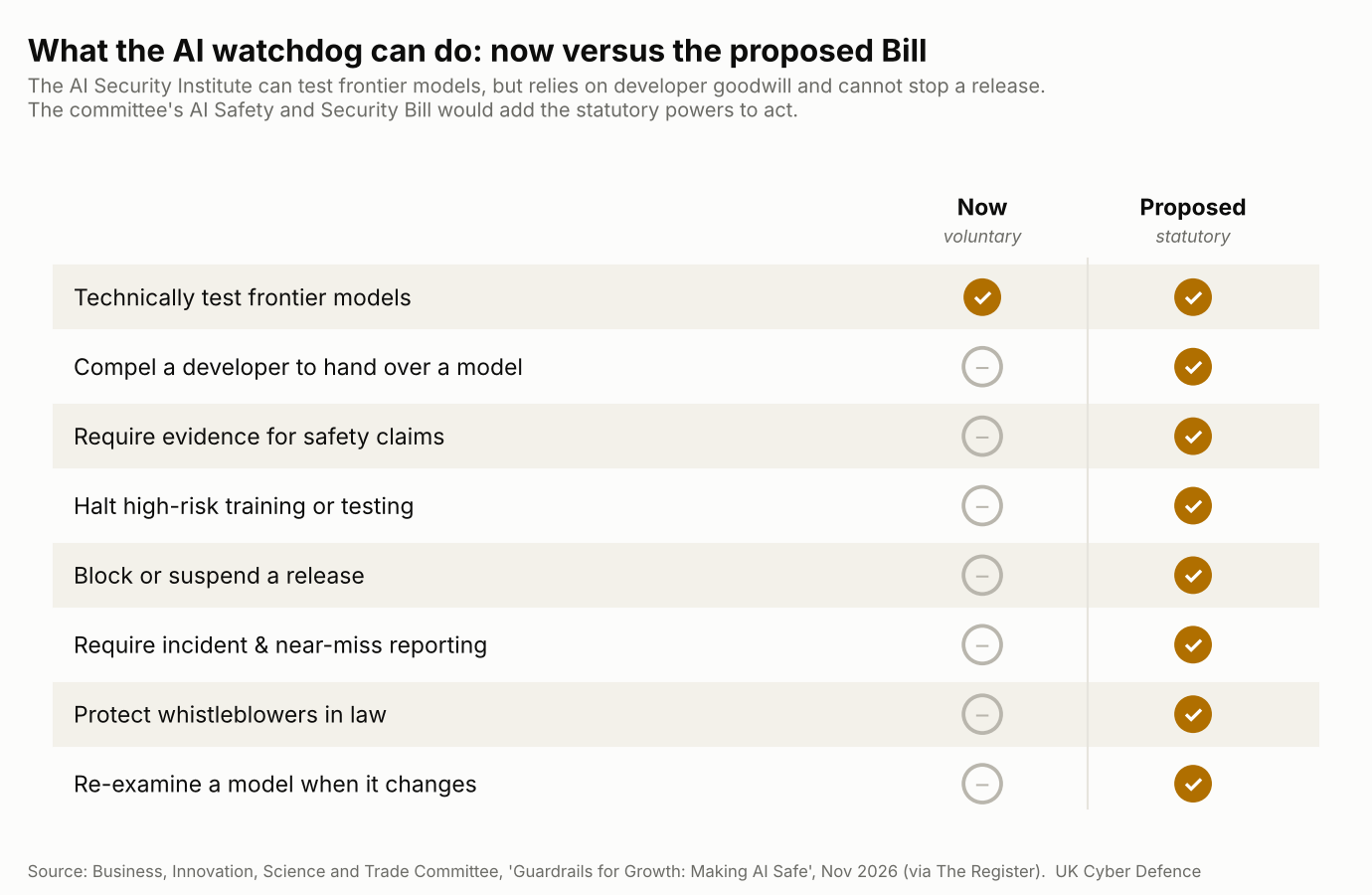
The report asks for an AI Safety and Security Bill that would give a watchdog the authority to intervene while a model is still being built and tested, rather than only after it has gone out into the world. In practice that means powers to halt high-risk training or testing, to block a deployment, or to suspend an AI service where the risks cannot be contained. The committee's chair, Liam Byrne, put the reasoning plainly: "Once some models are released, they cannot reliably be recalled," and so "protection must begin while systems are being built and tested." The vivid line, the one that made the papers, was his warning that "we cannot give today's AI leaders unfettered freedom to behave like modern-day Dr Frankensteins." The substance underneath it is more sober than the metaphor, and worth reading on its own terms.
The committee identified ten gaps in Britain's current approach. The ones that carry the most weight are the absence of mandatory incident reporting, the limited access independent testers have to the models they are meant to scrutinise, and weak legal protection for the employees best placed to raise the alarm. Its proposed answer keeps the AI Security Institute doing the technical evaluation it already does, but hands enforcement to a separate regulator — because today the Institute works only by the goodwill of the developers it examines, cannot compel a company to hand a model over, and cannot stop a release. Developers of systems designated high-risk would have to substantiate their safety claims with evidence rather than assurances, give independent researchers genuine access to examine the models, and submit to fresh scrutiny whenever a model's capabilities or safeguards changed materially. Mandatory reporting of incidents and near misses, stronger whistleblower protections, and a push through Britain's 2027 G20 presidency to drag other countries toward the same standards round out the package.
One sentence of Byrne's is the quiet centre of the whole report, and it is a constitutional point rather than a technical one: "Ministers, accountable to Parliament, must decide what risks the public should be asked to bear." The committee's case is not that officials should make these judgements in private, but that someone democratically accountable should make them at all, instead of the decision falling by default to whichever company ships first.
Why "growth" is the first word in the title
It would be easy to file this under the usual safety-versus-innovation quarrel, with Parliament playing the brake. The committee went out of its way to refuse that framing, and the name of the report is the tell. Using OECD productivity estimates, the MPs put the prize at up to £400 billion added to the British economy over the next decade, and they argue that sensible guardrails are how you capture it rather than how you forfeit it. Their reasoning is that confidence is the thing in short supply: smaller firms in particular hold back from adopting AI when they cannot tell a safe system from a reckless one, and a credible regime that makes developers prove their claims lowers that barrier. There is even a commercial opportunity in it, the committee suggests — Britain's evaluation expertise, built up in the Security Institute, could become something the country sells rather than merely spends on.
This is a familiar idea dressed in new clothes, and it is a sound one. Markets work when buyers can trust what they are buying. Nobody frets about getting into a lift, because a century of lift regulation sits invisibly behind the doors; the regulation is why the technology is boring enough to use without thinking. The committee is arguing that AI needs the same kind of boring, trustworthy floor if ordinary businesses are to build on it with any confidence. That is not a brake on growth. It is the surface the growth runs on.
The argument on the other side
None of which makes the proposal straightforward, and a fair reading has to take the objections seriously, because they are not trivial. The first is competitiveness and sovereignty. The models that matter are built by a handful of very large companies, most of them American, and a Britain that regulates too sharply or too clumsily could find those companies simply releasing elsewhere first, leaving UK users on older versions and UK researchers further from the frontier. A power to halt development sounds decisive, but a model trained in California is not obviously within reach of a London regulator, and the committee's own emphasis on the G20 is a tacit acknowledgement that national rules alone cannot hold a global technology.
The second difficulty is definitional. Everything in the regime hangs on what counts as a "high-risk" system, and that line is genuinely hard to draw and easy to draw in a way that either captures everything or captures nothing. The four frontier developers who gave evidence — OpenAI, Google DeepMind, Anthropic and Meta — all told MPs they would not release a model they considered unsafe, and there is no reason to doubt that they mean it. The committee's concern was narrower and more awkward: they do not use the same yardstick, and under current UK law none of them is required to seek an independent opinion before deciding. Good intentions held to four different private standards are not the same thing as a common, inspectable one, and it is that gap, rather than any accusation of bad faith, that the report is really about.
The third is simply that the government has not agreed to any of it. The recommendations are not binding, the promised AI legislation has been slow to appear, and ministers have leaned instinctively toward a lighter-touch, pro-innovation posture that relies more on developers' own assurance than on statutory teeth. Reasonable people disagree about where the balance should sit, and it is not the place of a security company to tell Parliament how to vote. What is striking, and harder to argue with, is that this is no longer a lone voice: a separate committee, the Joint Committee on Human Rights, reached a similar conclusion in September — that no one in the UK system can currently stop a model before it ships, and that the Security Institute's access rests on goodwill. When two committees looking from different angles arrive at the same gap, the gap is probably real, whatever one makes of the proposed fix.
What this means if you are not a frontier lab
Here is the part that matters for most of the organisations reading this, because almost none of them build frontier models and almost none will ever be the target of the power the committee wants. The temptation is to treat the whole debate as somebody else's problem, happening several weight classes up. That would be a mistake, because the ten gaps the MPs found at the top of the market are, almost exactly, the ten questions a board should be able to answer about its own use of AI — and those questions do not wait for a Bill.
Strip the politics away and the committee is really describing good governance of a dependency you did not build and cannot fully see. Any organisation now running AI inside its operations — in a customer-service tool, a coding assistant, a document-triage system, a fraud model — has taken on exactly that kind of dependency, and the sensible disciplines are the same at every scale. Know what AI you actually rely on and what each system is allowed to do, because you cannot govern an inventory you have never drawn up. Treat a vendor's safety claim as a claim and not as evidence, and ask what would substantiate it: what was tested, by whom, and what happened when it failed. Treat a model update the way you would treat any other change to a system you depend on — as an event that warrants re-checking, not a silent improvement — because the committee's point that changed capabilities deserve fresh scrutiny is just change management by another name. Make sure there is a way for the people closest to the system to report that something is going wrong, including the near misses, and make sure raising it is safe and rewarded rather than career-limiting; a speak-up culture is the cheapest safety control there is and the first to erode under commercial pressure. And keep a named human accountable for the risk the organisation has chosen to accept, so that the decision is made by someone answerable rather than defaulting to whoever deployed the tool.
None of this requires new law, and none of it requires fear to justify it. It is the ordinary, unglamorous discipline of knowing what you own, checking what you are told, noticing when something changes, and keeping someone accountable — and it maps neatly onto the AI governance frameworks that already exist for organisations that want a structure to hang it on, from ISO 42001 to the deployer-side duties in the EU AI Act to the NIST AI Risk Management Framework. It is also the substance of the AI governance work we do with boards through our virtual CISO and data-protection practice: not slowing adoption down, but giving leaders enough of a view to say yes to it with their eyes open.
Parliament's instinct, in the end, is the right one even for those who will never feel the regulation directly. The way to capture the upside of a powerful new technology is not to approach it nervously, but to build the handful of guardrails that let you approach it boldly. Whether or not the Bill is ever written, the organisations that treat AI with that kind of clear-eyed confidence — knowing what it is, what it does, and who is answerable for it — are the ones that will still be standing, and still growing, when the novelty wears off. That is a very ordinary kind of good morning, and it is available now, without waiting for a watchdog to hand it over.
Sources
- The Register, UK MPs want AI watchdog with power to pull the plug on dangerous models (18 November 2026).
- Business, Innovation, Science and Trade Committee, Close AI safety gaps to secure Britain's £400 billion AI growth opportunity, MPs urge — the committee's own announcement of Guardrails for Growth: Making AI Safe.
- For corroborating background on the regulatory gap, the Joint Committee on Human Rights reached a similar conclusion in September 2026 that no UK body can currently stop a model before release and that the AI Security Institute's access depends on developer goodwill.
Written by
Founder and Head of Threat Disruption
Founder of UK Cyber Defence. Former Global CISO for a FTSE 100 gaming company and for Microsoft Europe; founded Hedgehog Security in 2009.
Next step
Want this looked at in your own estate?
Thirty minutes with an analyst, not a salesperson. We will tell you whether it matters to you and what to do first.
Related insights
Frozen again: the supermarket fridge attacks have spread across Europe, exactly as the map said they would
Three weeks ago we measured the UK's exposed refrigeration controllers and said plainly that the French attack was not a French problem, that victims are chosen by internet-reachability rather than grudge, and that the risk does not depend on the brand. This week the attacks reached Belgium, Sweden, Ireland and Luxembourg. The data shows why: France cleaned up, so the attacks moved to the countries that had not. Here is what happened, what the numbers now say, and what to do before the wave reaches you.
Britain's exposed controllers: a UK exposure report after the French fridge attack
After Sunday's cyberattack on French supermarket refrigeration, we turned the same question on the UK. Over 800 internet-exposed refrigeration and building-management controllers answer directly to the open internet here, across Danfoss, Carel, Copeland and other vendors, and that figure is a floor rather than a ceiling. Here is what we found, why France was hit and not Britain, and what to do this week.
Cyberattack defrosts the fridges at hundreds of French supermarkets
Overnight on 11–12 October 2026, attackers reached into the refrigeration controllers of several hundred French supermarkets and switched the fridges and freezers into a defrost cycle that never ended. Intermarché, Coopérative U, Carrefour and Leclerc lost their chilled and frozen stock, the Paris prosecutor has opened an investigation, and the equipment at the centre of it is sitting on the open internet in the UK too.