Does a business our size need a SOC? Seven questions that settle it
Most owners of a business with fifty to five hundred people have been told they need security monitoring and have never been told how to decide. Here are the seven questions we would ask across a table, what your answers mean, what it costs if the answer is yes, and what to do instead if it is no.
The question I am asked most often by people who own or run a business is not a technical one. It is some version of "are we big enough to need this?", usually asked a little apologetically, as though there were a size at which one becomes a proper target and they are not sure which side of it they are on. It is a fair question and it deserves a straight answer, so this article is the conversation I would have with you across a table, written down. It takes about ten minutes, it needs no technical knowledge, and at the end you will know which of three positions you are in: you need round-the-clock monitoring, you need something smaller, or you can stop thinking about it for another year.
The short answer
A security operations centre, or SOC, is a team that watches your systems day and night, works out which of the thousands of things that happen on them matter, and acts on the few that do. Whether you need one has very little to do with how many people you employ and a great deal to do with five things: who would notice a problem outside office hours, who is asking you to prove you are monitored, how long you could trade without your systems, whose money and data you hold, and whether anyone reads the warnings your existing tools already produce. If three or more of those make you uncomfortable, you need monitoring. Whether you build it or buy it is then a matter of arithmetic, and the arithmetic is not close.
It is worth saying where medium-sized firms actually stand, because the picture is calmer and more ordinary than the headlines suggest. The government's Cyber Security Breaches Survey 2025/2026 found that 65 per cent of medium businesses, those with 50 to 249 staff, identified a breach or attack in the previous twelve months, against 43 per cent of businesses overall. Phishing was by far the most common kind, and for a growing share of firms it was the only kind. The same survey found that 57 per cent of medium businesses have a formal incident response plan and 61 per cent have some form of cyber insurance. In other words, the typical firm of your size has already met an attacker, usually in the form of an email, and has done some of the sensible things. The question is what happens on the one occasion that is not a phishing email.
The seven questions
1. If something went wrong at 2 a.m. on Saturday, who would know before Monday?
Start here, because it is the question that most often settles the matter on its own. Think of a specific event: an administrator account signing in from a country you do not trade with, or a server beginning to copy large amounts of data somewhere new. Now ask who would see it, and when. In most firms the honest answer is that the security software would record it faithfully and a person would read the record on Monday morning, by which time it is history rather than news.
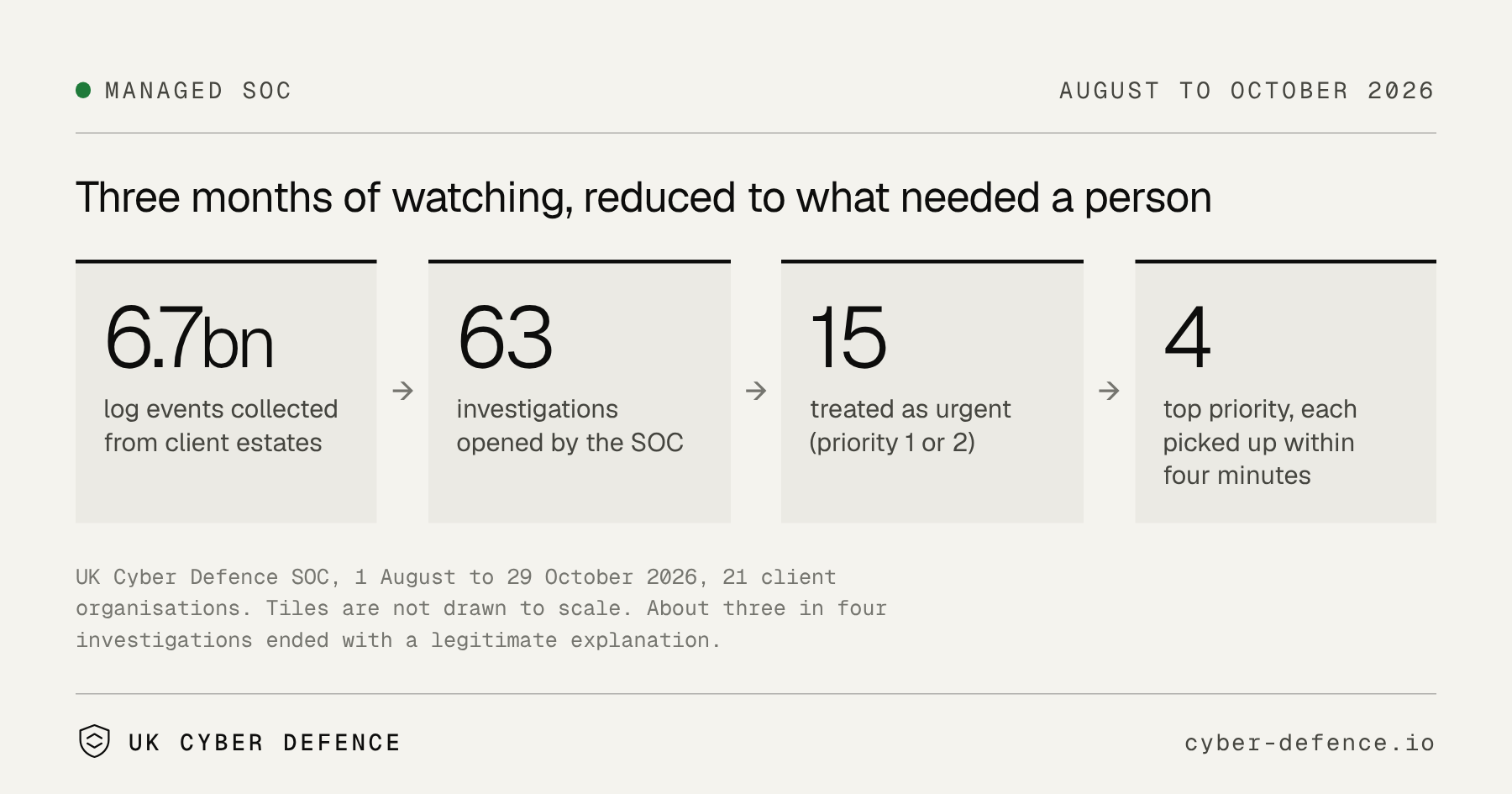
Our own figures show why the hours matter. Between August and October this year our SOC opened 63 investigations across the organisations we look after, and 25 of them, 40 per cent, began outside office hours. Fifteen of those began between six and eight in the morning, when our early sweeps run, which is the point: the work was done before anybody at the client had sat down.
2. Has a customer, an insurer or a regulator asked how you monitor your systems?
If the question has arrived in a tender, a supplier questionnaire or an insurance renewal form, you are no longer deciding in private. Large customers increasingly ask their suppliers how they would detect an intrusion, and insurers ask before they quote. A firm that can answer "we are monitored around the clock by a named provider, and here is last month's report" is answering a commercial question as much as a security one. If nobody has asked yet, note which of your customers is most likely to, and when their contract next comes up.
3. How long could the business run without its systems, and what does a day cost?
Do the sum roughly: a day's revenue, a day's wages for people who cannot work, and the cost of whatever you would have to tell customers. Some businesses can run on paper and telephones for a week. A manufacturer with a production schedule, a logistics firm or a practice that bills by the hour usually cannot manage a day. The shorter the time you can tolerate, the more an early warning is worth to you, because the purpose of monitoring is to turn a week-long recovery into a contained event on a single machine.
4. Do you hold money or data that belongs to other people?
Client funds, patient or pupil records, other companies' designs, payroll for other employers: holding any of these raises the standard of care you owe, in law and in the eyes of the people who trusted you with them. It also changes who would have to be told if something went wrong. If the answer is yes, questions one and two become considerably more pressing.
5. Who reads the alerts your existing tools already produce?
Most firms of fifty people or more already own good security tools. Microsoft 365 and most endpoint protection products raise alerts all day. The useful question is not whether you have the tools but who reads what they say, how quickly, and whether that person can tell an administrator doing their job from an intruder doing an impression of one. If the alerts go to a shared mailbox, or to an IT provider whose contract is to keep things running rather than to investigate, you have the smoke detector without anybody in the building.
6. Could you staff it yourself, every night of the year?
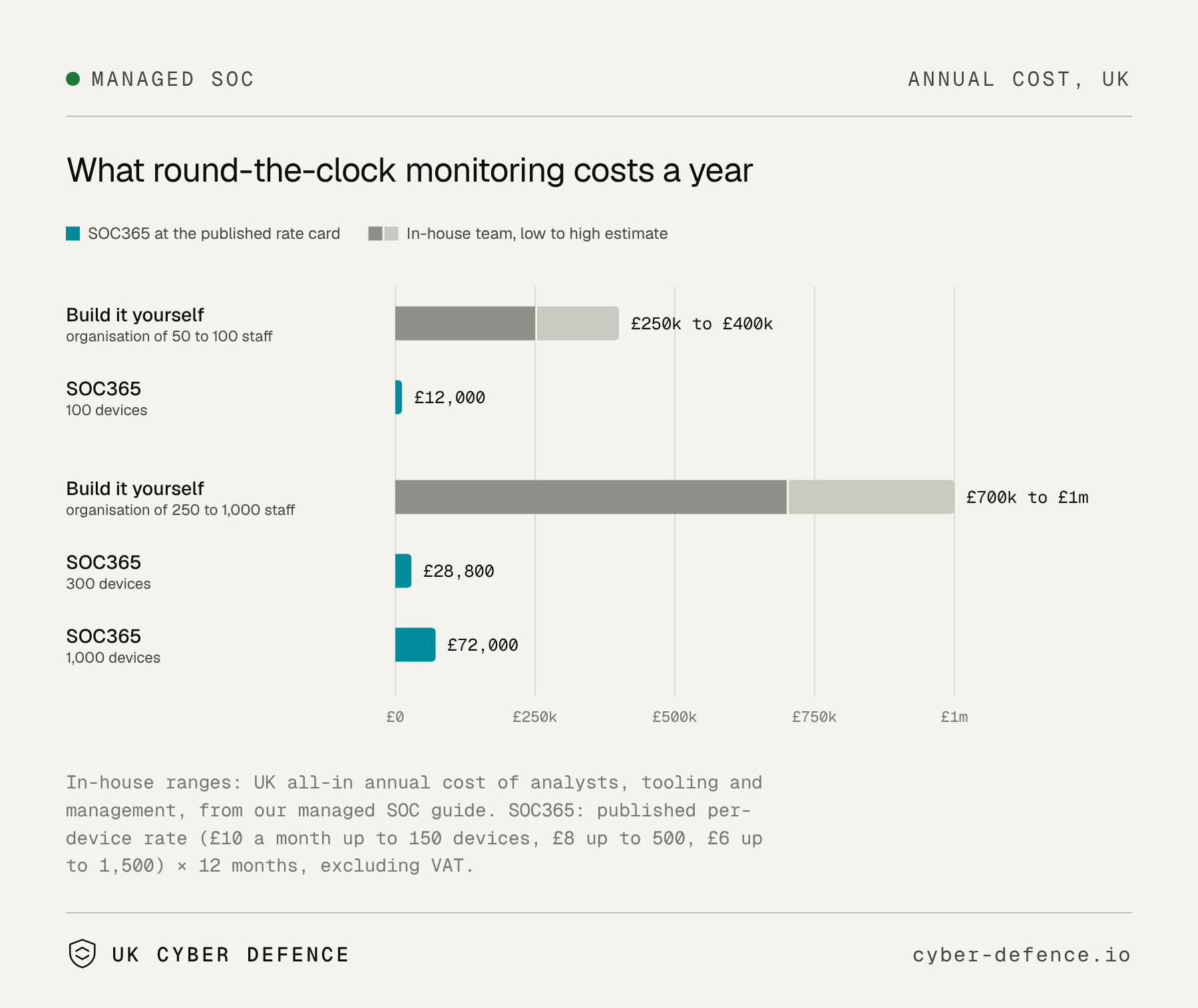
Round-the-clock cover needs five or six analysts before anybody is ill or on holiday, and they need a platform, detection rules that somebody keeps current, and a manager. For an organisation of 50 to 100 people that comes to something between £250,000 and £400,000 a year, as set out in our guide to managed SOC costs. Very few firms below a thousand staff do it, and those that try usually end up with good cover from Monday to Friday and none at the hours that question one was about.
7. What would it cost to hand over?
This is the question people expect to be told is complicated, and it is not. Count your laptops, desktops, servers and firewalls. SOC365 is priced per device per month on a published scale: £12 for up to 50 devices, £10 up to 150, £8 up to 500, £6 up to 1,500 and £5 beyond that, plus VAT. A firm with 120 devices pays £1,200 a month. A firm with 300 pays £2,400. The estimator on the SOC page does the sum for your own numbers in under a minute, and the figure it gives is the figure we quote.
Reading your answers
If three or more of the first five questions made you uncomfortable, you need monitoring, and questions six and seven tell you to buy it rather than build it. What you are buying is not software. It is the knowledge that somebody competent looked. Of those 63 investigations last quarter, about three in four ended with an innocent explanation: an engineer working late, a policy change, a tool behaving oddly. That is not wasted effort. It is the service doing what it is for, which is making sure that the question "is that anything?" is answered by someone qualified, at the time, instead of by you, later.
In our SOC the first pass is made by EmilyAI, the assistant we built in 2018, who gathers the context and drafts the case notes so that an analyst is looking at a decision, not a queue. She cannot change anything in a client's environment and never works without an analyst directing her. The analysts decide, and one of them is the named person you can ring.
If the answer is no
Some businesses do not need a SOC, and it would be a poor article that pretended otherwise. If you employ fewer than about twenty-five people, hold nothing on behalf of others, could work from paper for a few days and have no customer or insurer asking, your money is better spent elsewhere for now. Get Cyber Essentials, which costs from £295 plus VAT and deals with the commonest ways in. Turn on multi-factor authentication everywhere it is offered. Test that your backups restore. Read our plain-English guide to the basic skills every owner should have. And consider an incident response retainer, which starts at £2,500 a year, so that there is a number to ring on the day you need one. Then ask yourself these seven questions again in twelve months, or sooner if you win the kind of customer who sends a questionnaire.
Frequently asked questions
What is a SOC, in one sentence? A security operations centre is a team that monitors your systems around the clock, investigates anything suspicious and acts to contain what is real.
Is our IT provider already doing this? Sometimes, and it is worth asking them directly. Most IT support contracts cover keeping systems running and fixing them when they break; investigating security alerts at night is a different service with different staff. Ask who reads the alerts, at what hours, and what they are authorised to do.
Can we buy the tools and do without the people? You probably own the tools already. The tools raise alerts; the value lies in somebody deciding which of them matter. Without that, more tools mean more unread alerts.
How long does it take to be up and running? Weeks, not months. A short discovery confirms the device count and the price, the telemetry sources are connected and tuned, and full cover begins from go-live.
How do we compare providers fairly? Ask every provider the same questions and score the answers. We publish a free checklist of twenty questions to ask a SOC provider, with what a good answer looks like beside each, and we are content to be scored against it.
Next steps
If your answers pointed towards monitoring, put your device count into the estimator and see the monthly figure. If you would like to talk it through, get in touch and the reply will come from an analyst. And if your answers pointed the other way, enjoy the fact: a decision made deliberately is worth more than one avoided, and you now know what would change it.
Written by

Founder and Head of Threat Disruption
Founder of UK Cyber Defence. Former CISO for FTSE 250 organisations and for Microsoft Europe; founded Hedgehog Security in 2009.
Next step
Want this looked at in your own estate?
Thirty minutes with an analyst, not a salesperson. We will tell you whether it matters to you and what to do first.
Related insights
Continuous Threat Exposure Management
Continuous Threat Exposure Management. Cyber threats today evolve at breakneck speed, outpacing traditional defences.
Iranian state spyware ‘CHOSEN BRICK’: what it does and what to do
The NCSC, FBI and AIVD have exposed Iranian spyware — CHOSEN BRICK — used to surveil dissidents, activists and journalists. What the campaign does, who is really at risk, and the practical steps that protect the people targeted and the organisations around them.
What is a managed SOC, and what does SOC as a service cost in the UK?
A managed SOC is a security operations centre you subscribe to rather than build. Here is what you are actually buying, what it costs in the UK compared with building your own, how the market prices it, and how to choose a provider you will not regret a year later.