Types of Hackers: Motives, Methods and Risks for UK Organisations
'Hacker' covers the tester you hire and the criminal you would prefer not to meet. This guide explains the white, grey and black hat labels, the types of hacker by motive, how the categories overlap and what each means for a UK organisation.
"Hacker" is one word doing several jobs. It describes the penetration tester an organisation pays to break into its own systems, the teenager who talks a help desk into resetting a password, the ransomware affiliate working through a list of stolen credentials, and the intelligence officer who will sit in a network for a year without touching anything. This guide explains the types of hackers: the hat labels and what they mean in UK law, the types by motive, how the categories overlap, and what each means in practice for UK organisations, including regulated businesses and operators of critical infrastructure.
It is a companion to our guide to the types of cyber attackers, which profiles ten named groups active against the UK. That guide is about who. This one is about the vocabulary, and about the people on the other side of the line: the ethical hackers.
What is a hacker?
The word began as a compliment. Among programmers in the 1960s and 1970s a hacker was someone who understood a system well enough to make it do something its designers had not intended, and a good hack was an elegant one. That sense survives. Much of the internet's security exists because people who enjoyed taking things apart told the owners what they had found.
In everyday use a hacker is someone who gains access to computer systems, and whether that is a profession or a crime depends on one thing. The Computer Misuse Act 1990 makes it an offence to cause a computer to perform a function with intent to secure access that the person knows to be unauthorised. Skill is not the test, and neither is motive. Authorisation is. The basic offence carries up to two years' imprisonment, acts intended to impair a computer carry more, and attacks that cause or risk serious damage to human welfare or national security can carry life. The Crown Prosecution Service's guidance on the Act sets out each offence.
The hat labels: white, grey and black
The colours are borrowed from old Western films, in which the hero wore a white hat and the villain a black one. They sort hackers by permission.
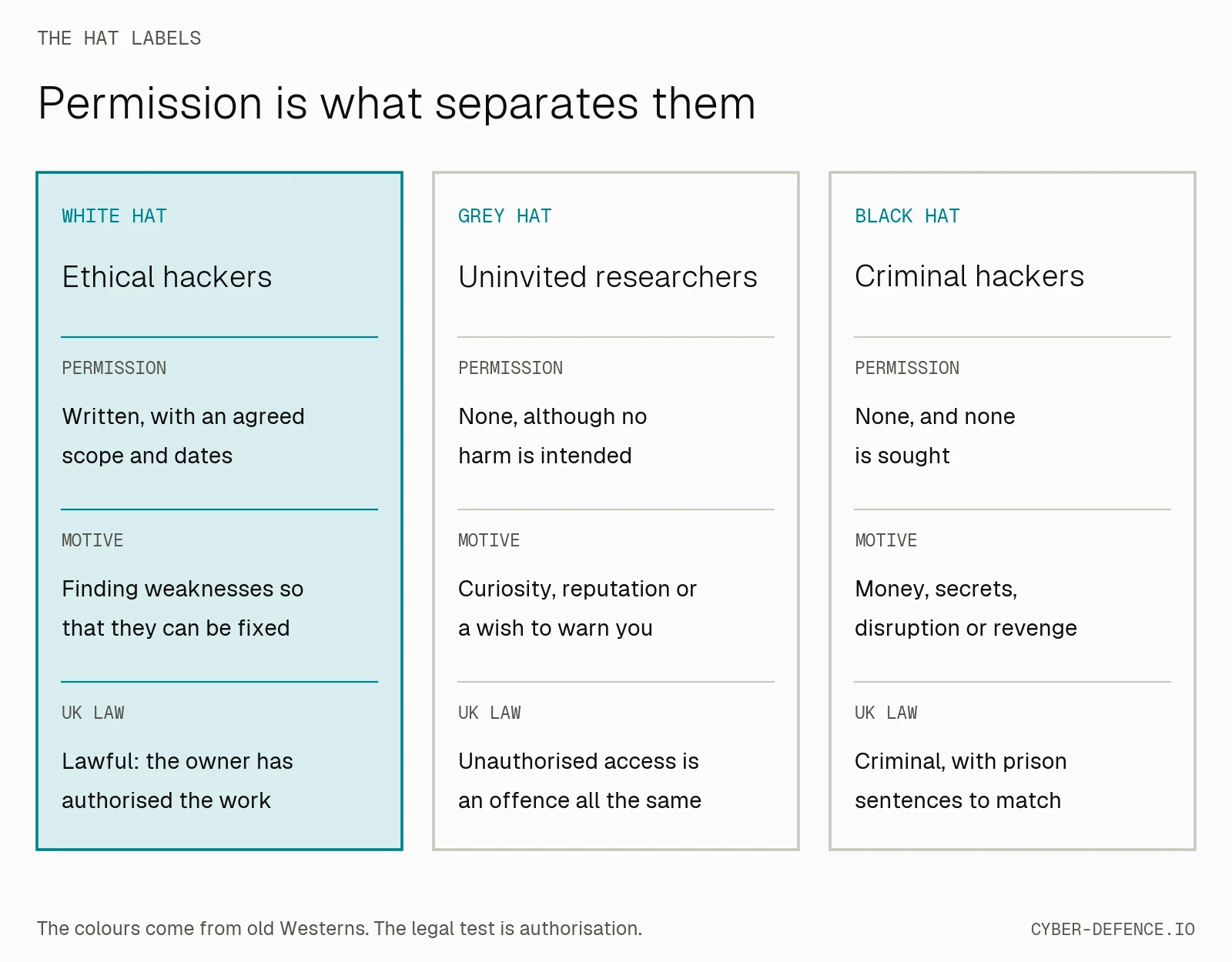
White hat hackers, also called ethical hackers, work with the written permission of the system's owner, within an agreed scope and period, and report what they find so that it can be fixed. Penetration testers, red teamers and researchers working within the rules of a bug bounty programme are all white hats. What makes the work ethical is less the tester's character than the paperwork: a contract, a defined scope, rules of engagement and a duty of confidentiality. In the UK the profession is organised around bodies such as CREST and the UK Cyber Security Council, which accredit companies and award professional titles to individuals, and around the NCSC's CHECK scheme, under which approved companies test government and critical national infrastructure systems. For clarity, we are a CREST member company accredited for penetration testing and not a CHECK company; organisations that need CHECK should use the NCSC's list.
Black hat hackers act without permission and for their own ends: money, information, disruption or revenge. Every type in the next section except the last is a variety of black hat.
Grey hat hackers sit between the two. A grey hat looks for weaknesses without being asked, intends no harm, and typically tells the owner, sometimes privately and sometimes in public. The intention may be good. The law as it stands does not distinguish: unauthorised access is an offence whatever the reason for it. The security industry has criticised that for years, and in December 2025 the Security Minister said the government was looking at a statutory defence for researchers. The King's Speech of May 2026 confirmed that reform of the Act would be carried in a National Security Bill. Reports since have suggested that the defence may be narrowly drawn, and as this guide was written the reform had not become law.
You may meet other colours. Red teams play the attacker in an exercise, blue teams defend, and in a purple team the two work together. Those describe roles within authorised testing and not kinds of hacker.
What to do when a stranger reports a vulnerability
The practical question grey hats raise is what to do when an unsolicited email arrives saying "I have found a problem with your website". The NCSC's advice, in its Vulnerability Disclosure Toolkit, is not to panic. Acknowledge the report and thank the sender, pass it to someone qualified to verify it, keep the sender informed and tell them when it is fixed. Most such reports are sent in good faith and some are valuable. A message that demands payment before giving any detail is a different matter and can be treated with caution.
The better preparation is to say in advance where reports should go. A security.txt file is a small text file at a standard address on a website that names the contact for security reports, and a vulnerability disclosure policy sets out what researchers may and may not do. Our free security.txt checker tests whether your site has one and will generate the file if it does not.
Types of hacker by motive
The hat says whether a hacker has permission. The motive says what they want, and that shapes whom they choose, how long they stay and what the damage looks like.
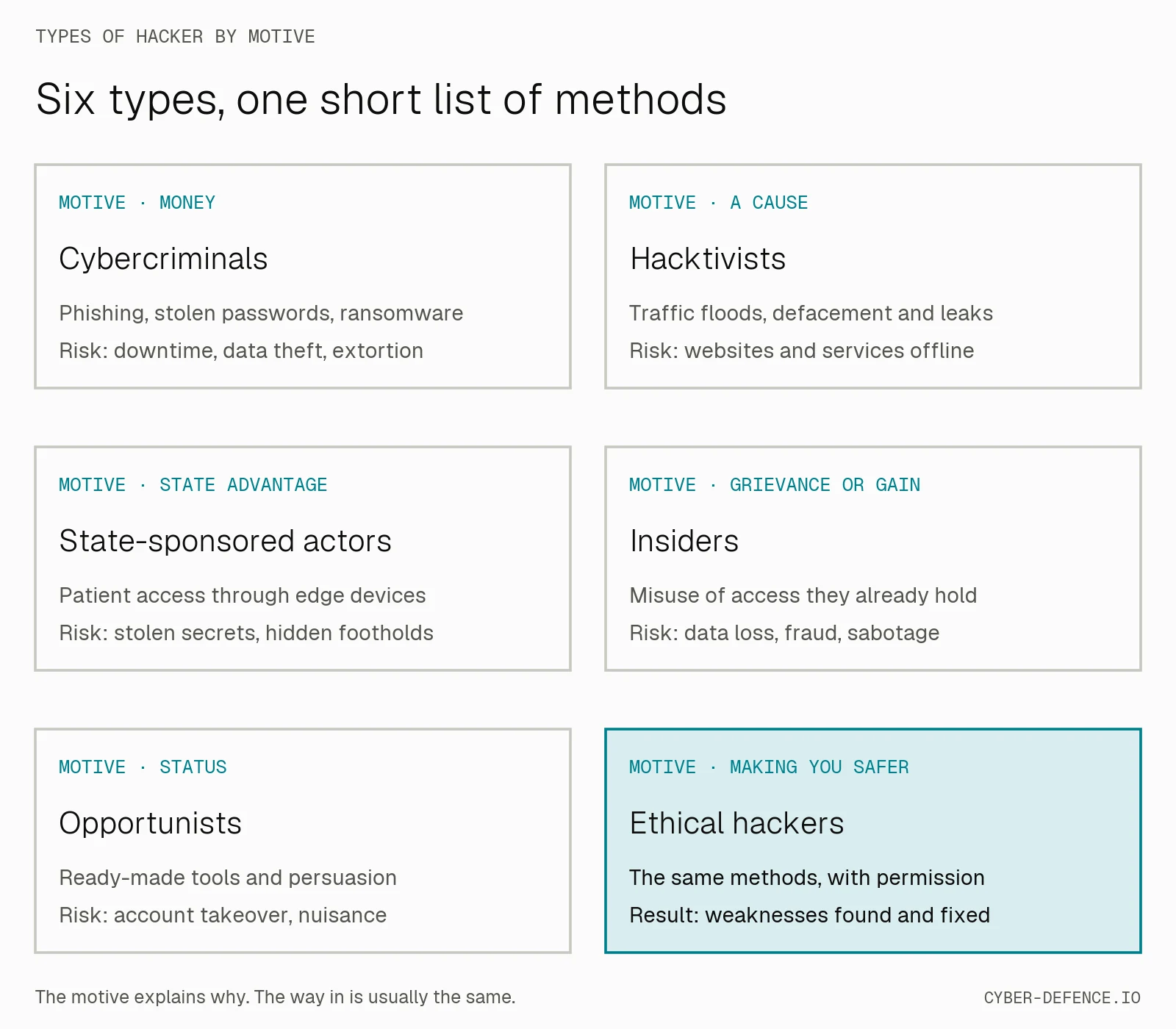
| Type | Motive | Typical methods | Risk to a UK organisation |
|---|---|---|---|
| Cybercriminals | Money | Phishing, stolen and purchased passwords, unpatched internet-facing systems, ransomware and data extortion | Days or weeks of disruption, stolen data, extortion and regulatory reporting |
| Hacktivists | A political or social cause, and attention for it | Denial-of-service floods, website defacement, leaks, tampering with poorly secured industrial equipment | Websites and public services offline, and reputational damage |
| State-sponsored actors | Intelligence, strategic advantage and the means to disrupt later | Patient exploitation of routers, firewalls and VPNs; stolen credentials; suppliers | Loss of intellectual property and sensitive data; a hidden presence that may last years |
| Insiders | Grievance or personal gain, or no motive at all where the cause is error | Misuse of legitimate access, copying data before leaving, being recruited or deceived by outsiders | Data loss, fraud and sabotage that controls aimed at outsiders do not see |
| Opportunists | Curiosity, status among peers, small-scale fraud | Ready-made tools, leaked passwords, persuasion by telephone | Account takeover, nuisance, and occasionally far more than the attacker intended |
| Ethical hackers | Improving security, for a fee or a bounty | The same methods as all of the above, within an agreed scope | None, properly managed: the output is a list of weaknesses to fix |
Cybercriminals are the type most organisations will meet. The government's Cyber Security Breaches Survey 2025/2026 found that 43 per cent of UK businesses identified a breach or attack in the previous year, and phishing was by far the commonest kind. Criminal hacking is an industry with a division of labour: some people write malware, much of it delivered as a Trojan horse, some break in and sell the access, some run the ransomware and some negotiate. They select victims by opportunity. An organisation is attacked because its password was in a batch for sale or its firewall appeared in a scan, and not because of who it is. Stolen credentials are traded on the criminal markets described in our guide to the dark web.
Hacktivists want to be noticed. In January 2026 the NCSC warned that Russian-aligned hacktivist groups were continuing to target UK organisations, local authorities and operators of critical national infrastructure in particular, with denial-of-service attacks. It described them as driven by ideology and not by money, and as operating outside the direct control of the state. Such attacks are technically simple, and the groups behind them tend to overstate the results, but an outage of a public service is a real cost to whoever depends on it.
State-sponsored actors are units of, or contractors to, foreign intelligence and military services. The NCSC Annual Review 2026 describes China as the most sophisticated and sustained cyber challenge the UK faces and Russia as the most audacious, and UK advisories during 2026 also concerned Iran and North Korea. Their aims are information and position: a quiet foothold in a network that might be useful later. The review's most practical observation is that they rarely need anything clever to get in. Most of the state-linked activity it examined exploited known vulnerabilities, many of which had a fix available that had not been applied in time.
Insiders already have what every other type is trying to obtain, which is valid access. Some act out of grievance or for gain, typically by taking data with them as they leave. More cause harm by mistake. A newer variant is the false hire, a remote worker who is not who they claimed to be: in July 2026 the UK and ten other governments warned that North Korean IT workers were taking jobs at Western companies under false identities. Our earlier article on the insider threat covers the controls.
Opportunists are the least skilled and the most numerous. The old term is "script kiddie", meaning someone who runs tools written by others. The label undersells them. The loosely organised, mostly English-speaking crews of young people behind the UK retail attacks of 2025 got in by telephoning help desks and asking for a password reset. The National Crime Agency's Cyber Choices programme exists because many young people drift into offences under the Computer Misuse Act without realising that is what they are: an NCA survey found that one in five children aged 10 to 16 had done something that broke it.
Ethical hackers complete the list because they use the same methods as all the others. That is the point of them.
How the categories overlap
The six types are tidy on paper and blurred in practice.
States use criminals, and tolerate them. Intelligence services contract work to private companies and to criminal groups, and some countries allow ransomware gangs to operate provided their victims are abroad. North Korea's state hackers steal money, which places them in two categories at once.
Hacktivism can be a costume. Groups that present themselves as volunteers angry about a cause are sometimes aligned with a state and occasionally directed by one, which is why the NCSC chose the phrase "state-aligned" for the pro-Russian groups in its alert.
Criminals recruit insiders, and outsiders become insiders by stealing a member of staff's account. From the network's point of view an intruder using a valid password is an insider.
People move between hats. Some capable testers began by exploring systems they had no right to explore, and a few researchers have crossed the line in the other direction. The tools are the same tools throughout.
And everybody shares the same ways in, which is the overlap that matters most. The NCSC found that 88 per cent of incidents at large organisations in the year to August 2026 began in one of four ways: an exploited internet-facing application, phishing, a misused valid account or an exploited remote service. The label on the attacker made little difference to the route.
The consequence is that defending by type of attacker is less useful than defending by method. Knowing who is out there helps to set priorities and to explain risk to a board. It rarely changes the first ten things to do.
What this means for regulated businesses and critical infrastructure
For most organisations the realistic adversary is a criminal one and the baseline controls are the answer. Two groups have to think further.
Regulated businesses, in financial services above all, are expected to show that they understand which types of attacker are relevant to them and that their defences have been tested against those types. That is the idea behind threat-led penetration testing, used by UK financial regulators in the CBEST scheme and required of the most significant firms under the EU's DORA: the testers are given intelligence about the actors most likely to target the firm, and imitate their methods. Even where no scheme applies, the same approach, red team testing built on a realistic adversary, tells a board more than a list of missing patches does.
Operators of essential services and critical infrastructure face the two types that others mostly do not: states seeking a foothold and hacktivists seeking a spectacle. Both look for the same thing, which is industrial equipment and remote access that can be reached from the internet. A joint advisory co-signed by the NCSC in December 2025 described pro-Russian hacktivist groups reaching poorly secured operational technology, and the Cyber Assessment Framework is the standard regulators use to judge whether an operator can withstand such attackers. The Cyber Security and Resilience Bill, in its final parliamentary stages as this guide was written, extends those expectations to more organisations, managed service providers among them.
Both groups share a supply chain problem. A supplier with remote access to your systems is, to an attacker of any type, a way in that has already been authorised. According to the same government survey, only 15 per cent of UK businesses review the cyber risks posed by their immediate suppliers.
What to do about it
Because the routes in are shared, a short list of measures works against every type in the table.
Close the common doors. Patch internet-facing systems first, require multi-factor authentication, and remove accounts and remote access that are no longer needed. Cyber Essentials is the government-backed baseline for exactly this.
Make persuasion harder. Give the help desk a procedure for password resets that a confident caller cannot talk round, and train staff on the phishing they really receive.
Hire the hackers yourself. A penetration test puts ethical hackers to work on your systems before anyone else gets round to it. Our guide to what penetration testing is explains the kinds of test and what a good report contains.
Watch for what gets through. Every type of intruder leaves traces: unfamiliar sign-ins, new administrator accounts, data moving at night. Someone has to be looking at every hour, which is the job of a security operations centre.
Rehearse the bad day. Decide in advance who is called, who decides and who speaks. An incident response retainer settles the first of those.
Tell researchers where to write. Publish a security.txt file and a disclosure policy, so that the well-intentioned stranger has somewhere to go.
Where UK Cyber Defence fits
We employ hackers, of the white hat kind. UK Cyber Defence is a CREST member company accredited for penetration testing, and our penetration testing practice covers external and internal infrastructure, web and mobile applications, APIs, cloud, wireless and red team exercises. SOC365, our managed SOC, provides detection and response around the clock: EmilyAI, our AI SOC analyst, reviews every client hour by hour and blocks clear-cut attacks at the firewall and on blocklists, and an analyst decides anything that affects a machine or an account. Between them the two services answer the questions this guide raises: what could a hacker do here, and would we know if one were doing it now?
Frequently asked questions
What are the three main types of hackers? White hat, black hat and grey hat. White hats are ethical hackers who test systems with the owner's permission. Black hats break in without permission for their own gain. Grey hats act without permission but without malicious intent, and typically report what they find.
Is hacking illegal in the UK? Unauthorised access to a computer is an offence under the Computer Misuse Act 1990, whatever the motive. Hacking with the owner's written permission, as in a penetration test, is lawful.
What is an ethical hacker? An ethical hacker, or white hat, is a security professional who uses an attacker's methods to find weaknesses in systems they have been authorised to test, and reports them so that they can be fixed. Penetration testers and red teamers are ethical hackers.
What is the difference between a hacker and a cybercriminal? "Hacker" describes a skill: getting computer systems to do things they were not meant to do. A cybercriminal is someone who commits crime using computers. Many hackers are not criminals, and many cybercriminals have little technical skill.
Which type of hacker is most likely to target my organisation? For most UK organisations, a financially motivated criminal who has found a stolen password or an unpatched system. Such attackers choose victims by opportunity, so the baseline controls are an effective defence.
What is a hacktivist? A hacktivist hacks to promote a political or social cause. The usual methods are knocking websites offline with floods of traffic, defacing pages and leaking data. Some hacktivist groups are aligned with states.
What should we do if someone reports a vulnerability to us? Acknowledge it, thank the sender, have someone qualified verify it and tell the sender when it is fixed. Publishing a security.txt file and a disclosure policy in advance tells researchers where to write.
Next steps
To see what any of these types would see first, start from the outside: our free external exposure report runs the eight checks on this site against your domain and gives the fixes in order. For the named groups behind the labels, read types of cyber attackers. And if you would like ethical hackers to answer the question properly, book a thirty-minute call about a penetration test.
Further reading
Written by

Founder and Head of Threat Disruption
Founder of UK Cyber Defence. Fellow of the BCS and Chartered IT Professional; former CISO for FTSE 250 organisations and for Microsoft Europe; founded Hedgehog Security in 2009.
Next step
Want this looked at in your own estate?
Thirty minutes with an analyst, not a salesperson. We will tell you whether it matters to you and what to do first.
Related insights
XakNet Team
A sourced profile of XakNet Team, a self-described group of Russian patriotic volunteers that Mandiant assesses to be coordinating with Russian military intelligence.
Trojan Horses in Cybersecurity: Common Types and How They Spread
A Trojan horse is malware dressed as something you wanted. This guide explains how Trojans get in, the common types, how they spread, the warning signs, how to prevent them and what to do if you think one has been opened.
The OWASP Top 10 explained: what changed in 2025
The OWASP Top 10 is the most widely used list of web application security risks. This guide sets out the 2025 list in plain English, what changed from 2021, and how to use it without mistaking it for a standard.