Subject Access Requests: A Step-by-Step Guide for UK Organisations
Anyone can ask your organisation for a copy of the personal information it holds about them, and you normally have one month to answer. This guide covers the eight steps, the deadline, the exemptions, and how to find and disclose the data securely.
A subject access request, or SAR, is a request from a person for a copy of the personal information an organisation holds about them. Any UK organisation that handles personal data can receive one, from a customer, an employee, a patient or a member of the public. The request need not be in writing or mention the law, and the organisation normally has one month to respond. This guide sets out how to recognise a request, the eight steps for answering it, how the deadline works, when information can be withheld, and the part most guides skip: how to find personal data scattered across cloud services, security logs and incident records, and send it without exposing anybody else's.
One caveat before we begin. We are a cyber security company and not a law firm, and this guide is general information based on the Information Commissioner's Office's published guidance as it stood in November 2026. Decisions about exemptions, employment disputes and anything contested belong with your data protection officer or a solicitor.
What is a subject access request?
The right of access is set out in Article 15 of the UK GDPR, and the Data Protection Act 2018 supplies the exemptions. It entitles a person to three things: confirmation that you are processing their personal information, a copy of that information, and supplementary details such as why you hold it, whom it has been shared with and how long it will be kept. The ICO's guide to subject access is the authoritative summary.
Four features catch organisations out. A request can be made verbally, in writing or over social media. It does not need to use the words "subject access request" or refer to any legislation. It can be made to any member of staff, not only to a designated contact. And it is normally free. The receptionist who takes a telephone call, the engineer who reads a comment on the company's social media account and the manager who receives an angry email may each have received a valid SAR.
The right is to personal information and not to documents. A person is entitled to the information about them contained in an email, which is not necessarily the whole email, and they are not entitled to information about other people.
Three changes arrived with the Data (Use and Access) Act 2025. All are in force, and the ICO updated its guidance for them in December 2025 and July 2026. The law now says in terms that you need only carry out a reasonable and proportionate search. It allows the deadline to pause while you wait for clarification that you reasonably need. And since 19 June 2026 every organisation must have a process for handling data protection complaints, which is where a dissatisfied requester will go first.
The time limit: one month, and when the clock waits
You must respond without undue delay and at the latest within one month of receiving the request.
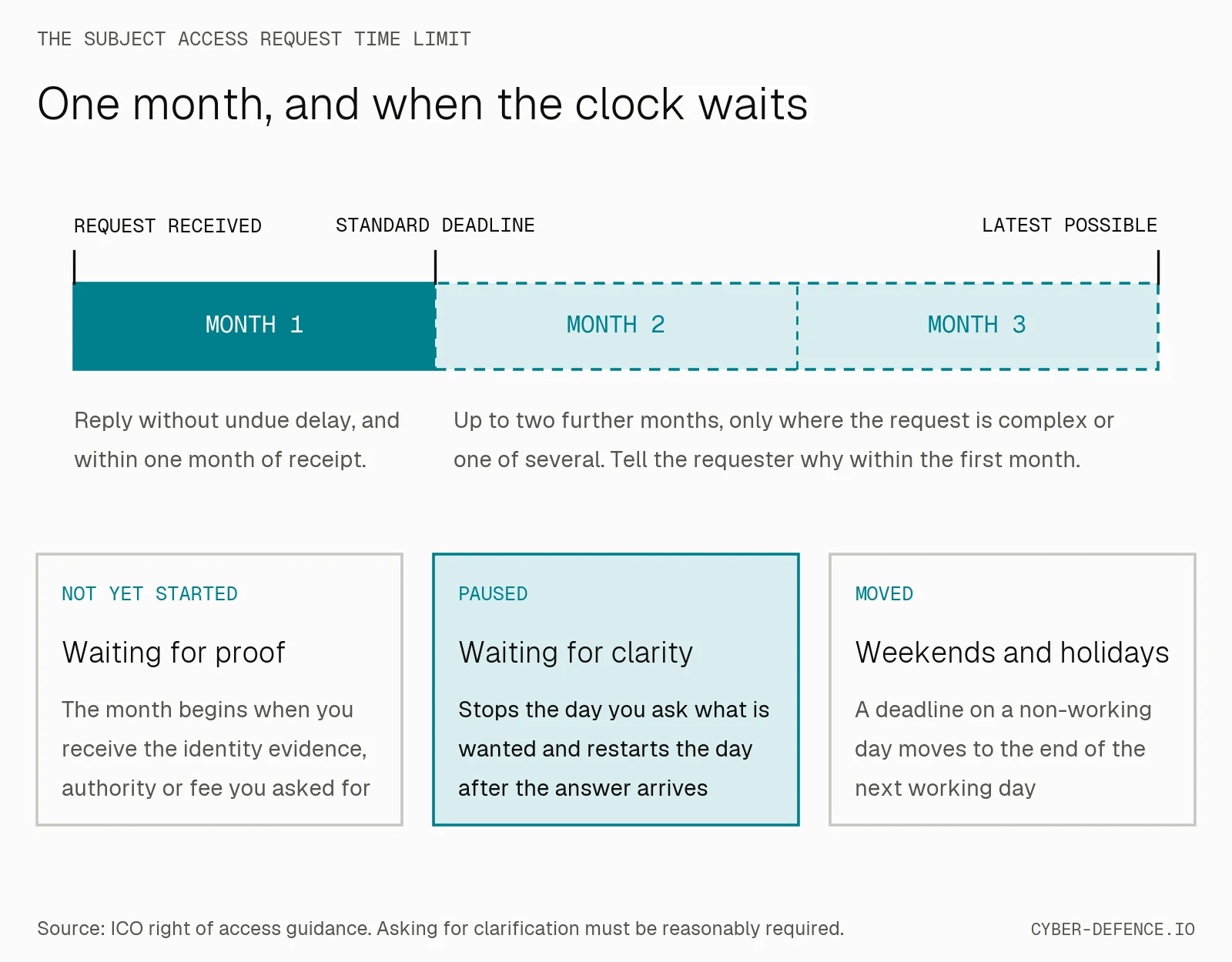
The ICO's detailed guidance on responding to a request explains how to count. The month runs from the day of receipt, whether or not that is a working day, to the same date in the following month. A request received on 3 September is due by the end of 3 October. If the following month has no such date, the deadline is its last day. If the deadline falls on a weekend or a bank holiday, it moves to the next working day. Because months differ in length, the ICO suggests that an organisation wanting one internal rule could work to 28 days.
Three things alter the calculation.
The clock does not start until you have received any evidence of identity, proof of a third party's authority or fee that you have properly asked for. Ask promptly. Holding back a request for identification in order to gain time is not acceptable.
The clock pauses if you ask the requester to clarify what they want, from the day you ask until the day after the answer arrives. This applies only where clarification is reasonably required, typically because you hold a great deal of information about the person and cannot respond properly without knowing what they are looking for. You cannot oblige anyone to narrow a request. If the reply is that they want everything, you carry out a reasonable search for everything.
The deadline can be extended by up to two further months where a request is complex or the person has made several. You must tell the requester, with reasons, within the first month. A large volume of information does not make a request complex on its own account, and neither does reliance on a supplier to retrieve it.
How to respond to a subject access request, step by step
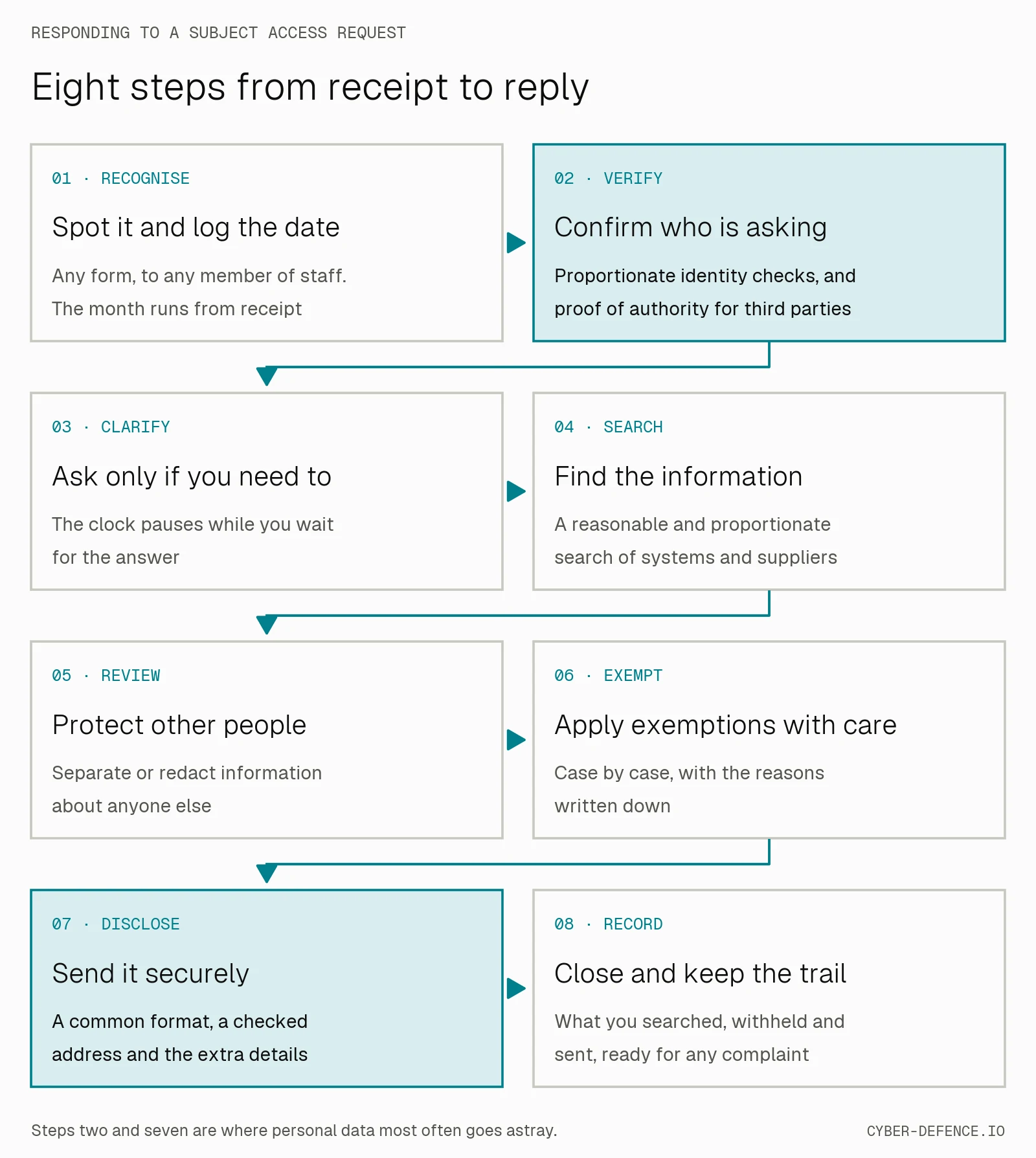
1. Recognise the request and record the date
Train everyone who deals with the public or with staff to recognise a request made in ordinary language, such as "I want to see what you have on me", and to pass it to a named person the same day. Record the date of receipt, the requester's details and what was asked for. A simple log is enough, and it becomes your evidence that the deadline was met.
2. Confirm who is asking
You must be satisfied that the requester is who they say they are, because the alternative is handing one person's data to another. The checks should be proportionate. A current employee writing from a work account, or a customer signed in to their own account, may need no further proof. A request from an unfamiliar email address about an account that holds financial or health information does.
This step is a security control as much as a legal one. In 2019 an Oxford researcher, James Pavur, sent access requests in his fiancée's name, with her consent, to 150 organisations, armed with little more than her name, email address and telephone number. In the published study, about a quarter of the organisations that held her data supplied it without verifying who was asking. A SAR is an officially sanctioned way to ask a stranger for personal data, which makes it a natural vehicle for the kind of social engineering more often seen in phishing. Verify through a channel you already trust, such as the account's registered email address or telephone number. Be cautious about asking for copies of passports and driving licences: they can be forged, and once you hold them you have to protect them.
Where a solicitor, a relative or an online portal makes the request on someone's behalf, ask for evidence of their authority before you disclose anything.
3. Clarify, if you need to
If the request is clear, begin the search. If you hold a great deal of information and cannot respond sensibly without knowing what the person wants, ask, and ask early. Keep a note of why clarification was needed.
4. Search for the information
Carry out a reasonable and proportionate search of the places where the person's information is likely to be; the next section covers where those are. Instruct any suppliers that hold the data on your behalf to search as well, since their delay is not a defence. Record where you looked and the search terms you used.
5. Review what you found, and protect other people
Most of what a search returns will mention other people: colleagues in an email thread, the author of a complaint, other customers in an export. You do not have to disclose information that identifies someone else unless they have consented or it is reasonable to disclose it without their consent. The ICO sets out a three-step approach: can you provide the requester's information without the other person's, has the other person consented, and if not, is it reasonable in all the circumstances to disclose anyway? In practice the answer is usually to separate or redact.
6. Consider whether an exemption applies
The Data Protection Act 2018 contains exemptions that allow information to be withheld in defined circumstances. Those met most often in business are legal professional privilege, management forecasting and planning, negotiations with the requester, confidential references, and cases where disclosure would prejudice the prevention or detection of crime. Each applies to specific information and not to the request as a whole, each has to be justified case by case, and the reasoning should be written down. This is the step at which to take advice.
7. Disclose securely
If the request was made electronically, send the information in a commonly used electronic format unless the person asks otherwise, together with the supplementary details. Then treat the reply as what it is: a file of personal data leaving the organisation. Send it to the verified address. Prefer an encrypted transfer, or a secure portal from which the person can download a copy, to an ordinary email attachment, and send any password by a different route. Redact properly. A black rectangle drawn over text in a PDF can often be lifted off, and spreadsheets carry hidden rows, hidden columns and earlier versions. The ICO's guidance on disclosing documents securely explains how to check. A reply sent to the wrong person, or with another customer's details visible beneath a redaction, is a personal data breach of your own making.
8. Record the outcome and close
Keep a record of what you searched, what you found, what you withheld and why, and what you sent and when. If you have withheld information or refused the request, you must normally tell the person why, and tell them that they can complain to you, complain to the ICO and apply to a court. A complaint made to you has to be acknowledged within 30 days under the rules on handling data protection complaints that came into force in June 2026.
Where personal data hides: cloud services and security records
The search is where a SAR consumes most time, and the reason is that few organisations have a current picture of where personal data lives. Ten years ago the answer was a file server and an email system. Today it is likely to include all of the following.
| Where | What to search | What to watch for |
|---|---|---|
| Email and calendars | Mailboxes of the people who dealt with the requester, shared mailboxes and archives | Threads full of other people's details |
| Chat and collaboration tools | Microsoft Teams, Slack, shared channels, meeting recordings and transcripts | Informal remarks nobody expected to disclose, and AI-generated meeting notes |
| Documents and file storage | SharePoint, OneDrive, Google Drive and network shares | Duplicates and old versions |
| Business systems | HR, payroll, CRM, finance, ticketing and support desks | Free-text notes fields |
| Phones and messaging apps | Company phones, and work conversations held over WhatsApp or text message | Personal devices that staff have used for the organisation's business |
| Recordings | CCTV, door access records and call recordings | Other people in frame or on the line |
| Suppliers | Outsourced payroll, IT providers and marketing platforms | What the contract says about assistance and timescales |
| Security records | Sign-in logs, web and email filtering logs, endpoint monitoring and incident reports | See below |
Microsoft 365 and Google Workspace both include search tools built for this purpose, able to query mail, chat and files by name, email address or keyword in one pass. They are only as good as the access they are given and the list of places they are pointed at. That is why an up-to-date record of systems and suppliers, the record of processing that most organisations are already required to keep, pays for itself the first time a request arrives. Suppliers deserve particular attention: as we set out in the supplier you stopped using still has your data, personal data often outlives the contract it was collected under.
Security logs and incident records
Security data is personal data more often than security teams assume. A sign-in log records who signed in, from where and when. Web filtering records what a member of staff browsed. An investigation report may name the employee whose account was compromised, the colleague who raised the alarm and the customers whose records were viewed. Where any of this relates to an identifiable requester it falls within the right of access, and requests from employees in dispute with an employer, or from customers after a breach, increasingly ask for it by name.
Four principles keep this manageable.
Search proportionately. Nobody is expected to read every raw log line across years of retention. A targeted query of the security platform for the person's account names, email address and devices over the relevant period is the kind of search that can be defended as reasonable. Record what you ran and why.
Disclose the information, not the system. The person is entitled to the personal information about them, in a form they can understand. That can be an extract or a summary of the relevant entries. It need not be an export that reveals how your detection rules work, what your monitoring can and cannot see, or the internal layout of your network.
Protect the other people in the record. An incident report almost always concerns several individuals. Apply the same three-step approach as for any other document, and remember that the person who reported a concern may be owed confidentiality.
Take advice before relying on an exemption. Where disclosure would prejudice the prevention or detection of crime, for example while an intrusion is still being investigated, or where a report was prepared in order to obtain legal advice, an exemption may apply. Whether it does is a legal judgement on the specific facts.
There is a planning point here too. A publicised breach is often followed by a wave of access requests from the people affected. An incident response plan that includes a prepared SAR process, a template reply and a named owner turns that wave into an administrative task. A plan that omits it produces a second incident, made of missed deadlines.
When can a subject access request be refused?
Rarely, and never by ignoring it. You can refuse to act on a request, or charge a reasonable fee for it, if it is manifestly unfounded or manifestly excessive, and the ICO is clear that the threshold is high. A request is not excessive merely because it is large or inconvenient, or because the requester is in dispute with you. Where you do refuse, respond within the month and explain.
Two things must never happen. Information must not be altered to make it more palatable, and nothing must be deleted because a request has arrived. Under section 173 of the Data Protection Act 2018 it is a criminal offence to alter, deface, block, erase, destroy or conceal information with the intention of preventing its disclosure to a person entitled to receive it. Routine deletion under a retention schedule may continue. Deletion prompted by the request may not.
Common mistakes, and how to avoid them
The usual failures are procedural, not legal. The request is not recognised because it reached the wrong person. Identity is queried in the fourth week instead of the first. The search is confined to email when the conversation took place in Teams. A redaction can be undone. The reply goes to an address nobody verified. And afterwards there is no record of what was done.
Each is cheap to fix in advance: a one-page procedure, a named owner with a deputy, a log, a search that has been tried before it is needed, and a secure way to send the reply.
Where UK Cyber Defence fits
A SAR is a legal obligation, and the legal judgements in it, above all on exemptions and on other people's information, should be made by your data protection officer or solicitor. What makes those judgements quick or slow is practical, and that is where we work. Our consulting practice and virtual CISO service help organisations establish where information is held, who can reach it and how it leaves. Our consultants write incident response plans and playbooks and run tabletop exercises, so that the requests and notifications that follow a breach are rehearsed, and our incident response team helps with the ICO when the day comes. And SOC365, our managed security operations centre, keeps security records in one searchable place, so that a question about one person's sign-ins over one month has an answer in minutes.
Frequently asked questions
How long do we have to respond to a subject access request? One month from the day you receive it. The period can be extended by up to two further months if the request is complex or one of several, provided you tell the requester why within the first month.
Can we charge for a subject access request? Usually not. You may charge a reasonable fee for administrative costs only where a request is manifestly unfounded or excessive, or where the person asks for further copies.
Does a subject access request have to be in writing? No. A request can be made verbally, in writing or through social media, to any member of staff. It does not have to mention the law or use the words "subject access request".
Do we have to ask for proof of identity? Only where you need it. You must be satisfied about who is asking, but the checks should be proportionate: ask for formal identification only when it is necessary, and ask promptly.
Do emails that mention other people have to be disclosed? The requester is entitled to their own personal information, not to other people's. Information that identifies someone else can usually be redacted, unless that person consents or it is reasonable to disclose it without their consent.
Are security logs and CCTV covered by a subject access request? Yes, where they relate to an identifiable person. Sign-in records, monitoring data, call recordings and CCTV footage can all be personal data. The search has to be reasonable and proportionate, and other people's information protected.
What happens if we miss the deadline? The requester can complain to you and then to the Information Commissioner's Office, which has formal enforcement powers, and can apply to a court for an order. If you are running late, keep the person informed: silence is what turns a delay into a complaint.
Next steps
Three preparations make the difference between a routine task and a scramble: a one-page procedure with a named owner, a current list of the systems and suppliers that hold personal data, and a tested, secure way of sending the reply. If the second of those is the difficulty, or if you would like your incident response plan to cover the requests that follow a breach, book a thirty-minute call. For the foundations every organisation should have in place first, see the basic cyber skills every UK business owner should have.
Further reading
Written by

Founder and Head of Threat Disruption
Founder of UK Cyber Defence. Fellow of the BCS and Chartered IT Professional; former CISO for FTSE 250 organisations and for Microsoft Europe; founded Hedgehog Security in 2009.
Next step
Want this looked at in your own estate?
Thirty minutes with an analyst, not a salesperson. We will tell you whether it matters to you and what to do first.
Related insights
UK ICO Investigates TikTok, Reddit, and Imgur Over Child Data Privacy Concerns
The UK ICO has launched investigations into TikTok, Reddit, and Imgur over child data privacy concerns, focusing on the protection of teenage users' personal information.
The supplier you stopped using still has your data
Revolut's customers have had their details taken twice in a month, and on neither occasion was Revolut hacked. The second time, the data walked out of a brokerage Revolut had finished migrating away from over a year ago. Supply chain risk does not end when the contract does, and this is what to do about it.
Your supplier was breached. What did you do before it happened?
A London property manager has told its customers that bank details, passwords and lockbox codes may have been taken through a cloud reporting tool. The tool was the supplier's; the decision about what it could read was not. Here is how to review your supply chain, write it down, and be able to show your working when the inevitable happens.